Climate change impact
Coastal buffalo farms at risk of disappearing
There are no ownership documents on paper; there is only a tiny ‘mark’ made on a buffalo’s ear. A dairy and meat market worth nearly Tk 55 billion along the coast stands on this age-old practice. But in the digital age of the 21st century, the nearly 200-year-old marking system no longer holds up as proof of ownership. In recent times, administrative harassment and political malpractice have put the traditional coastal buffalo farms in eight districts at risk of disappearing.
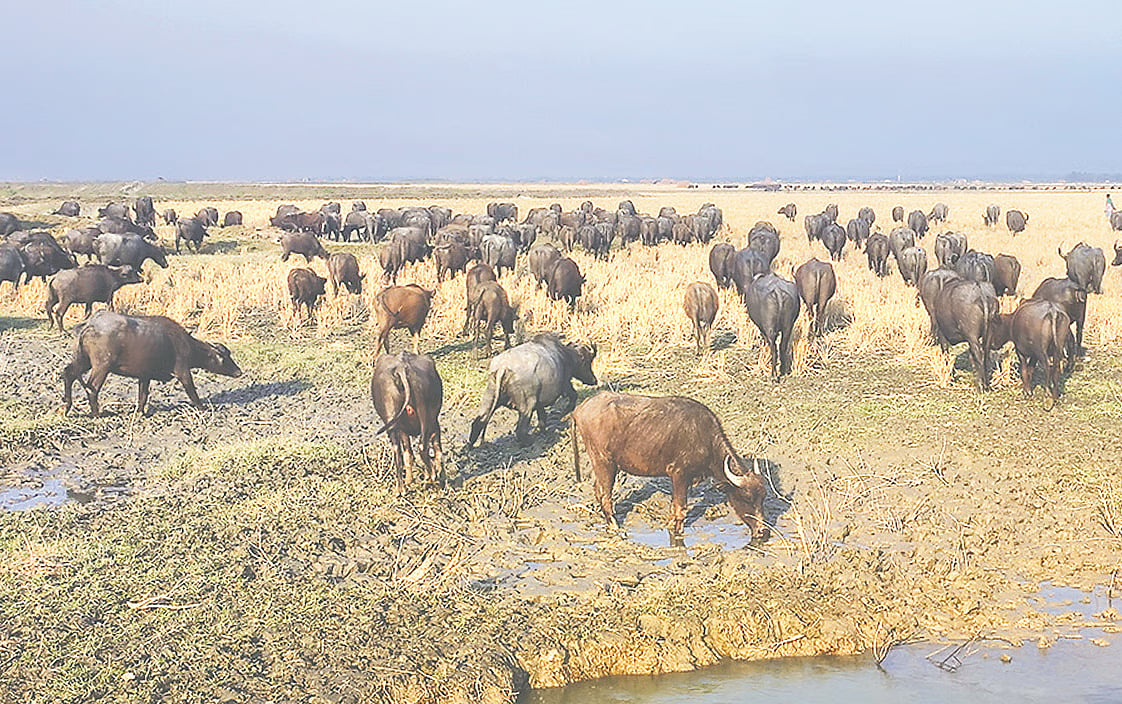
Buffalo rearing on coastal islands and in char areas has long been one of the main pillars of the rural economy. Currently, around 600,000 buffaloes are raised on the islands and chars of Barguna, Patuakhali, Barishal, Bhola, Lakshmipur, Noakhali, Feni and Chattogram. Herds of buffaloes roam freely across the extensive grazing lands of newly emerged coastal islands and chars under the ‘bathan’ (farming) system. These buffaloes have no cattle sheds. These indigenous water buffaloes have an extraordinary ability to survive in char areas through day and night, storms and droughts. However, the number of coastal buffaloes and bathan (buffalo farms) is currently declining at an alarming rate due to various adverse circumstances.
An investigation by Prothom Alo has found that coastal buffalo farms are now under threat due to four factors: shrinking grazing lands, activities of the Forest Department, food shortages caused by climate change, and political ulterior motives. Experts in this sector believe that the livestock sector across the country is grappling with various problems due to the impacts of climate change. Agricultural disasters and food shortages resulting from the destruction of grazing lands are among them. However, coastal buffaloes have the ability to survive these impacts. According to experts, the country does not have a distinct, comprehensive and integrated livestock policy. Formulating a timely policy is essential to preserve the coastal buffalo farm tradition.
Recently, a dispute over proving ownership arose involving 284 buffaloes brought to the grazing land of Kalir Char in Sandwip upazila. The local administration demanded ownership documents from those who had brought the buffaloes. Prothom Alo published a report on the matter on 30 July. At the time, the Sandwip livestock office could not explain what government guidelines existed regarding ownership documents. As the buffaloes remained in the administration's custody for nearly two months, they were deprived of their regular food intake and freedom of movement. The incident brought the government's lack of policy on livestock and grazing land management into sharp focus.
Importance of coastal buffalo farms
There are more than 600,000 buffaloes in around 700 farms across eight coastal districts. This information has been confirmed by data provided by the respective district livestock offices. Of these buffaloes, around 300,000 produce milk annually, while more than 150,000 are used for meat production. Every year, owners sell some buffaloes to cover farm expenses and earn cash.
According to the provisional estimate of the Bangladesh Bureau of Statistics (BBS), the livestock sector contributed 1.81 per cent to the country's gross domestic product (GDP) at constant prices in the 2024–25 fiscal year. At current prices, the size of this sector is around Tk 910 billion. However, government statistics do not maintain separate figures for coastal buffalo farms. Prothom Alo's investigation found that the buffalo farms along the coast produce milk and meat worth approximately Tk 55 billion annually.
Twelve buffalo farm (bathan) owners and caretakers from three different areas provided Prothom Alo with figures on the sale of buffalo milk and meat. In addition, according to information gathered from milk and meat markets, traders and herders during field visits, around 300,000 of the 600,000 buffaloes in the eight coastal districts produce milk in rotation every year. If each buffalo produces an average of three litres of milk daily and milk is sold for 300 days a year, the annual value of milk sales from buffalo farms in the eight districts stands at approximately Tk 35.10 billion. On the other hand, if each of the 150,000 buffaloes slaughtered annually produces an average of 240 kilograms of bone-in meat, and the average selling price from the farms is Tk 600 per kilogram, the market value of the meat amounts to Tk 21.60 billion. Accordingly, the total annual value of milk and meat products sold from coastal buffalo farms is around Tk 56.70 billion.
Ability to withstand the impacts of climate change
The impacts of climate change have already put Bangladesh's livestock sector at risk. A study published in the journal Veterinary and Animal Science in 2024 stated that the level of heat stress on livestock in different parts of the country was severe to extremely severe between 1995 and 2022.
A study published in the Journal of Food Quality in 2017 found that around 200 hectares of land used for animal feed in Kalapara, Patuakhali, are affected by salinity every year. This increases food shortages and the risk of various livestock diseases. Another study published in the journal Discover Environment in 2025 found that 63.4 per cent of respondents from three coastal areas reported livestock being injured or killed in cyclones, while 63.6 per cent reported the same during floods.
Temperature rises, cyclones, tidal surges, floods, salinity and various other disasters are increasing along the coast due to climate change. In such circumstances, experts believe that rearing indigenous water buffaloes could offer relative advantages because of their ability to move through wetlands, swim for long periods during floods or tidal surges, consume low-quality feed and naturally cool their bodies in water.
Field-level experience shows that their survival rate during cyclones or tidal surges is much higher than that of other livestock, and their ability to recover quickly is also comparatively stronger. However, the absence of policy recognition and planned management is increasing the risks facing this promising sector day by day.
The marking system and the crisis
The ‘marking system’ has been in practice for nearly 200 years to determine buffalo ownership on coastal chars. Buffalo farm owners cut specific marks on both ears of their buffaloes using knives or blades to distinguish them from others on grazing lands. These are known as their individual ‘marks’. By looking at these marks among large herds, farm owners and herders can easily identify their own buffaloes. However, this system has no legal basis. Although owners can distinguish their buffaloes, the marks are not accepted as proof of ownership when legal complications arise.
On 24 April 2013, the Assistant Judge Court in Companiganj, Noakhali, ordered five buffaloes to be auctioned, refusing to accept the marking system. The buffaloes, which were in the custody of the administration, had drifted from the buffalo farm at Jahajjar Char to the coast of Companiganj. The administration then demanded proof of ownership. Buffalo owner Shahadat Chowdhury told Prothom Alo, “Companiganj police station demanded a large sum of money to release the buffaloes. I sent the bribe to the court. The court ordered the buffaloes to be auctioned and the money deposited in the government treasury. Although I got the buffaloes back after appealing to the High Court, I lost an amount equivalent to the value of the buffaloes.”
Shakila Faruque, livestock expert and acting director general of the Bangladesh Livestock Research Institute, believes that although buffaloes can be identified by their marks, this is not sufficient to prove ownership. It will be difficult to protect bathan (buffalo farms) in the future without digital registration.
Wherever there is grass, there are buffaloes
There is no separate policy to protect grazing lands under Bangladesh's land management system. There is also no clear classification of ‘grazing land’ in the lists of agricultural or government-owned land.
According to herders, food shortages for buffaloes, scarcity of fresh water and security concerns make it essential for them to change grazing lands. A buffalo farm generally has 50 to 500 or more buffaloes. To keep these buffaloes alive, they have to be moved to coastal areas wherever grass is available. However, whenever a herd of buffaloes arrives from one char to another, it creates a stir. Sometimes they face obstruction from local political leaders, sometimes rumours, and at other times administrative complications.
A 2019 study by the Department of Livestock Services stated that the risks of ‘Anthrax, Foot and Mouth Disease’ and ‘Brucellosis’ among livestock in the country's coastal areas are increasing. If guidelines for obtaining permission to relocate grazing lands were in place, administrative complications driven by political motives could be eliminated, while the spread of diseases could also be prevented through health checks of the buffaloes.
Ecosystem centred on buffalo farms
Buffaloes are not just a source of meat or milk; they also play a role in changing the characteristics of newly formed soil, locally known as ‘poysty’ land, on coastal chars. When new grass grows on a char, the movement of buffaloes naturally trims the grass, helping to increase the fertility of the topsoil. Most importantly, there is buffalo dung. The amount of organic fertiliser deposited on char soil every day by thousands of buffaloes accelerates the process of transforming saline char soil into cultivable alluvial soil.
In addition, a small ecosystem develops on the chars around buffalo farms. Various migratory birds, including egrets and mynas, come to feed on insects on the buffaloes' bodies. Small plants and insects that grow in the muddy areas dug up by buffaloes enrich the biodiversity of the chars. Experts believe that if the bathan (buffalo farm) system disappears, the natural soil formation process in char areas will be disrupted, and many rare species of animals and birds will lose their habitats.
Risks increasing, buffalo numbers declining
Livestock offices in five of the eight coastal districts have reported evidence of a decline in buffalo numbers over the past few years. However, herders claim that the number of buffaloes along the coast is declining at an alarming rate.
According to herders there, there were around 25,000 buffaloes in the farms of Jahajjar Char 15 years ago. The number has now fallen to 10,000. The Barishal district livestock officer has said that the number of buffaloes is declining noticeably compared to the past.
Prothom Alo's investigation found that a four-pronged pressure has now emerged behind the contraction of buffalo farms. Many are winding up their farms due to shrinking grazing lands, cases filed by the Forest Department, buffaloes being swept away by cyclones and tidal surges, and administrative harassment. In Subarnachar and Companiganj areas of Noakhali, 10 families each had between 500 and 1,000 buffaloes. Now, only one family in Companiganj has 800 to 900 buffaloes. In Subarnachar, some families now have only 20 to 25 buffaloes each.
Ashraf Uddin, a buffalo farm owner at Dobachar near Sandwip, said, “If my buffaloes are detained somewhere, the government must decide what documents I will have to show.”
Another owner named Nizam Uddin said, “We work ourselves to the point of exhaustion. Due to a lack of space, we hire bulkhead vessels and move the buffaloes from one char to another. If they enter a plantation, the Forest Department files a case. If we move from one char to another, they say the buffaloes are stolen. I cannot do it anymore. I will sell all the buffaloes.”
It is a common occurrence for herds of buffaloes to be swept away from one char to another or from one district to another during cyclones, tidal surges and unusually high tides. Prothom Alo's investigation found that political criminals take advantage of such incidents to seize the buffaloes that drift ashore. As a remedy, buffalo farm owners seek help from the relevant police stations. Taking advantage of the situation, the police offer to settle the matter in exchange for a large sum of money to recover the buffaloes. Otherwise, if the matter is sent to court, complications arise in proving ownership.
Owners have no other proof except the marks they themselves make on the bodies of their buffaloes according to their own preferences. As a result, they face court orders to auction the buffaloes and deposit the money in the government treasury. Helpless buffalo owners are then forced to accept settlement offers in exchange for money. In this way, the cycle of political and administrative power is swallowing up the buffalo farm system.
Existing livestock framework
Various laws and regulations have been formulated at different times, including the Animal Disease Act of 2005 on farm registration, the Animal Disease Prevention Rules of 2008, the National Livestock Extension Policy of 2013, the Animal Slaughter and Meat Quality Control Rules of 2021, and the Bangladesh Livestock Award Policy of 2022. Under the Bangladesh Labour Act of 2006, workers employed at institutions under the Department of Livestock Services are also entitled to appropriate medical treatment and financial benefits if they are injured or suffer losses. However, a comprehensive and independent livestock policy is still absent.
These laws and regulations do not contain any separate policy for coastal buffalo farms, grazing land ownership or char areas endangered by the impacts of climate change. The National Agriculture Policy 2013 also mentions the livestock sector only as an important sub-sector. As a result, the management of buffalo farms and grazing lands largely depends on the old practices developed by buffalo farm owners and herders, known as bathani.
Prothom Alo's investigation found that although there are livestock offices in every upazila, there is no separate monitoring cell or registration process for bathans in char areas. There is no monitoring system or database at the field level concerning livestock ownership, health records or relocation. In addition, a lack of coordination among the local administration, land offices, Forest Department and Department of Livestock Services is increasing disputes over the ownership of buffalo farms and grazing lands, further endangering future livestock management and coastal buffalo farms.
Why a policy is necessary
To achieve Goal 2 of the United Nations Sustainable Development Goals (SDGs), fairness and a legal framework in livestock management are essential to ensure the supply of safe food and nutrition in Bangladesh. On the other hand, coastal buffalo farms could be a sustainable solution for livestock rearing in the face of climate change impacts such as droughts, excessive rainfall, tidal surges and salinity.
Experts believe that every buffalo farm should be brought under digital mapping and a central database should be created, with the Forest Department, Ministry of Land and Department of Livestock Services working together. The ‘silvopasture’ or forest-grassland model could be followed to ensure the free movement of buffaloes inside plantations established by the Forest Department. This would prevent damage to the forest while also providing food for the buffaloes. Such an integrated initiative could transform this centuries-old practice into a modern and profitable industry.
What the authorities are thinking
Sandwip Upazila Livestock Officer Md Nabil Farabi said there are no officially designated grazing lands in this region. He said buffalo rearing could become easier if grazing lands were designated for buffaloes through inter-ministerial coordination. However, he advised buffalo farm owners to register their farms to avoid complications. The buffalo farm owners, however, claim that the concept of a farm is not compatible with the bathan (buffalo farm) system.
The owners and herders have proposed designating grazing lands, registering buffalo births and ownership online, updating sales and transfer information, updating the names and locations of grazing lands, and introducing an online application system to obtain permission before moving buffaloes from one grazing land to another.
The recently retired director general of the Department of Livestock Services, Md Reazul Haque, told Prothom Alo, “The Ministry of Land owns poysty (newly emerged) land. The Forest Department establishes plantations there. We want these lands to be leased to the livestock department for grazing.” Reazul Haque said online registration of buffaloes and the creation of a database were timely initiatives that could be implemented by the department.
However, Shakila Faruque, acting director general of the Livestock Research Institute, believes that instead of leasing the land, provisions could be made to use it as grazing land through an inter-ministerial agreement, depending on when the trees planted by the Forest Department reach maturity. This would ensure the sustainability of newly emerged land.
Immediate action needed
Bathan owners and herders want designated grazing lands for them. They have demanded the construction of raised shelters, ponds and deep tube wells on designated grazing lands. They have also strongly demanded that the government immediately formulate clear regulations to determine buffalo ownership.
Livestock expert Shakila Faruque believes that buffaloes should have unique identity numbers. If these are attached to their ears immediately after birth, they can be identified. Information about the buffaloes and their owners would be stored online against these identity numbers. As a result, owners would be able to locate their buffaloes even if they were swept away by storms and high tides. It would also be possible to establish which calf belongs to which buffalo.
Regarding grazing lands, Shakila Faruque said, “To sustain the buffalo farm system, attention must be paid to grazing land management. Although new land is emerging, the actual area of grazing land is shrinking due to plantations and cultivation. Separate grazing land and ownership policies must be adopted for coastal char areas.” She stressed the importance of inter-departmental coordination for sustainable grazing land management.
Md Abu Syed, senior fellow at the Bangladesh Centre for Advanced Studies (BCAS) and an expert in coastal risk assessment, said buffalo herds roam on isolated and remote islands and chars. The Department of Livestock Services must reach those places and ensure services. At the same time, its capacity must be increased and logistical support provided. Easier communication with buffalo farm owners and herders would make it easier to assess risks and take measures accordingly.
According to experts, simply releasing buffaloes in char areas will not be enough. Sufficient raised shelters or elevated mounds must be constructed there to ensure disaster preparedness. At least one deep tube well must be installed in every large grazing land so that there is no shortage of fresh water during the dry season. They believe that coastal bathans are not merely part of the economy; they are also an integral part of the livelihoods, nutrition and culture of several hundred thousand people.