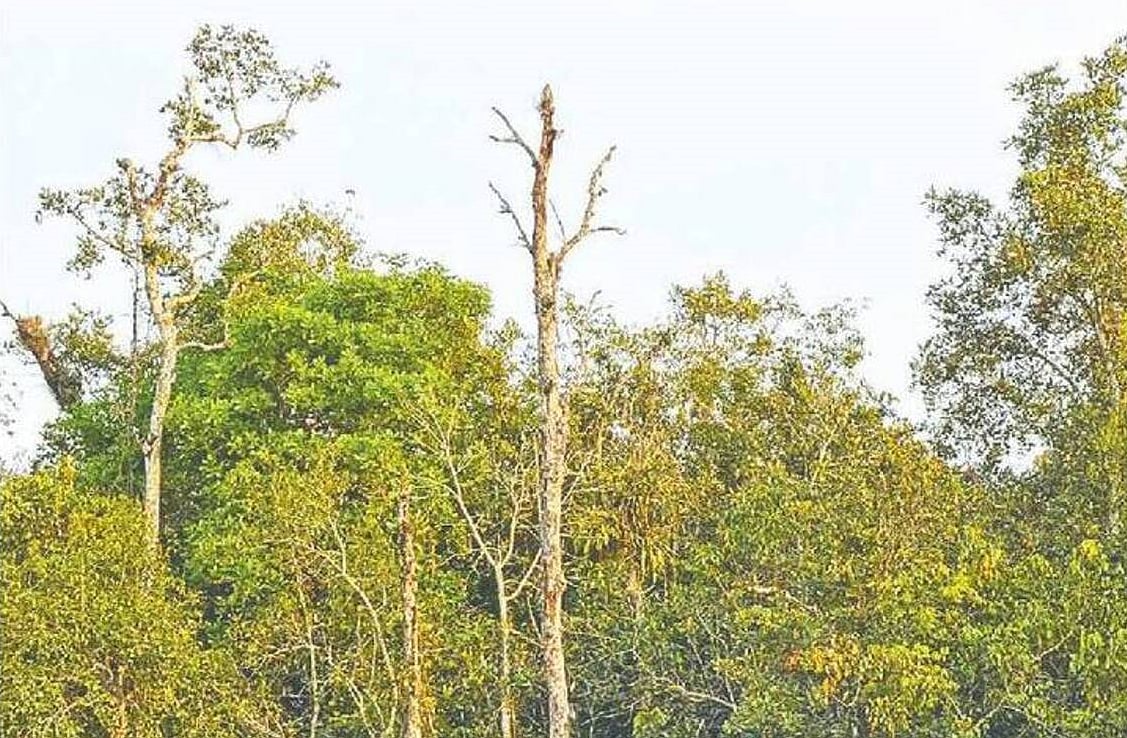
Sundarbans: 39pc Sundari trees affected by disease
Four out of every 10 Sundari trees (39 per cent) in the Sundarbans are affected by top-dying disease. The number of affected Sundari trees now stands at 129.5 million. Of them, 20.24 million are severely affected.
The Sundarbans now has around 330 million Sundari trees. The rate of natural seedling regeneration per hectare has also declined in the world’s largest mangrove forest. As a result, the Sundarbans’ carbon absorption capacity has fallen by 15 per cent. These findings emerged from a two-year study (2024–25) on the overall ecosystem of the Sundarbans.
The multidimensional study, titled Ecological Monitoring of Sundarbans, was conducted by the Centre for Environmental and Geographic Information Services (CEGIS), an organisation affiliated with the Ministry of Water Resources, and the Arannayk Foundation.
The research covered wildlife, air, soil, water and tree resources in the Sundarbans. The findings were presented at a workshop at the Forest Department’s headquarters in Agargaon, Dhaka, on 14 September. The study provides a detailed picture of the plight of Sundari trees.
Researchers fear that the forest cover, carbon storage capacity, and habitats and distribution of wildlife in the Sundarbans may change. When top-dying disease strikes, it initially affects the leaves of Sundari trees. The branches and twigs then dry out, eventually destroying the main trunk. Experts have attributed the decline of this important tree species to rising salinity, reduced freshwater flow, sediment deposition, changes in tidal patterns and climate change.
Not all affected trees in the Sundarbans suffer from the disease to the same degree. The percentage of infection is determined by how far the disease has spread, from the leaves to the main trunk.
The study was conducted by Dr Swapan Kumar, a professor in the Department of Forestry and Environmental Science at Shahjalal University of Science and Technology. He told Prothom Alo that 120 permanent survey plots had been established in the Sundarbans since 1986. After identifying changes in the trees in these plots and following a specific methodology, the researchers estimated the number of affected trees.
He said the incidence of top-dying disease had declined somewhat compared with 1986, but the number of severely affected trees had increased. The rate of infection is higher in areas with high and moderate salinity.
Further research is needed to determine how the large number of trees affected by top-dying disease is affecting the forest, its wildlife and the overall ecosystem.
Over 20 million trees severely affected
Not all affected trees in the Sundarbans suffer from the disease to the same degree. The percentage of infection is determined by how far the disease has spread, from the leaves to the main trunk. For example, a tree whose leaves and branches are affected to a limited extent is considered to have less than 25 per cent infection.
According to the study data, 83.03 million trees have less than 25 per cent infection.
The incidence of top-dying disease had declined somewhat compared with 1986, but the number of severely affected trees had increased. The rate of infection is higher in areas with high and moderate salinity.Swapan Kumar, Professor, Department of Forestry and Environmental Science, SUST
Another 25.08 million trees have infection levels of 25 to 50 per cent, affecting their leaves and branches extensively. A total of 20.24 million trees have more than 50 per cent infection, meaning their leaves, branches and main trunks are affected. According to the study, around 200 million of the Sundarbans’ 330 million trees are healthy.
Professor Swapan Kumar said, “In 1986, the number of severely affected trees was 11.92 million. It has now reached 20.24 million. This is a matter of concern. We need to monitor these trends over the long term and find solutions.”
The study identified salinity as one of the most serious threats to the ecological health of the Sundarbans. It said the central and western parts of the forest face a high risk of salinity. The problem is worsening due to reduced upstream water flow, rising sea levels and variations in rainfall.
Areas where the disease is spreading most
For the study, the Sundarbans was divided into 53 compartments. Among these, the highest levels of top-dying disease were recorded in the Patkostam, Kaga Dobeki and Gewakhali areas of the Khulna Range.
The density of seedlings per hectare in the Sundarbans is declining. According to the study, the forest had 2,689 seedlings per hectare in 1986. By 2022, the figure had fallen to 776. Over 36 years, seedling density declined by around 71 per cent. This indicates that the Sundarbans is losing its capacity for natural regeneration.
The areas with the second-highest levels of infection were Dobeki in the Satkhira Range, Harbaria in the Chandpai Range, Charaputia and Kokilmoni in the Sharankhola Range.
In January 1988, British botanist and University of Aberdeen professor Eric Boa conducted a study titled Symptoms and Causes of Top-Dying. That study identified rising salinity as a possible cause.
According to Professor Swapan Kumar, although the disease is more prevalent in areas with high salinity, it has not yet been scientifically established that salinity alone is responsible. Further long-term research is needed.
The density of seedlings per hectare in the Sundarbans is declining. According to the study, the forest had 2,689 seedlings per hectare in 1986. By 2022, the figure had fallen to 776. Over 36 years, seedling density declined by around 71 per cent. This indicates that the Sundarbans is losing its capacity for natural regeneration. The forest’s above-ground biomass (AGB) has declined by 15 per cent over the past three decades.
Asked about the findings, Chief Conservator of Forests Md Amir Hosain Chowdhury told Prothom Alo that this was the first baseline study of the Sundarbans covering the periods before and after independence.
He further said that top-dying has been a centuries-old problem in the Sundarbans. To tackle it, the Bangladesh Forest Research Institute (BFRI) identified and felled affected trees in the 1980s and the early 1990s. The assumption was that the disease would not spread to healthy trees. However, the method proved ineffective and was later discontinued, he said.
No continuous research
Experts say it is not possible to determine whether Sundari trees will survive in the long term, how the replacement of Sundari trees by other species is affecting the Sundarbans ecosystem, or what impact these changes are having on wildlife. The main reason is the lack of continuous academic or government-led research on the Sundarbans.
Professor Khaled Misbahuzzaman of the Institute of Forestry and Environmental Sciences at the University of Chittagong told Prothom Alo that Sundari trees appear at the final stage of plant succession in the Sundarbans. In other words, Sundari seedlings are the last to grow in open areas of the forest. This is why the species is known as a climax species. It is also the dominant tree species in the Sundarbans.
In some areas that previously had a much higher concentration of Sundari trees, natural regeneration of smaller tree species such as Singra and Amur is now being observed. In addition, the spread of Gewa trees is increasing in some areas where Sundari trees once predominated, he added.
He said understanding the effects of these changes was essential to saving the Sundarbans. He expressed hope that the government and the Forest Department would give serious consideration to the need for continuous research.