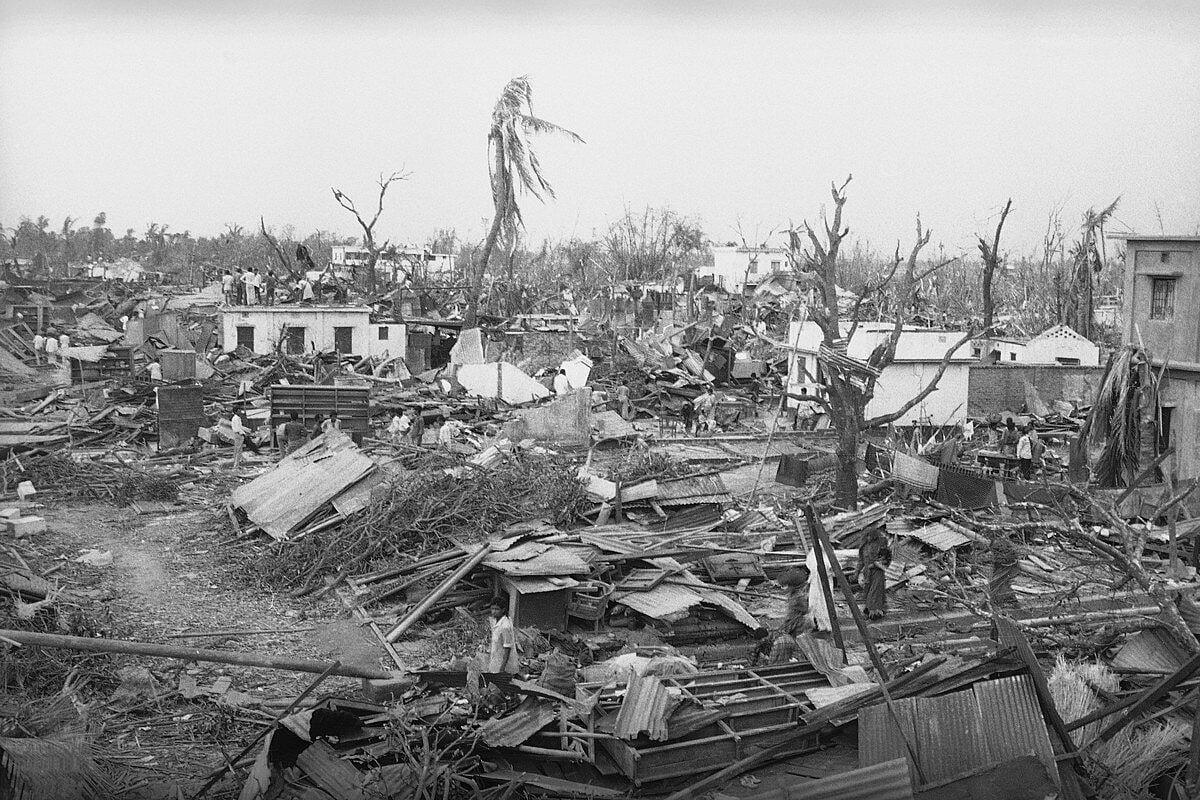
Bhola Cyclone 1970: A day of tears for coastal Bangladesh
Then, one day, the faint sound of a steamer’s whistle reached her ears. The sound grew increasingly distinct. No, it wasn’t a dream—it was real! Mofiza opened her eyes. Perched atop the carcass of a dead cow, she saw a steamer passing by in the distance. Mofiza lacked the strength to stand up or cry out, yet the thought of catching the steamer’s attention crossed her mind. But how?
With great effort, she retrieved a piece of colorful polythene from among the debris floating in the water. She wrapped it around a stick and held it high, hoping to draw the attention of those on the vessel. When she saw the steamer begin to slow down, a glimmer of hope for survival stirred within her.
Looking around, she realised that amidst the countless corpses, a few people were still drifting, barely clinging to life—their cries sounding like low, agonizing moans. Three or four days earlier, the number of survivors had been much higher. A new, fragile hope began to take root in Mofiza’s heart. A speedboat launched from the steamer drew near, and she was rescued.
This is the story of Mofiza Begum, a survivor of the catastrophic cyclone. She was a resident of Char Jatin, on Manpura Island in the Bhola district. At just 35 years old, Mofiza had been embarking on a new chapter in her life—but the fury of the Bhola cyclone on November 12, 1970, shattered everything. Mofiza lost her daughter, and she herself was swept away from her home, ending up at the mouth of the Karnaphuli River in Chittagong—nearly 100 kilometers away.
Mofiza is not alone; the harrowing events of November 12 left behind thousands of such stories all along the coast. Countless people lost their loved ones and their property. Many families were completely wiped out.
A catastrophic disaster
November 12th—a date that evokes horror, a day synonymous with an apocalyptic catastrophe. That somber anniversary has come around once again. On that day, the coastline was transformed into a graveyard. In the span of a single night, more than a million people lost their lives. Eyewitnesses recounted harrowing scenes, corpses were found in ponds, ditches, canals, and even hanging from the branches of trees. Countless people were left destitute, having lost everything.
Known as the ‘Bhola Cyclone,’ this storm struck the coast of Bangladesh with immense ferocity. The lack of timely weather warnings, an absence of cyclone shelters, and the fragile state of embankments and infrastructure exacerbated the scale of the tragedy, leading to an staggering loss of life and destruction. According to records from the World Meteorological Organization (WMO), this remains the deadliest tropical cyclone in recorded history.
Conversations with elderly residents from the coastal districts of Bhola, Patuakhali, and Lakshmipur offer a glimpse into the horror of that day. They recall how the water levels rose with startling, inexplicable speed. Driven by powerful winds from the southeast, a fine, persistent rain began to fall as the waters surged.
People sought refuge—first on the plinths of their homes, then on elevated platforms within their dwellings, and finally, by climbing trees. The sheer force of the water tore away the roofs of houses, sweeping away those who had taken shelter upon them. Others clung desperately to tree branches in a bid to survive. The entire coastline was submerged under 17 to 18 feet of water. After a prolonged period, the rain and wind ceased, leading many to believe the storm had ended.
But after a brief lull, a second, even more violent surge of wind struck from the northwest, washing away everything in its path. As the tide receded, the waters drained back into the sea, carrying with them people, livestock, and homes. When the sun rose the following morning, the full, terrifying extent of the devastation was revealed—everywhere one looked, there were only corpses. The survivors lived much like the dead.
In the aftermath of the catastrophic 1970 cyclone, the coastal population faced an extreme crisis. Many lost everything they had accumulated over a lifetime and were left destitute. Having lost their entire families, some were rendered speechless by the trauma. Most had to begin their lives from scratch. The government of what was then East Pakistan failed to provide adequate assistance; even a week after the cyclone, relief aid had yet to reach many of the devastated coastal areas.
Medical facilities were woefully insufficient to address the outbreaks of disease that followed. Many children who survived the storm itself later perished due to a lack of medical care. In many households, while the men survived, the women did not—leaving the surviving men to struggle with the daily demands of domestic life. The survivors faced immense hardship as they attempted to rebuild their lives and get back on their feet.
46pc perished in Tazumuddin!
Tazumuddin Upazila in Bhola District was among the areas most severely affected by the 1970 cyclone. At that time, the Upazila comprised both Tazumuddin and Manpura—the latter being a single union. While Tazumuddin had embankments along the banks of the Meghna River, Manpura had none.
According to Wikipedia, out of a total population of 167,000 in the entire Tazumuddin Upazila, only 77,000 survived—meaning approximately 46 percent of the population perished. The toll was even higher in the Manpura area; lacking any protective embankments, the island was struck by surging waters from the east, while currents from the northwest swept everything away.
Mizanur Rahman Naju, a resident of Shashiganj village in Bhola District’s Tazumuddin Upazila, was only 13 years old at the time of the 1970 cyclone. He was a student at the Hakimuddin Primary School. Recounting the event, he says, “After my home was swept away by the violent force of the water, I managed to grab hold of a mango tree. When I climbed down at dawn, I could no longer even recognize where my home had once stood. I didn’t see any houses within a kilometer or two.”
“We had no preparations whatsoever. We hadn’t received any cyclone warning, and there were no arrangements for shelter. Although there was an embankment, it collapsed, allowing the water to rush in. I don’t even know how we managed to survive that crisis. We’ve had to start all over again,” adds Mizanur Rahman.
Islands faced extensive damage
During the catastrophic cyclone of 1970, Dhalchar—a small, promising island in Charfasson Upazila, located at the southernmost tip of Bhola District—was swept away. At the time, the island, covered in dense forest, had only just begun to see human settlement. People from various places had started building homes there, while others would stay on the island seasonally to graze their cattle and buffalo.
As the devastating storm intensified, water levels began to rise, leaving the inhabitants helpless. Some managed to take shelter in the island’s only two-story concrete building; however, many others, unable to reach this refuge due to the dense vegetation, were swept away. Meanwhile, Char Abdullah—an island union in Ramgati, Lakshmipur—also suffered catastrophic damage, with many lives lost and entire families completely wiped out.
Yusuf Ali Patwary, a resident who survived by taking shelter in Dhalchar’s only concrete building, was a 16-year-old teenager during the 1970 cyclone. Recalling the harrowing scenes of that day, he says, "I had arrived on this island with my elder brother two years before the cyclone. The day before the storm, fierce winds began blowing from the southeast, and the water levels started to rise."
"While some managed to reach the concrete building, many others could not. Everyone who remained outside that building was swept away. It wasn't just people—hundreds of cattle and buffalo were also carried off by the violent surge of water. Dhalchar was completely wiped off the map."
The grim reality of what befell Dhalchar was also recounted by 72-year-old Hasan Ahammed in the village of Kulsumbag, Charfasson. Although the family’s primary home was in Charfasson, Hasan Ahammed’s father, Moulvi Montaz Uddin, and his brothers, Hochen Ahammed and Nur Mohammad, had been staying on Dhalchar to look after their land and livestock. They, along with their cattle, buffalo, and all their other possessions, were swept away by the ferocious storm.
Hasan Ahammed himself had also been caught in the midst of the tempest; five days later, he traveled to Dhalchar in search of his father and brothers. He could not find anyone. Upon reaching the site, he learned that most of the people—along with their livestock and everything else—had been swept away.
Meanwhile, Hasan Ahmed found himself in a dire situation after losing his father and brothers. His elder brother’s wife, Sufia Begum—who had been married only a short time earlier—was left nearly inconsolable. With his father and elder brother gone, the responsibility of the household fell upon Hasan, despite his youth. But where was his sister-in-law, Sufia Begum, to go? With the consent of both families, Hasan married her. Thus, life began anew. Hasan and Sufia built a life together, and what started from nothing eventually flourished. Yet, they still cannot forget that horrific night.
A call for a ‘coast day’
A ‘day’ is more than just a date on the calendar. It serves as a focal point for collective discourse, allowing for a unified discussion on the crises, challenges, and potential of a specific subject. Such a day can elevate the importance of an issue in the public consciousness. There is now a call to establish a 'Coast Day'—a demand that is both logical and well-founded.
The coastal region is a territory frequently battered by storms and tempests, where the inhabitants are in a constant struggle against nature. Farmers may toil to produce a bountiful harvest, only for it to be lost to the ravages of the elements before it can ever be brought home. A family might manage to build a new home—using their hard-earned savings supplemented by loans—only for it to be razed to the ground by a storm the very following year. The constant threats of tidal surges, riverbank erosion, and soil salinity haunt the people living there.
We need a dedicated day to focus specifically on the coastal population—a time to discuss the crises they face and the possibilities that exist, a moment for everyone to come together and speak about these issues. Whenever a disaster strikes, the media, development workers, and representatives from both the public and private sectors rush to the coast.
When a catastrophe leaves everything in ruins, even more people arrive. In the wake of major events, representatives from international organisations also appear, and national media outlets suddenly give significant coverage to the coastal region. But who pays attention to the lives of coastal residents during 'normal' times—when, in reality, their daily existence is anything but normal?
This is the rationale behind the call for a ‘Coast Day’—a day when everyone can collectively turn their attention to the coast. November 12th—a date remembered as the most tragic day for the people of the coast—could serve as ‘Coast Day.’
This date should not only be recognized within Bangladesh but should be observed globally as ‘World Coast Day.’ The concept of a ‘Coast Day’ could also be brought into the discussions at the Conference of the Parties (COP), as it is intrinsically linked to issues of climate justice and human rights.
The idea of having a dedicated day for the coast first occurred to me while I was working as a journalist covering coastal issues. It was a night in October 2016; I was walking through the town after leaving the Paikgachha Dak Bungalow. The thought of a ‘Coast Day’ kept occupying my mind, and I decided to propose one. Then came the question—which date should be chosen?
After much deliberation, I settled on November 12th—the date in 1970 when a cyclone struck the coast of Bangladesh, remaining the deadliest such event in recorded history. This date is deeply intertwined with the sorrow of countless coastal residents. I wrote an article for various newspapers, titled — ‘Let November 12th Be Coast Day.’
I interviewed at least 100 survivors of the 1970 cyclone, listening to their hardships, emotions, and stories of struggle and survival.
I then realized that simply proposing the day wasn't enough; I needed to take the initiative to actually observe it. A day can be commemorated even without official recognition—many national and international observances are held through citizen-led initiatives. My journalist colleagues in the coastal regions took the lead in organizing the observance locally.
On November 12, 2017, ‘Coast Day’ was observed for the first time across 34 locations along the coast. That year, Voice of America featured an interview with me as the initiator, along with co-initiator Sanaullah Sanu. The BBC also conducted an interview with a Union Parishad (UP) chairman from Charfasson.
Risks in coastal areas
Since independence, Bangladesh has made significant strides in disaster management. Cyclone warning systems have been improved, numerous cyclone shelters have been constructed, embankments have been built, and road infrastructure has been developed. These measures have drastically reduced both the death toll and the extent of damage caused by disasters. Nevertheless, risks remain.
Many coastal areas are still unprotected; homes are submerged whenever the tide rises, and fragile embankments collapse under even minor pressure. Not only are embankments missing in some coastal locations, but existing ones have not been raised to the necessary height. Consequently, one cannot rule out the possibility of catastrophic damage should a disaster on the scale of the 1970 cyclone strike the coast again.
To cope with natural hazards, local residents are calling for the construction of robust, elevated embankments. They also demand the establishment of an adequate number of cyclone shelters in strategic locations, along with the assurance of a decent environment within these shelters. Furthermore, coastal residents emphasize the need to ensure that the roads leading to these shelters remain accessible. Residents in high-risk areas believe that raising awareness about warning signals at all levels would go a long way toward mitigating the impact of natural disasters.
Women like Mafiza Begum—who suffered the ravages of a cyclone—do not want to be swept away again; they do not want to lose everything once more. Mofiza says, “We have nowhere else to go from the coast. Please ensure that we can live here safely.”