In Bangladesh, thousands of volunteers are battling climate-fuelled disease at its source
It is a cloudy, humid September morning near the end of monsoon season in Dhaka, the capital of Bangladesh and one of the world's most densely populated cities. Streets normally bustling are quiet as residents of the Uttara neighbourhood prepare for the weekly prayer.
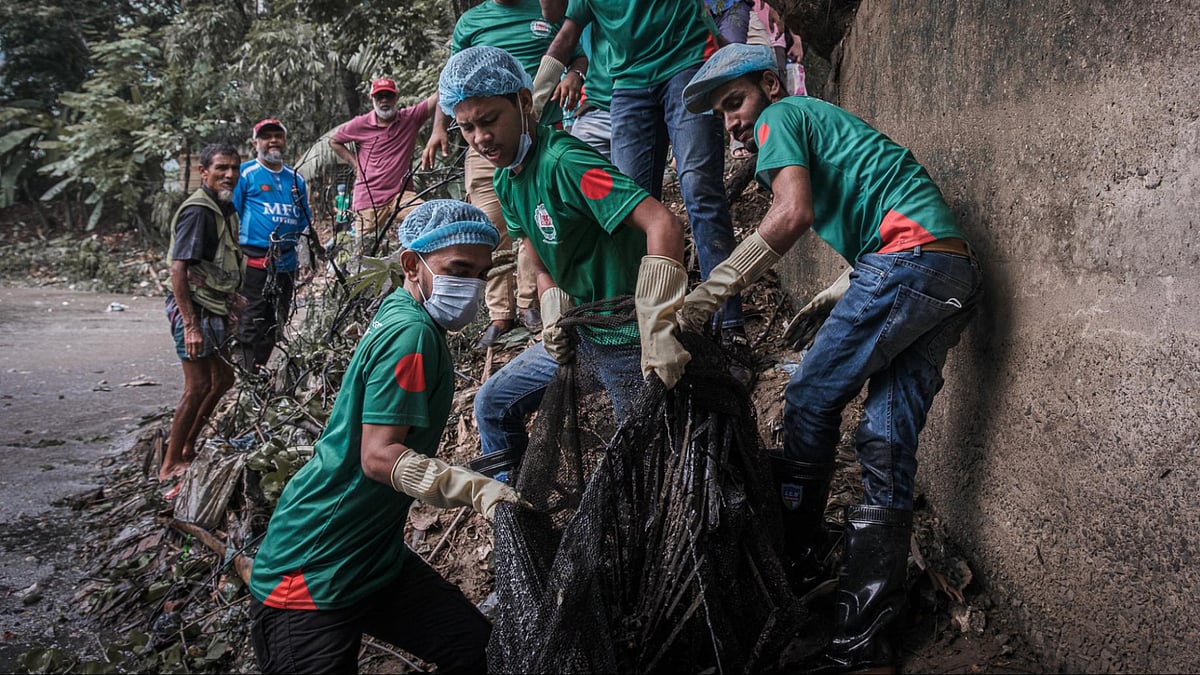
Suddenly, dozens of young volunteers emerge from the silence, gathering before heading to the shores of a small nearby lake. There, the stench of rotting waste hangs heavily in the air, burning the inside of their nostrils and stifling breaths.
They begin to organise into different teams. Some pick litter off the ground. Others take a canoe and nets into the stagnant water. They collect plastic containers, banana peels, and anything else that has pooled in or near the lake over months and years. Some volunteers even dive into the murky water searching for waste.
Dhaka is home to almost 37 million people and growing fast. It is expected to become the world's largest city by 2050. But municipal services have not been able to keep up with its breakneck growth, making the city one of the world’s most polluted as well. More than half of its daily trash is not collected.
“All of us young volunteers are working hard to clean [up] and represent our country to the world,” said Umme Kulsum Siddiki Brishti, a university student, as she took a break during the Uttara clean up. “We are trying to change people's mindset.”
Bangladesh Clean, the group that organised the day’s volunteers, is not just a beautification effort. In a country where more than 2,72,000 premature deaths are associated with air pollution, unsafe water, poor sanitation, and lead exposure annually , it’s an acknowledgment that the stakes are life-or-death.
Between 1901 and 2019, average temperatures in Bangladesh have increased by nearly 2°Celsius during some months. This warming, coupled with increasingly irregular rainfall patterns, is leading to longer summers and warmer winters. Mosquitoes are now breeding more rapidly, bringing with them diseases such as dengue and chikungunya. The insects thrive in warm, humid environments rich in the kind of organic matter found in much of Dhaka’s waste.
Bangladesh Clean has become one model for how residents are taking matters into their own hands.
The organisation was founded in 2016 and today is composed of more than 50,000 volunteers, mostly teenagers and young adults recruited through social media and word of mouth. Every Friday, they fan out across the country to clean waterways and neighborhoods. Since its founding, the group has organised about 15,000 cleanup events across the country.
Rahat Sarker Hridoy joined the cleanups in 2021 after seeing the group advertised on Facebook; he has been a regular ever since.
“It's important for my country, I never get tired of doing these [events]. I dream one day my country will be neat and clean,” he said during the Uttara cleanup, soaked in contaminated water. “I can't do this alone. That's why I joined the organisation.”
Bangladesh has experienced big spikes in mosquito-borne diseases, especially dengue and chikungunya, in recent years. In 2023, there were 3,21,179 reported cases of dengue and 1,705 deaths — the country’s worst outbreak on record. Official numbers were smaller in 2025, just over 100,000 cases, but health experts warn it is likely an undercount. Only a fraction of hospitals document dengue infections, while limited access to healthcare in rural areas leaves many cases undiagnosed.
''Without action by the people, without action by society, [dengue] is not possible to manage,'' said Karibul Bashar, an entomologist and epidemiologist at Jahangirnagar University and adviser to the World Health Organization in Southeast Asia. ''There are a lot of small containers, canned food, packaged food, polythene sheets, polythene bags, and plastic bags everywhere." Even a small amount of water in any plastic bag or plastic cup is enough for Aedes mosquitoes to breed, he added.
Bashar is developing an artificial intelligence system that can help predict future outbreaks. His approach involves placing mosquito traps in neighborhoods and analysing both mosquito populations and the number of infected people in surrounding areas.
“We can develop an early warning system,” he said, surrounded by dengue-infected mosquitoes in his laboratory on the outskirts of Dhaka. “If the mosquito density is high in a place where patients are already present, we can say the disease will spread rapidly. [It] can flag this on a government server, showing where the next hotspot is likely to emerge in the next two or three weeks for dengue.”
Early warning means the potential for quick action and control, he said.
For decades, millions of Bangladeshis have flocked to cities in search of new economic opportunities and to flee small towns and villages inundated during the monsoon. But the crowded neighbourhoods make them powerful vectors for mosquito-borne diseases.
This was the case for Nilufar Begum, who lives with seven of her relatives in a tiny home covered by steel plates. Begum and her four-year-old granddaughter were diagnosed with chikungunya last August. While not as severe as dengue, its effects can last for months, if not years. When Grist visited the family a month after the infection, they were still experiencing headaches and muscle pain.
''The mosquitos are unbearable now. There were not this many 10 years ago,'' Begum said, sitting on a bed in the dark room where her family sleeps. It had been a year since former Bangladesh Prime Minister Sheikh Hasina was ousted from power after weeks of student-led protests that resulted in the killing of 1,400 people. Begum said that the political turmoil had taken a toll on basic civic functions. The interim government had been struggling to provide services once common in her area such as fumigation, trash collection, and drain clearance.
All of this has a ripple effect in healthcare centers unable to cope with the influx of patients. Many who end up there wait in crowded corridors without beds or medicine, as Grist observed during a visit to the Mugda Medical College Hospital in September. Families with children crowded the halls, waiting to be attended by medical personnel who could not do much besides providing pain relief and monitoring vital signs as dengue has no specific treatment.
''We had to buy all the medicine [ourselves],” said Rubina Begum, who almost burst into tears while holding her unconscious dengue-infected two-year-old son, Omar, in her arms at the hospital. “The hospital only provided one bag of saline [solution] at the beginning. Until now, the medicine has cost us 8,000 Taka [equivalent to USD 65] in total.''
It’s common in Bangladesh for the vast majority of medical expenses to be covered by patients out-of-pocket — a tall order in a country where one in three people earns less than USD 5 per day. According to an interview with an official from the country’s Ministry of Health and Family Welfare, Bangladesh only invests 0.78 per cent of its gross domestic product in healthcare. By comparison, countries such as India and Indonesia spend about double that amount, while the United States commits more than 18 times as much.
''Most of the hospitals make temporary wards for six to seven weeks [during the peak of the monsoon season] by pulling some doctors and nurses from other departments,'' explained Abu Sayeed Chowdhury, a senior pediatrician at Mugda Medical College Hospital.
Dengue cases are found all year now, so we should make a permanent care system for this. During the peak time, due to so many patients, sometimes there's a shortage for saline solutions, so we should focus on the emergency preparedness for these kind of situations. - Abu Sayeed Chowdhury, Senior Pediatrician, Mugda Medical College Hospital.
Speaking from a government building in central Dhaka, Bangladesh’s Special Assistant to the Chief Adviser for the Ministry of Health and Family Welfare Sayedur Rahman told Grist that most of the country’s health budget is directed toward prevention rather than care.
"Any number of [mosquito-related] patients at the hospital is a failure of the vector control program…that is the responsibility of another ministry and local government," said Rahman, a doctor who was appointed to the ministry a few months after the ousting of Bangladesh's former government in August 2024.
''We have 150,000 patients admitted in the hospitals right at this moment, whereas we have beds for only 110,000. So the rest — 20,000 to 30,000 patients — are on the floor in the government hospitals.''
Rahman also explained that his ministry does not plan to allocate more money to better equip hospitals to fight against mosquito-borne diseases. Instead, it intends to negotiate preventive measures with other ministries to reduce the need for hospital care in the first place. These ideas include instituting educational programs in schools and releasing sterilised mosquitoes into the environment to reduce mosquito populations.
Karibul doubts the effectiveness of this plan, given the overwhelming number of disease-carrying mosquitoes already breeding in Bangladesh. He believes this population will crowd out any sterilised mosquitoes released by the government.
"During adaptation, 50 per cent [of laboratory-bred] male mosquitoes will die," he said, adding that the other 50 per cent will face unfavorable odds in sexual competition with local males, who are better adapted to the environment.
Back at the lake in Dhaka's Uttara neighborhood, Brishti and the other volunteers have packed their bags and are ready to go home to shower and attend the Friday prayer. The water already looks noticeably cleaner, but it will take weeks — and a sustained community effort — to remove all the waste and keep it that way.
"We can't clean it in one day. The people living nearby have to step up so that the lake gets clean. By doing the cleaning today, we're sending them a message that we've started the work of cleaning but to continue and finish it will be up to them," said Brishti. "If people here don't change then we can't do anything. No matter how much we clean here it won't matter if people don't change their mindset.''
*This story has been co-published by Asian Dispatch as part of a special arrangement with Grist on 22 January. This reporting is made possible thanks to support from the Wellcome Trust. It has been republished by Prothom Alo English with permission.