Stories of resilience amid climate change
'Our dream is children will study, grow up'
Due to climate change, rising sea levels and saline tides are moving further inland in Sutarkhali Union of Dacope upazila, Khulna.
As a result, underground water is gradually becoming saline. In many areas, even after installing tube wells, people cannot get fresh water.
Because of the scarcity of drinking water, many people no longer want to live along this coast. The southernmost settlement of Dacope, Kalabogi’s “Jhulantapara,” sits along the Shibsha River. Narrow paths pass in front of rows of hanging houses built tightly together on the riverbank.
After the 1988 cyclone, displaced people began settling in Jhulantapara. Since then, repeated river erosion has devoured land and homes along the Shibsha and Sutarkhali rivers. About 3,500 residents have endured the blows of cyclones Sidr, Aila, and Amphan. During Cyclone Amphan in 2020, the riverbank settlement of Fakirkona was cut off from Kalabogi. Here, drinking water is as rare as gold.
Resident Ruma Rani said that before, women had to walk five to six kilometers to fetch water from village sources, and even then, there was no guarantee of getting fresh water. Drinking that water often caused stomach illnesses. “Our children suffered from the lack of water,” she said.
“They couldn’t go to school, always had stomach problems. Now we get fresh water. The children go to school regularly, and they’re healthy. Our dream is for them to study and have a better life.”
Things began to change after a water treatment plant was installed here. In February 2023, Queen Mathilde of Belgium visited and observed the water collection activities under the Local Government Initiative on Climate Change (LoGIC) project. She also spoke with local beneficiaries of the project.
Like Ruma, many lives have been transformed through the LoGIC project, jointly implemented by the United Nations Capital Development Fund (UNCDF) and the United Nations Development Programme (UNDP) under Bangladesh’s Local Government Division (LGD) of the Ministry of Local Government, Rural Development and Cooperatives. The project is a collaboration between the Government of Bangladesh, Sweden, Denmark, UNCDF, and UNDP.
Under the Performance-Based Climate Resilience Grants (PBCRG) scheme, LoGIC has established over 300 climate-smart drinking water systems, ensuring safe water even during the dry season. These include purification and supply systems, rainwater harvesting at schools and shelters, and more. For example, during Cyclone Remal, more than 5,000 people in Khulna accessed safe water from 38 LoGIC water points.
Just like the coast, water scarcity in the hill areas of Chattogram is also worsening. Springs and natural water bodies are drying up, and pesticide and chemical runoff has made the remaining water unsafe. The remoteness of water sources adds to the problem, limiting access to safe water.
To address this, UNCDF through the LoGIC climate change project is bringing change and hope to climate-vulnerable rural lives in Bangladesh.
The local government division implements the project with technical support from UNDP and UNCDF.
Funding came from the European Union (2017–2023), while the Swedish Embassy contributed from 2017 through December this year, and the Danish Embassy from July 2023 to December this year.
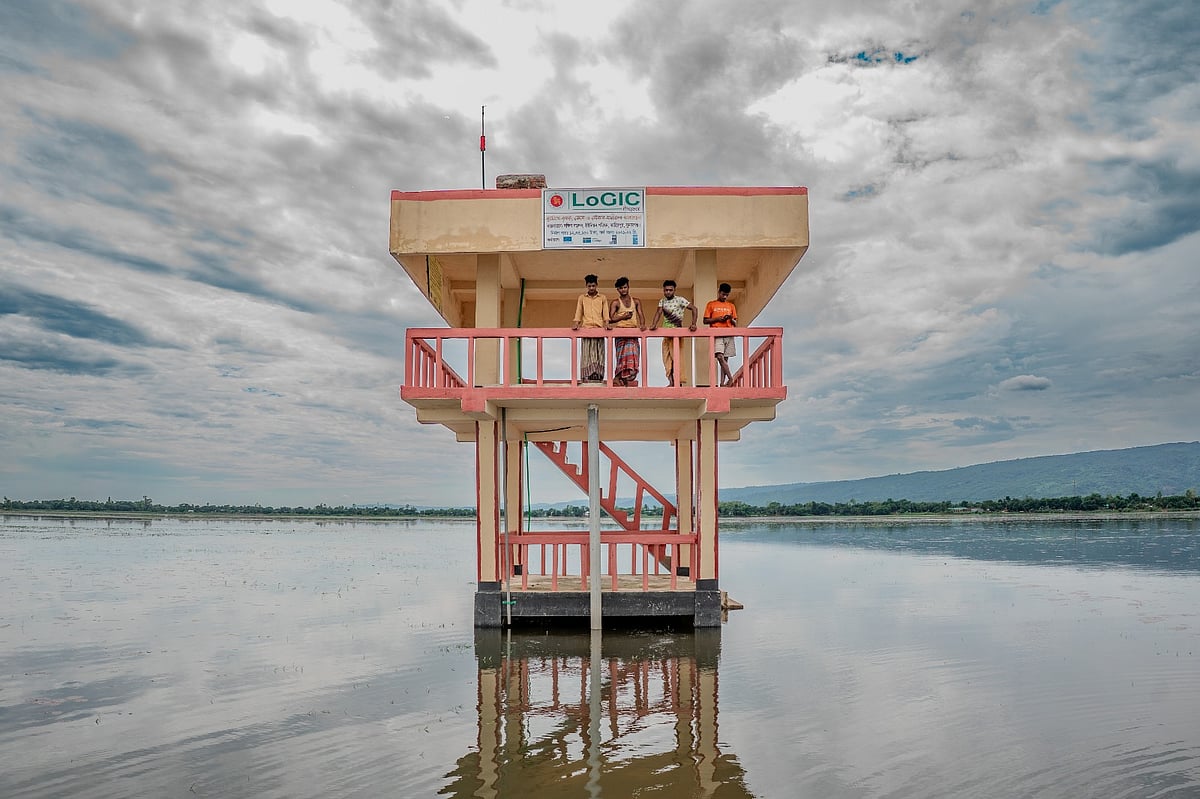
Lightning shelters: beacons of hope
Due to climate change, Bangladesh has seen a rise in lightning strikes and related deaths, especially among farmers, day labourers, and young men working in open fields.
Since her marriage, Afiya Begum of Rafinagar Union in Sunamganj used to panic whenever storms approached. Her husband and sons often went fishing or farming in the haor wetlands. She had witnessed neighbours die from lightning strikes. Now, she feels safer. Lightning protection towers have been installed in her area, and many people take refuge there during storms.
“We’re not scared anymore,” Afiya said. “My sons can fish at night and farm during the day because they know there’s a safe shelter nearby.”
The LoGIC project built 21 lightning shelters in Sunamganj equipped with clean water and lightning protection. These shelters have helped residents survive flash floods and storms, reducing waterborne diseases and deaths. The availability of safe nearby shelters has strengthened both safety and confidence in the community. Awareness billboards have also improved local disaster preparedness.
Early warning saves lives
Before, Amena Begum of Patuakhali didn’t understand what cyclone warnings meant. When storms hit, she would flee in anyway she could. These coastal districts have suffered devastating cyclones—Amphan, Remal, Sidr—that caused massive deaths, many of which could have been prevented through proper early warning systems.
Thanks to the LoGIC project’s signal towers, Amena now receives alerts ahead of time and can prepare and move to safety. “This tower has really helped,” she said. “We know in advance when a storm is coming. We can grab our children’s books and our belongings. Before, we couldn’t save anything.”
Timely evacuation can mean the difference between life and death. In coastal and flood-prone areas, early warning towers jointly operated by communities and local administration use sirens and light signals to alert people—even where television, radio, or mobile networks are unavailable. These towers also help guide fishing boats at night. LoGIC has installed three early warning systems in Patuakhali and distributed safety equipment in Barguna, Patuakhali, and Bhola, further strengthening local preparedness.
Building resilient infrastructure
In the haor wetlands, sudden floods frequently destroy crops, homes, and livelihoods. LoGIC has constructed 74 guide walls to protect roads and 46 embankments to protect villages in Kurigram, Bhola, Barguna, Patuakhali, and Sunamganj. These infrastructures have reduced losses and encouraged people to reinvest in homes and farming.
To ensure safer evacuation during cyclones and floods, 136 km of roads, bridges, and ghats have been built or repaired to help women, children, and the elderly reach shelters quickly. Gender-sensitive water and sanitation facilities were set up in 35 shelters to protect public health. Ten shelters were renovated in Kurigram, Sunamganj, Patuakhali, Khulna, and Bhola, making them safer and more accessible.
Additionally, 118 culverts and 46 drains were built in Barguna, Patuakhali, and Bhola to reduce waterlogging. During disasters, shelters often serve as the last refuge for rural people. LoGIC’s focus on safe water and sanitation during emergencies has greatly reduced waterborne diseases. Special facilities were added for women, children, and people with disabilities.
Beyond physical improvements, these shelters and preparedness programmes have saved lives and built trust among communities, helping people face disasters with greater resilience.
Local action, global recognition
Supporting the lives and livelihoods of those most vulnerable to climate change is never easy. Yet, LoGIC’s initiatives are built around exactly that—empowering local communities to adapt and survive.
So far, 1,004 local adaptation projects have been successfully implemented since 2018 across 29 upazilas in nine districts. Communities now identify their own needs, choose solutions, and take part in implementation through Local Adaptation Plans of Action (LAPAs) aligned with the National Adaptation Plan (NAP 2023–2050).
For its innovative approach, Bangladesh’s LoGIC project received the Global Centre on Adaptation’s Local Leadership for Adaptation Champion Award in the category of Innovation in Developing Finance.
This recognition proves that even a small lightning shelter or community tower can save lives, protect livelihoods, and give people strength to endure an uncertain future.