Gazipur City Corporation
Dumping station being built inside protected forest
Construction of an STS began on 11 April by breaking the boundary wall of Bhawal National Park.
Studies show that in two decades, forest land and water bodies in Gazipur have declined by two-thirds.
After crossing Masterbari in Gazipur along the Dhaka–Mymensingh highway, the sal forest begins. Rows of sal trees stand tall, and groups of monkeys can be seen.
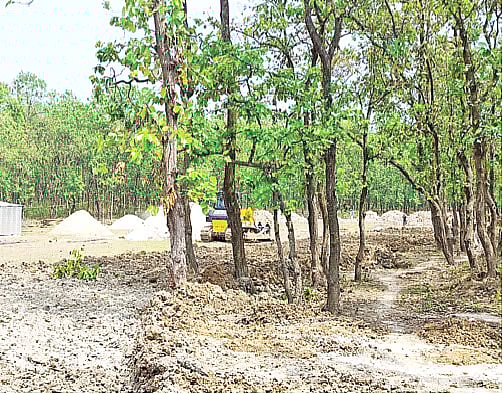
The forest is largely quiet. However, just before the main entrance to Bhawal National Park, that calm is broken by the sound of excavators. Visiting the site yesterday, Monday afternoon, this correspondent saw a paddy field surrounded by sal trees.
A newly built dirt road runs along one side of the field beside the highway, while a tin-shed structure stands on the other side.
Two excavators were digging the soil, while around 20 workers were piling it up. A young man was supervising the work from the shade of the forest nearby. He identified himself as Ifti but declined to give his full name.
Ifti said a Secondary Transfer Station (STS) would be built there. He is overseeing the work as a site supervisor on behalf of Gazipur City Corporation (GCC). An STS is a dumping station where waste collected from households is temporarily stored before being transported to a permanent landfill.
City corporation officials ignored objections from the Forest Department. No clearance was taken from the Department of Environment.
The sal forest of Bhawal National Park is one of the country’s important central forest areas. On 11 April, Gazipur City Corporation began constructing the STS inside the protected forest after breaking the park’s boundary wall.
The park is declared a protected forest under Section 20 of the Forest Act, 1927, where entry is restricted without permission from the Forest Department. However, GCC claims that the land where the facility is being built is privately owned and not under the Forest Department.
Under the Wildlife (Conservation and Security) Act, recently passed in the parliament, dumping and piling waste inside a national park is prohibited. The law also bans the establishment of industrial or commercial facilities and brick kilns within two kilometres of a park boundary.
When asked, MKM Iqbal Husain Chowdhury, divisional forest officer (wildlife management and nature conservation division) for the Dhaka region, told Prothom Alo that GCC is forcibly constructing a waste facility by breaking the park wall. “Such behaviour from a government institution is unwarranted,” he said.
The park is declared a protected forest under Section 20 of the Forest Act, 1927, where entry is restricted without permission from the Forest Department. However, GCC claims that the land where the facility is being built is privately owned and not under the Forest Department.
He added, “We spoke with the city corporation’s administrator and chief executive officer, but they did not stop the work. When we tried to intervene, they gathered hundreds of people and proceeded with construction after breaking the wall.”
Iqbal Hossain said the Forest Department has written to higher authorities seeking intervention and has informed the ministry of environment and forests.
In a letter sent on 15 April, the Forest Department said GCC had started dumping waste at the area near the park’s Gate 6 from early 2024. Exposure to this waste has been making birds and monkeys in the sal forest ill, while visitors suffer from foul stench. The department had earlier written to GCC’s chief waste management officer to stop dumping waste there.
On 23 January 2025, the Forest Department seized a GCC garbage truck after it was found dumping waste at night in the Baupara beat area of the park. The vehicle was later released after GCC pledged in court not to dump waste there again.
A 2023 study by the River and Delta Research Centre (RDRC) found that in Gazipur, forest land and water bodies have declined by two-thirds over the past two decades, alongside a rise in unplanned industrialisation and urbanisation.
According to GCC’s waste management division, around 3,000 metric tonnes of waste are generated daily in the city corporation area. Of this, only about 1,000 tonnes are collected, while the rest is dumped along roadsides.
Asked why the STS is being built inside the forest instead of selecting a suitable site, chief waste management officer at GCC, Md Sohel Rana said the land is privately owned.
The Forest Department noted that privately owned land exists within eight mouzas inside the park boundary. While agricultural activities are allowed there, a government notification issued on 6 December 2009 prohibits any construction on such land. The government had also initiated steps to acquire these lands, but the process stalled due to financial constraints.
When asked how construction is continuing in violation of the law, Sohel Rana declined to comment. Meanwhile, a team from the Department of Environment’s Gazipur office visited the site last Sunday.
When asked, Arefin Badal, deputy director of the Department of Environment’s Gazipur office, told Prothom Alo that under environmental law, both environmental and site clearance are mandatory for constructing an STS.
However, Gazipur City Corporation has not obtained any such clearance. He said, “Even if the land is privately owned within the forest, we have recommended in our report that the STS should not be built there.”
A 2023 study by the River and Delta Research Centre (RDRC) found that in Gazipur, forest land and water bodies have declined by two-thirds over the past two decades, alongside a rise in unplanned industrialisation and urbanisation. The district’s forest area decreased from 39,943 hectares in 2000 to 16,174 hectares in 2023.
Alamgir Kabir, general secretary of the Bangladesh Poribesh Andolon (BAPA), told Prothom Alo that constructing an STS inside a forest is unacceptable. He said the construction must be stopped immediately and that GCC should adopt alternative waste management measures.