Environment
Khulna in crisis as water bodies disappear: temperatures up, water level down
Royal Mor, one of the main hubs of Khulna city, is always bustling with activity, surrounded by major educational institutions, residential hotels, hospitals and a children’s park. Behind this busy urban scene lies a lost history—this very area once had several large ponds, bogs, and open green spaces. Elderly residents of the city still vividly remember those bodies of water.
Former treasurer of Khulna University, Mohammad Mazharul Hannan, also vividly recalls many of the city’s ponds. Reflecting on his childhood, he said, “Khulna was full of ponds. We never bathed at home. We would go from one pond to another. Beside Royal Mor, where the United Nations Children’s Park now stands, there used to be a huge pond called Tarer Pukur. We swam there, caught fish, and inter-school swimming competitions were held in that pond.
“There was a large pond beside Singher Math in Sheikhpara area. We used to jump in there after playing in the field. The Golokmoni Park near Dharmasava area was created by filling in a large pond. There were big ponds inside PTI and City Law College. None of those could be preserved,” he added.
Like Royal Mor, more than a hundred such ponds, reservoirs and low-lying water bodies have disappeared across various wards and neighbourhoods of Khulna city. In their place, multi-storey buildings, shops, cinema halls, bus stands and residential projects have been constructed there.
Residents say that the reduction of water bodies has led to waterlogging in Khulna even with light rainfall. During the dry season, nearly 50 per cent of the city faces water shortages. According to Khulna WASA, the groundwater level is falling by an average of six inches each year. Meanwhile, Data from the meteorological office shows that the highest temperature in Khulna has been increasing annually over the past decade.
Researchers say the loss of water bodies and green spaces is a key reason behind the water crisis and rising temperatures. Professor Abdullah Harun Chowdhury of the Environmental Science Discipline at Khulna University told Prothom Alo that the city’s temperature is steadily increasing with periods of extreme heat becoming longer due to the reduction of water bodies and greenery. In addition, the groundwater level is declining. As a result, most tube wells fail to produce water during the summer, creating a new crisis for city residents.
Water bodies disappearing one by one
Researcher Mahbub Siddiqi, in his book ‘Bangladesher Bilupto Dighi–Pushkorini–Jolashoy’, has presented information on more than a hundred lost water bodies across 80 locations in Khulna. On the other hand, Abul Kalam Samsuddin, in his book ‘Shohor Khulnar Adi-Parbo’, notes that the pattern of settlement in the city was once different—each household would establish a homestead with a pond, garden, and open space.
In 2024, the environmental organisation Bangladesh Environmental Lawyers Association (BELA) collected data showing that there were 171 ponds across 31 wards of Khulna. The organisation’s divisional coordinator in Khulna, Mahfuzur Rahman, said that there were once at least nine large ponds in the area where the modern Khulna railway station now stands. Now there are railway tracks and urban infrastructure.
Many ponds, including Golam Mawla’s pond on KDA Avenue, have been replaced by wide roads and tall commercial buildings. The main academic building of Khulna Collegiate School stands on the former Mariampara pond. Sangeeta Cinema Hall has been built over the pond at Sheikhpara intersection, and Hotel Royal has been constructed over Ananta Mallik’s pond. Many ponds still lie neglected, while some have turned into dumping grounds.
Around one-quarter of Khulna city is now experiencing excessive heat. Most areas of the city are now covered with buildings, roads and concrete. Over the past 30 years, built-up areas have increased by around 44 per cent, while vegetation has declined by around 38 per cent.
Khulna City Corporation’s chief planning officer, Md Abir Ul Jabbar, said that during the preparation of the master plan in 2012, there were around 3,600 public and private water bodies. Almost all private ponds have been filled up. Plans have now been taken to conserve and beautify 18 state or institution-owned ponds, and the design work for that has been completed.
A large share filled in and encroached upon illegally
The latest survey on water bodies by the Khulna Development Authority (KDA) was completed in 2025. The survey presents the current condition of locations identified as water bodies in the Detailed Area Plan (DAP) map.
According to KDA data, there were 298 water bodies across 31 wards of the city in the DAP map. Of these, 80 water bodies have completely disappeared. Another 27 have been partially filled. The rest are in a fragile state but somehow still survive.
A ward-wise analysis of KDA data shows that among the city’s 31 wards, Wards no. 1, 2, 3, 6, 9, 14, 16, and 17 each had between a minimum of 15 and a maximum of 33 water bodies. In several of the 31 wards, the extent of landfills is alarming.
For example, in Ward no. 17, in the mouzas of Chhoto Boyra and Baniakhamar, there were once 19 ponds. Now only seven remain. A total of 13 have been fully or partially filled. In Wards no. 13, 15, 18, and 24, the number of filled-in water bodies exceeds those that still exist.
KDA urban planner Tanvir Ahmed told Prothom Alo that, in the interest of sustainable urban development, environmental protection and resolving waterlogging, letters have been sent to the City Corporation and relevant authorities with details of the water bodies, urging necessary measures and effective initiatives to preserve those that remain.
Many people still do not realise that filling water bodies is a serious offence. If we receive complaints, we stop it. Often, filling takes place quietly and secretly, and such incidents do not come to our attention.Khondkar Md Fazlul Haque, director, Department of Environment’s Khulna divisional office
Laws exist, weak enforcement
The Bangladesh Environment Conservation Act, 1995 (amended in 2010), and the Mega city, Divisional Town and District Town’s municipal areas including country’s all the municipal areas’ playground, open space, park and natural water reservoir Conservation Act, 2000 state that filling ponds, reservoirs, ditches or any natural water body is prohibited and is a punishable offence by law. In practice, however, despite there being of laws, enforcement on the ground allegedly has long been weak.
According to the Khulna divisional office of the Department of Environment, there is no comprehensive record of how many water bodies have been filled so far in Khulna. However, there has been only one case filed over the filling of a water body. The case was filed in 2015 over allegations of an attempt to fill the 700-year-old Khan Jahan Ali Dighi in the Mujgunni area of the city.
Khondkar Md Fazlul Haque, director of the Department of Environment’s Khulna divisional office, said, “Many people still do not realise that filling water bodies is a serious offence. If we receive complaints, we stop it. Often, filling takes place quietly and secretly, and such incidents do not come to our attention. However, monitoring has now been increased. We try to take action as soon as we receive information.”
Md Babul Howlader, coordinator of Bangladesh Poribesh Andolon (BAPA) in Khulna, said there is a lack of coordination among KDA, KCC, the district administration and the Department of Environment. Due to this lack of coordination, negligence and, in many cases silence among government agencies, water bodies have been filled one after another.
Ponds turning into "mosquito breeding grounds"
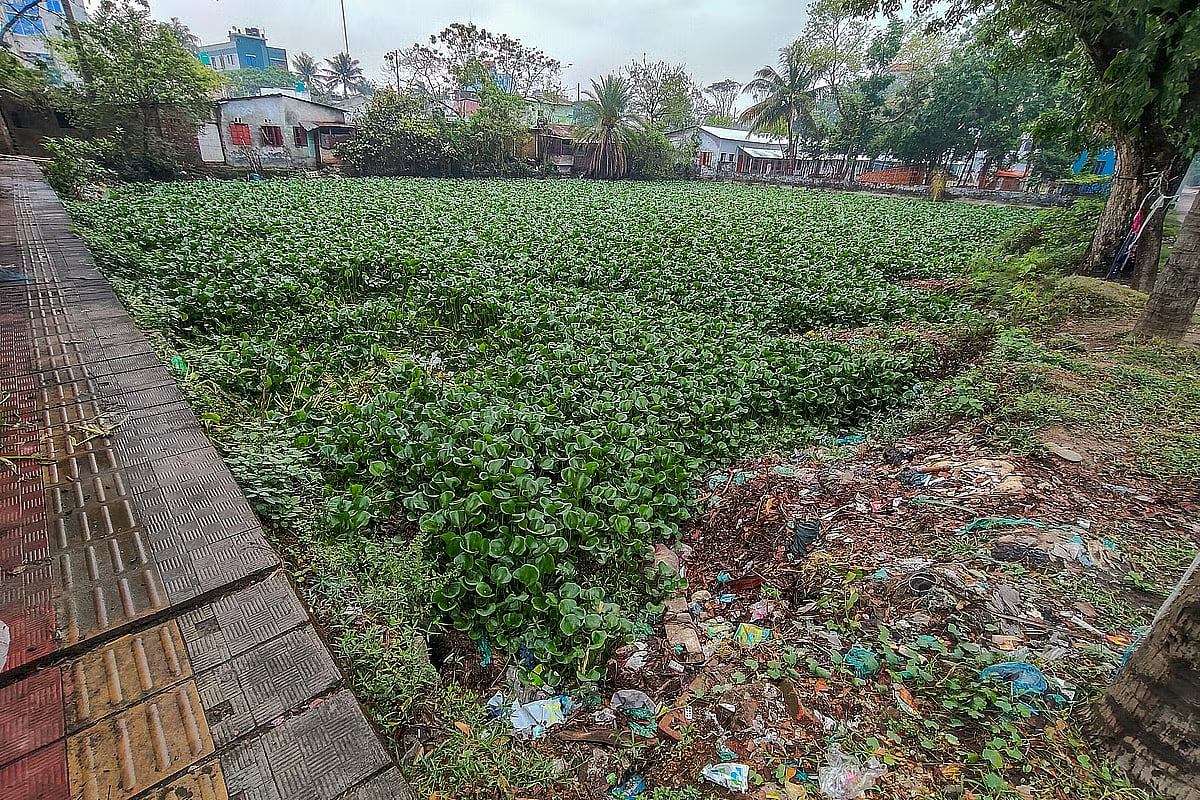
A recent visit to various sites in the city—including Nirala Dighi, Bhogir Dighi, Lions School pond, Notun Bazar, Andir pond, Bastuhara Park pond and ponds in the Pabla area—shows that in some places embankments are collapsing, in others ponds are partially filled in, elsewhere they are under pressure from encroachment, while in some cases the water bodies are covered with water hyacinth, obscuring the water itself.
Abu Sayeed, a resident of the Bhogir Dighi area, said people in the locality once used the pond for bathing. “Now there is some kind of dispute over ownership. The banks have been encroached upon. And covered with water hyacinth, it has now become a mosquito breeding ground.”
On the night of 28 March, during a public holiday, work was underway at the dead of the night to fill up a 90-year-old pond adjacent to Pabla Madhya Para Mosque. Following complaints from local residents, the filling was halted through the intervention of the Department of Environment.
Waterlogging and groundwater crisis
In recent years, even light rainfall has led to waterlogging in the city. Abdul Alim, a resident of Ward no. 9, said that around 70 per cent of the Boyra, Mujgunni, Bastuhara and Daulatpur areas were once wetlands. These have are landfills for housing projects, resulting in waterlogging even after a small amount of rain. Conversely, during the dry season, nearly 50 per cent of the area experiences water shortages.
According to Khulna WASA, even 10 years ago water could be extracted using tube wells at depths of 120 to 125 feet in the city. At present, that level has dropped to 130 to 135 feet. On average, the groundwater level is falling by about six inches each year.
Studies by Khulna University, KUET and other institutions show that there are three layers, or aquifers, of groundwater in Khulna. Due to high levels of salinity, iron and arsenic, water from the first layer has already become unsuitable for use. The second layer is also highly saline, limiting its usability.
Meanwhile, as it is not possible to extract water from the third layer using tube wells, residents are forced to use submersible pumps. This crisis becomes even more severe during the dry season. At the same time, more than half of the water supplied by WASA to its customers is extracted from underground sources.
Sardar Shariful Islam, deputy director of the Department of Environment’s divisional office in Khulna, told Prothom Alo that as water bodies have declined, more groundwater has to be extracted. “As a result, the empty spaces underground are increasingly being filled with saline water, raising salinity levels. This is becoming a serious risk.”
Temperatures rising every year
The impact of losing ponds and wetlands is not limited to water management it is also driving up temperatures in the city. Over the past 10 years, the maximum temperature in Khulna has increased by around 0.6 to 0.7 degrees Celsius annually.
According to data from the Khulna Meteorological Office, the highest temperature in 2015 was 36°C in May, which rose to 41.8°C in April 2024. During this period, the recorded temperatures were 36°C in 2015, 36.3°C in April 2016, 35.9°C in May 2017, 33.8°C in April 2018, 36.2°C in May 2019, 34.4°C in April 2020, 36.4°C in 2021, 35.2°C in 2022, and 36.7°C in 2023. However, in 2024 the temperature jumped sharply to 41.8°C.
A study titled ‘Urbanization induced heat wave risk assessment of Khulna City, Bangladesh: A 30-years analysis of land surface temperature, climate trends and forecasting’ found that over the 30 years from 1993 to 2023, the average land surface temperature increased by around 7 degrees Celsius.
Around one-quarter of Khulna city is now experiencing excessive heat. Most areas of the city are now covered with buildings, roads and concrete. Over the past 30 years, built-up areas have increased by around 44 per cent, while vegetation has declined by around 38 per cent, the study added.
Dhiman Kumer Roy, a member of the research team and head of the Department of Geology and Mining at the University of Barishal, said that this trend of land-use change is directly linked to rising urban temperatures. He warned that unless effective steps are taken now to increase greenery, conserve water bodies and restore them, Khulna could become a high heat-risk city in the future.