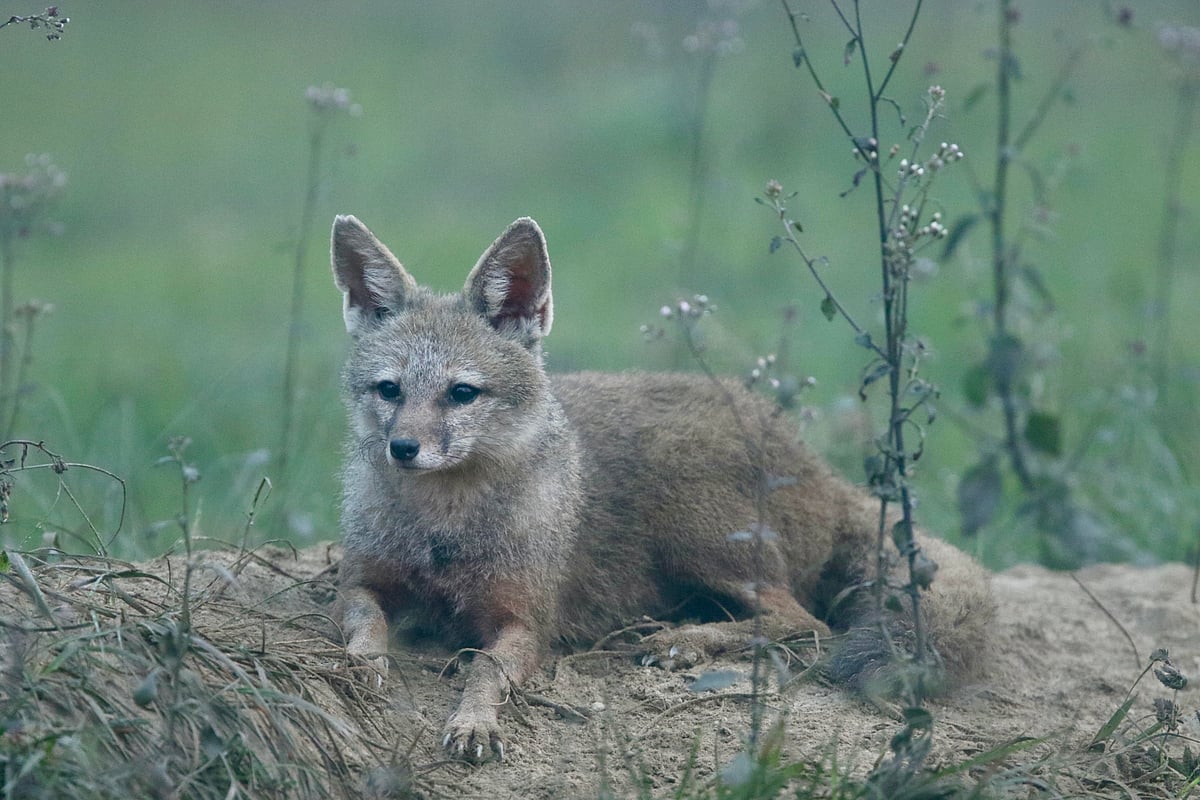
More than ‘chicken thieves’, Bengal foxes help protect nature and agriculture
Bengal foxes are often known simply as animals that prey on chickens. But research shows they play an important role in protecting agriculture and helping ecosystems cope with climate change. Rapid urbanisation, destruction of forests and the tendency to kill them indiscriminately, however, are pushing the species towards extinction.
In Panchagarh, a team of researchers spent three months monitoring a Bengal fox den in a quiet cemetery in Atwari upazila. Camera traps captured the animals’ daily lives, including their hunting, social interactions and efforts to protect their young.
The study, conducted by researchers from the Department of Zoology at the University of Dhaka and an expert from the University of Illinois, has revealed previously undocumented aspects of the Bengal fox’s behaviour.
A small carnivore, the Bengal fox weighs just 1.8 to 3.6kg and can grow up to 31 inches long. Its sandy-coloured body and bushy tail are distinctive. Once common across Bangladesh, the species is now listed as Vulnerable on the Bangladesh Red List of the International Union for Conservation of Nature (IUCN).
The species is now documented mainly west of the Jamuna and Padma rivers. Habitat destruction and human disturbance have pushed it into secluded areas. Climate change is adding to the threat. Rising temperatures and erratic rainfall are shrinking the grasslands and dry open areas of northern Bangladesh that the fox prefers. More frequent flooding can also inundate underground dens, putting cubs at risk during the breeding season.
3 months of camera-trap footage
The study was conducted from March to May 2024 around a Bengal fox den in a cemetery in Atwari, Panchagarh. Researchers analysed 12 hours and 18 minutes of video footage, comprising more than 4,500 video clips of Bengal foxes.
The research team included University of Dhaka assistant professor Muntasir Akash and researchers Md Rokonuzzaman, Sultan Ahmed and Mohammad Samiul Alam, along with Professor Dr Maximilian Allen of the Prairie Research Institute at the University of Illinois.
The study, titled “Den-Site Behavior of Bengal Fox (Vulpes bengalensis) Reveals Persistent Use, Social Interactions, and Co-Existence in Shared Spaces,” was published in the journal Ecology and Evolution, jointly published by the British Ecological Society and Wiley, in the first week of April this year.
Deputy Chief Conservator of Forests Rakibul Hasan Mukul told Prothom Alo that Bengal fox habitats are shrinking as forests are cleared to make room for human settlements. He described the situation as a major concern for ecological balance.
The Forest Department currently has no specific programme to protect Bengal foxes, he said. A project has been prepared, and if approved, it will include awareness programmes for local communities to protect Bengal foxes and other wildlife.
Life inside the den
The study found that Bengal foxes are highly loyal to their dens and become particularly active around them during the breeding season, with activity peaking in mid-April. Activity continues while the cubs are being raised but declines around May as the cubs grow.
Researchers recorded up to six foxes in a single den. They were most active around dawn and dusk, particularly between 4:30 am and 6:30 am and 6:00 pm and 8:00 pm. They rarely ventured outside during the day, possibly to avoid people and other predators.
Not just ‘chicken thieves’
The study found Bengal foxes to be skilled, opportunistic hunters with a varied diet.
Researchers identified the food consumed in 45 per cent of 540 camera-trap videos showing foxes feeding. Insects accounted for 19 per cent of the recorded diet, followed by birds at 18 per cent and rodents at 8 per cent.
Adult foxes often brought birds back for their cubs. During the cub-rearing season, they appeared to favour heavier prey to provide adequate nutrition.
The study found no evidence of the foxes eating snakes, plant matter or human waste, although such behaviour has been documented in a study in Odisha, India.
Cubs initially depend mainly on their mother’s milk. The footage captured mothers nursing their young. As the cubs grew, small animals and insects found near the den became their main food.
Termites were an especially important food source close to the den. In 16 videos, cubs were seen eagerly eating termites when swarms emerged from the ground. Researchers described them as an easily available and nutritious “near-den” food.
Social lives and interactions
Bengal foxes generally live alone outside the breeding season, making them difficult to observe. During cub-rearing, however, the parents stay together and become highly social.
The study documented 16 types of behaviour, including five major forms of social interaction. Of 425 relevant video clips, play between cubs and between cubs and their parents was the most common, appearing in 327 clips.
In 50 clips, foxes were seen greeting one another through tail movements, sniffing each other’s bodies and faces, making low sounds and lowering and trembling their bodies. Researchers believe these behaviours help foxes recognise group members and maintain social bonds.
In 21 clips, one fox was seen grooming another by biting, licking or scratching its fur. Five clips showed mothers nursing their cubs, while 13 clips showed cubs or adults climbing onto one another, which researchers consider a form of social dominance.
Researchers say play is more than entertainment: it strengthens social bonds among cubs and helps them develop skills needed for hunting and self-defence.
Conflict with Bengal monitor lizards
The camera traps recorded seven bird species around the den. Golden jackals appeared six times, dogs five times and humans 34 times.
One of the most striking findings was the regular presence of Bengal monitor lizards (guisap) around the fox den.
The study recorded Bengal foxes and Bengal monitors together in 447 video clips. In 16 clips, foxes charged at monitors and attempted to drive them away. In 31 clips, the foxes remained highly alert in the presence of monitors, while in only two clips did they retreat.
Previous studies in Gujarat and Andhra Pradesh have suggested that Bengal monitors may prey on Bengal fox cubs. A Gujarat study also recorded a Bengal monitor using a den abandoned by an Indian fox after the breeding season.
The conflict may be driven largely by competition over cubs and dens. Bengal monitors breed from April to October and may seek shelter in fox dens after the foxes' breeding season. They may also be attracted by leftover food around the dens.
Living alongside people
The researchers also observed the foxes’ ability to adapt to human activity. A paved road was just 20 metres from the den, yet the animals did not appear significantly disturbed by human movement or the presence of camera traps.
Each time they appeared in front of a camera trap, they continued moving around for at least two hours. This suggests that human activity near their dens may not greatly disturb them as long as people do not attempt to harm them.
Wildlife photographer and Bangladesh Animal Welfare Association convener Adnan Azad, who has closely observed Bengal foxes, told Prothom Alo that the animals are highly adaptable.
“They can live undisturbed near human settlements and even busy roads as long as there is no direct threat,” he said. “Human movement and camera traps do not appear to significantly affect their behaviour. They maintain a certain distance while continuing their normal activities, including feeding, resting and moving around. This shows that coexistence is possible if people are tolerant and do not try to harm them.”
Protecting the cubs
Adult Bengal foxes take several strategic measures to protect their young from predators and harsh weather. They raise their cubs in underground dens and remain highly attached to them during the breeding season, regularly guarding the area.
They constantly monitor their surroundings and become highly alert when they sense danger, lowering their bodies and raising their ears.
Golden jackals and domestic dogs can kill Bengal fox cubs, according to studies from central India. Although dogs and golden jackals were recorded in the Panchagarh study, the camera traps did not capture direct encounters between them and Bengal foxes.
The foxes appear to reduce the risk by being most active at dawn and dusk, when human activity and the presence of larger predators are lower. When necessary, they hide inside dens with multiple entrances.
New approach to studying den-dwelling animals
The Panchagarh study is notable for its research method. Although camera traps have previously been used to study the den-based behaviour of various carnivores, this is the first such study of Bengal foxes in the region.
Muntasir Akash told Prothom Alo that camera-trap studies have examined den-based behaviour in species such as red and grey foxes, including how they raise cubs, what they eat and how they respond to threats.
“But if we consider the Bengal fox, there has not been a single study like the Panchagarh research before,” he said.
Calls for conservation
Muntasir Akash and his team say Bengal foxes continue to survive in northwestern Bangladesh by sharing space with people. But rapid urbanisation, forest destruction and the indiscriminate killing of the animals are pushing the species towards extinction.
The study says government action alone will not be enough. Local awareness is also essential. Shrublands, small forests and quiet places such as cemeteries in rural areas provide important shelter for the animals.
Protecting these habitats and making people aware of the foxes’ role in controlling insects and rodents could help conserve the threatened species.
Akash said conservation efforts often begin only when a species faces an obvious and widely recognised threat. That approach needs to change, he said, pointing out that small carnivorous mammals that coexist with people are often taken for granted.
“We see at different times that these animals too can move towards extinction. Thailand’s large-spotted civet is one example,” he said.
Bengal foxes living around human settlements in Bangladesh have no protected areas. The study recommends protecting small village forests, fallow land and termite mounds as an effective conservation measure. Such habitats are rapidly disappearing, while rural forests are increasingly important in mitigating environmental and climate-change pressures.
Why foxes matter to farmers
The role of small carnivores such as Bengal foxes is becoming increasingly important amid climate change. Several studies have found that rodent reproduction has increased with global warming, while declines in small carnivorous mammals and snakes are among the factors behind growing rodent populations.
This increases farmers’ reliance on pesticides to protect crops. Bengal foxes, however, naturally control insects and rodents, reducing damage to farmland. Losing such natural predators could therefore increase the burden on farmers.
Jahangirnagar University zoology professor and wildlife researcher MA Aziz told Prothom Alo that the study shows Bengal foxes can live peacefully around human settlements if given adequate space and security.
“The role of this small wild animal in maintaining the balance of nature is undeniable,” he said. “When a species disappears from nature, an important link in the entire ecosystem is broken.”
Forest Department campaigns have often highlighted the financial benefits wildlife provides to farmers, but there had been little specific research to support those claims. The Panchagarh study underscores the point: protecting Bengal foxes can help maintain balance in farmland by controlling insects and rodents.
In the era of climate change, biodiversity protection and environmental conservation are inseparable. Protecting species such as the Bengal fox is ultimately about maintaining healthy ecosystems—and, in turn, protecting human interests.