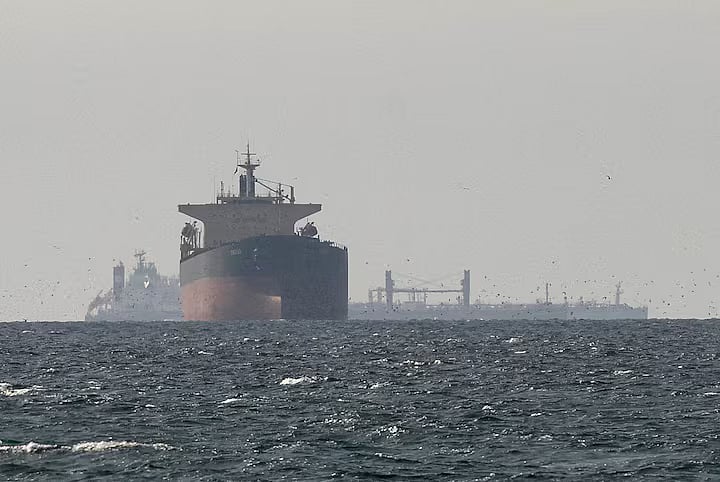
World anxious to open Hormuz Strait while Trump and Iran trade threats
Dozens of countries sought ways to restart vital energy shipments through the Strait of Hormuz on Thursday after US President Donald Trump vowed more aggressive attacks on Iran, sending oil prices higher again and deepening strain on consumers.
After speculation proved untrue that Trump might discuss ending the war in a speech on Wednesday, the president persisted with threats on Thursday, saying in a social media post, "IT IS TIME FOR IRAN TO MAKE A DEAL BEFORE IT IS TOO LATE".
He also posted video of the US bombing a newly constructed bridge on Thursday between Tehran and the major northwest suburb of Karaj. The B1 bridge was scheduled to open to traffic this year. According to Iran's state media, eight people were killed and 95 others were wounded in the US attack.
"Striking civilian structures, including unfinished bridges, will not compel Iranians to surrender," Iran Foreign Minister Abbas Araqchi said in a statement.
In the speech on Wednesday night, Trump repeated his threats against Iran's civilian power plants and gave no clear timeline for ending hostilities, drawing vows of retaliation from Iran and depressing share prices.
"We're going to hit them extremely hard over the next two to three weeks," Trump said amid mounting domestic pressure to end the conflict. "We're going to bring them back to the Stone Ages where they belong."
Nearly five weeks after it started with a joint US-Israeli aerial assault, the war in Iran continues to spread chaos across the region and roil financial markets, raising the pressure on Trump to find a quick resolution to the conflict.
Britain chaired a virtual meeting on Thursday of some 40 countries to explore ways to restore freedom of navigation that did not produce any specific agreement, although participants agreed that all nations should be able to use the waterway freely, one official said.
Iran has effectively shut down the Strait of Hormuz, which normally carries about a fifth of the world's total oil trade, in retaliation for US-Israeli attacks that began on 28 February. The war has caused an increase in oil prices, inflation concerns, supply-chain problems and worries about the impact on the global economy.
Tehran offered a competing vision for future control of the strait, and said it was drafting a protocol with neighboring Oman that would require ships to obtain permits and licenses.
"These requirements will not mean restrictions, but rather to facilitate and ensure safe passage and provide better services to ships that pass through this route," Deputy Foreign Minister Kazem Gharibabadi said, according to the official IRNA news agency.
An Iranian military spokesperson said the strait would remain closed "long term" to the US and Israel.
The European Union's foreign policy chief Kaja Kallas pushed back against Tehran's plan, saying Iran cannot be allowed to charge countries a bounty to let ships pass. "International law doesn't recognise pay-to-pass schemes," wrote Kallas on social media.
Oil Hits $108
Benchmark Brent crude prices jumped by about 7 per cent to around USD 108 per barrel, US bond yields spiked and global equity markets gave back gains.
"The key question in all investors' minds is 'When is this going to be over?'" said Russel Chesler, head of investments and capital markets at VanEck Australia.
Trump in Wednesday's speech told countries that rely on fuel shipments through the Strait of Hormuz to "just grab it".
However, European and other states have said they will only help secure the strait if there is a ceasefire.
"It can only be done in consultation with Iran," French President Emmanuel Macron said.
Iran Threatens More Attacks
Iran's armed forces responded to Trump with a warning of "more crushing, broader and more destructive" attacks in store.
The war will continue until the "permanent regret and surrender" of Iran's enemies, said Ebrahim Zolfaqari, spokesperson for the Iranian military's Khatam al-Anbiya central headquarters, in a statement carried by Iranian media.
Iran's Fars news agency later listed several bridges in Saudi Arabia, Kuwait, Abu Dhabi and Jordan, which host US military bases, as potential targets for Iran's military in response to the US attack on the B1 bridge. The Revolutionary Guards said they had targeted an Amazon cloud computing centre in Bahrain.
There are fears the conflict may leave Iran with a stranglehold over Middle East energy supplies now that it has shown that it can block the Strait of Hormuz by targeting oil tankers and attacking Gulf countries hosting US troops.
Gulf states say they reserve the right to self-defence but have refrained from responding militarily to repeated Iranian attacks over the past month, seeking to avoid escalation into a far more devastating all-out Middle East war.
Iran's parliament was reviewing a bill that would formalise the blocking of vessels from hostile countries passing through the strait and the charging of tolls for others wishing to pass, spokesperson Abbas Goodarzi said.
Strike on Iran Bridge Kills 8
Thousands of people have been killed and tens of thousands injured across the Middle East since the war began, with the head of the International Federation of Red Cross and Red Crescent Societies delegation saying on Thursday that medical needs were rising exponentially and supplies could run low.
Sirens and the booms from interceptors rang out over Jerusalem after the Israeli military said it had identified the launch of a missile from Yemen toward Israel.
Yemen's Iran-aligned Houthis first claimed an attack on Israel at the end of March, as the conflict with Iran has expanded across the region.
Fuel shortages have already caused economic strains across Asia and are expected to bite in Europe soon, while a report by two UN agencies warned a sharp economic slowdown could spark a cost-of-living crisis in Africa.