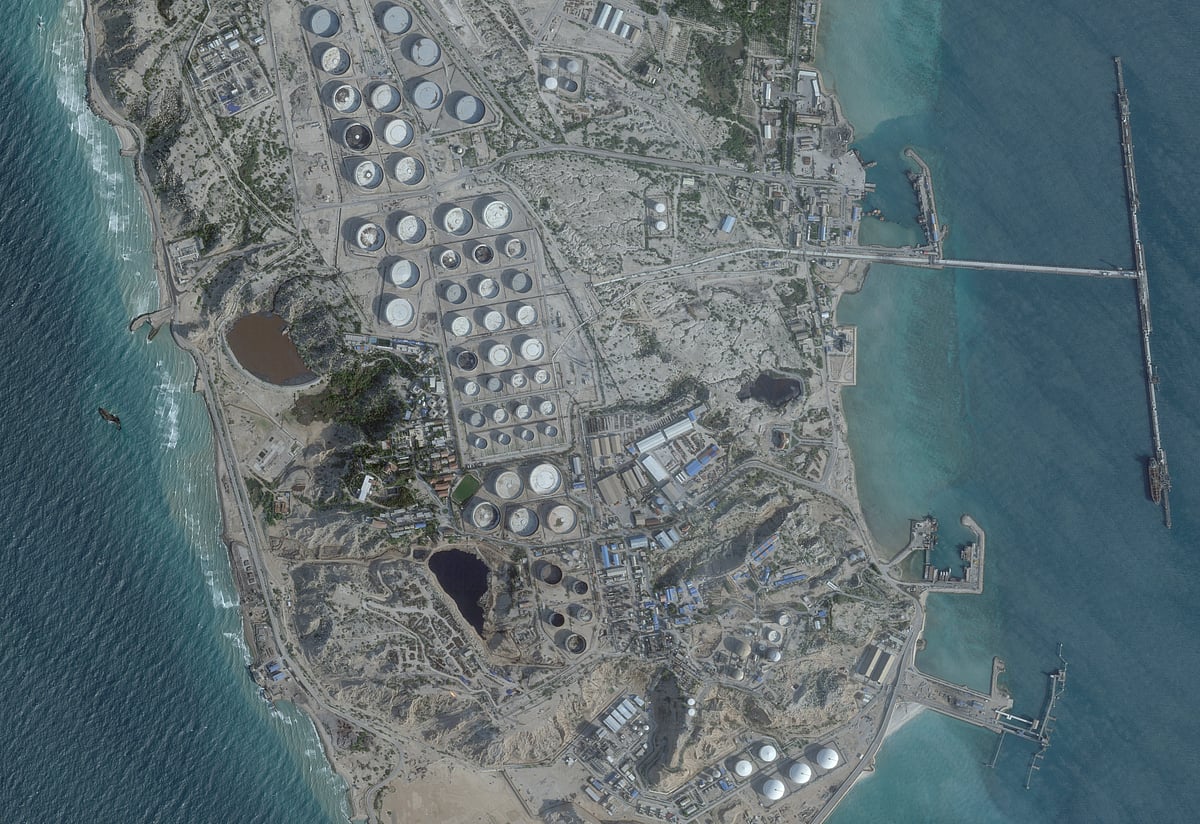
US bombed military sites on Kharg Island vital to Iran's oil network
The United States on Friday destroyed military targets on Iran's main oil hub of Kharg Island, President Donald Trump said, threatening to strike its oil infrastructure if Iran continues attacks that have halted most ship traffic in the Strait of Hormuz.
The island serves as the export terminal for 90 per cent of Iran's oil shipments. In a social media post, Trump wrote the U.S. military "totally obliterated every MILITARY target" on Kharg while leaving oil infrastructure intact.
"However, should Iran, or anyone else, do anything to interfere with the Free and Safe Passage of Ships through the Strait of Hormuz, I will immediately reconsider this decision," Trump wrote, a warning that could further roil markets already dealing with what the International Energy Agency has called the biggest oil supply disruption in history.
Iran had no ability to defend against U.S. attacks, the president added. "Iran’s Military, and all others involved with this Terrorist Regime, would be wise to lay down their arms, and save what’s left of their country, which isn’t much!" he said.
Oil prices have been whipsawing on Trump's changing comments on the likely duration of the Iran war, which has prompted Iran to attack vessels in the strait, the conduit for a fifth of the world's oil. Although he has previously said the war would last only weeks, the president on Friday declined to publicly project an end date for the conflict.
"I can't tell you that," Trump said to reporters. "I mean, I have my own idea, but what good does it do? It'll be as long as it's necessary."
Kharg is 16 miles (26 km) from Iran's coast, about 300 miles (483 km) northwest of the Strait of Hormuz. Iran continued to export crude oil while other producers in the Gulf halted their shipments due to fear of Iranian attacks.
Multiple very large crude oil tankers were loading at Kharg Island on Wednesday, according to satellite imagery reviewed by TankerTrackers.com. Iran exported between 1.1 million barrels per day and 1.5 million bpd from February 28 when the war began to Wednesday.
Markets will watch closely for any sign the U.S. strikes damaged the island's intricate network of pipelines, terminals and oil storage tanks. Even minor disruptions could further tighten global supply, adding pressure to an already volatile market.
Bob McNally, president of Rapidan Energy Group, said Trump's comments on Friday "will focus the market's mind on pathways that this energy disruption, already history's largest, could expand and last longer."
Some energy industry observers expressed doubts that Kharg's oil facilities would stay intact.
“Bombing Kharg Island but not the oil infrastructure is like going to McDonald's and getting a hamburger with no meat,” said Josh Young, chief investment officer at Bison Interests. "What's the point?"
Iran's new leader vows to keep strait shut
Iran's new supreme leader, Mojtaba Khamenei, in his first public comments on Thursday, vowed to keep the Strait of Hormuz shut and urged neighbouring countries to close U.S. bases on their territory or risk being attacked themselves.
Trump said on Friday the U.S. Navy will "soon" start escorting tankers through the Strait of Hormuz.
European powers are trying to work out how to defend their interests, and France has been consulting with European, Asian and Gulf Arab states over the past week with a view to putting together a plan for warships eventually to escort tankers through the strait, French officials said.
With gasoline and diesel prices rising at pumps in the United States and around the world, the U.S. on Thursday issued a 30-day licence for countries to buy sanctioned Russian oil and petroleum products already at sea.
The move was welcomed in Moscow but left Kyiv and its allies angry that the proceeds could help the Kremlin fund its war effort in Ukraine.
"Six members of the G7 expressed a very clear opinion that this was not the right signal," German Chancellor Friedrich Merz told a press conference in Norway. "We then learned this morning that the American government has apparently decided otherwise."
Ukrainian President Volodymyr Zelenskiy said the move could provide Russia with $10 billion, adding: "It certainly does not help peace."
War on Iran extends across Middle East
After nearly two weeks of war, 2,000 people have been killed, most in Iran, but many in Lebanon and a growing number in the Gulf, which has for the first time in decades of Middle East conflicts found itself on the front line.
Several million people have been displaced from their homes. As Israeli warplanes pounded Beirut's suburbs with air strikes, Lebanon's interior minister said authorities were unable to accommodate the hundreds of thousands of people who have sought refuge in the capital.
Israel also dropped leaflets threatening Gaza-scale devastation as it deployed more troops to fight Iran-backed Hezbollah and warned of more attacks on Lebanon's infrastructure.
U.S. forces have also suffered casualties. The U.S. military confirmed that all six crew members aboard a refuelling aircraft that crashed in western Iraq were dead.
Iran fired more missiles and drones at Israel, and Iranian drones were reported flying into Kuwait, Iraq, the United Arab Emirates, Bahrain and Oman.
The Israeli military launched strikes across Tehran. It said its air force had struck more than 200 targets in western and central Iran over the past day, including ballistic missile launchers, air-defence systems and weapons production sites.
The U.S. was sending additional forces to the region, including the USS Tripoli along with its Marine expeditionary unit, two U.S. officials, speaking on the condition of anonymity, said. The amphibious assault ship, currently in Asia, is capable of carrying fighter jets. In total, 2,500 additional Marines will be sent to the Middle East, along with additional sailors.