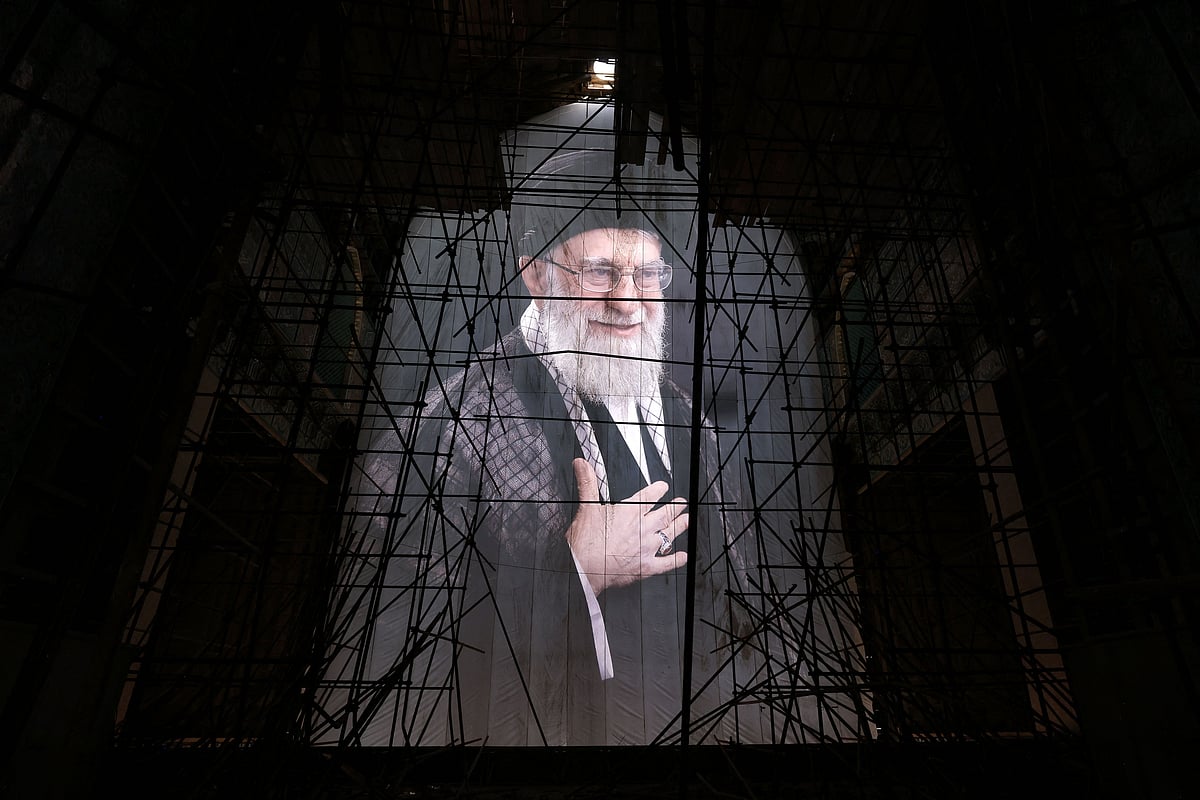
Prayers offered for Iran's Khamenei on day two of funeral ceremonies
Prayers were held Sunday over the casket of Iran's late supreme leader Ali Khamenei, the second day of funeral ceremonies that have drawn huge crowds to pay their final respects in Tehran.
Khamenei ruled the Islamic republic from 1989 until he was killed aged 86 in an airstrike on the first day of the US-Israeli war with Iran on 28 February.
Sunday's service at Tehran's Grand Mosalla complex was led by prominent Shia cleric Ja'far Sobhani, a 97-year-old scholar who teaches in seminaries at the holy city of Qom.
Khamenei's son and successor Mojtaba Khamenei, who is said to have been wounded in the 28 February attack, has not appeared in public since being named supreme leader and was notably absent from the funeral prayers.
The late supreme leader's other three sons, Masoud, Mostafa and Meysam, were in attendance.
Sunday was declared a public holiday across Iran, and later in the day, Khamenei's body will be moved from the Grand Mosalla complex where it is lying in state in preparation for processions through the capital on Monday.
The vast religious complex and surrounding streets were packed with mourners on Sunday morning, AFP journalists saw.
With temperatures set to exceed 35C, mourners carrying Iranian flags and portraits of Khamenei, as they made their way to the Grand Mosalla, were handed refreshments.
President Masoud Pezeshkian attended the ceremony alongside senior officials including parliament speaker and Iran's chief negotiator Mohammad Bagher Ghalibaf, state television footage showed.
Khamenei's coffin, draped in the Iranian flag and topped with his black turban, was placed alongside the coffins of four relatives also killed in the February strikes, including an infant granddaughter.
Authorities have said they expect more than 10 million people to take part in ceremonies in Tehran.
Allies in attendance
After five weeks of intense hostilities, the Middle East war is on hold after a ceasefire and an initial accord with the US. But both Washington and Tehran have warned they are ready to resume fighting at any time.
Khamenei's funeral is being viewed outside Iran as a test of support for the government following mass protests before the war in January that rights groups say were quelled by a crackdown that left thousands dead.
"What is observed today in the emotions, tears, and passionate presence of the people in various scenes is the most telling sign of his position among the Iranian nation and the free people of the world," Pezeshkian said in a speech Saturday, accusing Israel in particular of acting as a "destabilising factor" in the Middle East.
"Muslims have shown that they will not surrender to oppression and bullying," he added.
Khamenei had long pursued a course of confrontation with the West, and Tehran for years has provided support to anti-US and anti-Israel armed groups around the region, including Palestinian Hamas and Lebanon's Hezbollah.
Delegations from both groups met with Foreign Minister Abbas Araghchi on Saturday, state media reported, while representatives of Yemen's Houthi rebels and Hamas ally Palestinian Islamic Jihad were also in attendance at the funeral.
After Monday's procession, Khamenei's coffin will be moved on Tuesday to Qom, then on Wednesday to neighbouring Iraq, before the burial on Thursday in his northeastern hometown of Mashhad.
Significant security measures have been imposed in the capital, and official media has warned attendees of the risk of crowd crushes.
Organisers have also taken measures to mitigate a heatwave that may nudge 40C in Tehran over the next few days, with crowds on Saturday sprayed with mists of water to keep cool at the Grand Mosalla complex.