What is art, really? And who is an artist? Why does art often seem difficult to understand, almost like a distant world, to ordinary people? Are artworks meant only to be displayed on gallery walls and admired in the living rooms of wealthy collectors? Or can ordinary people experience and appreciate art in their own way, standing before an artwork and discovering its meaning through their own experiences and perceptions?
These questions often come to mind when thinking about the relationship between art and people. Art Dhaka 2026 brought me face to face with them once again. I would not describe myself as an art insider. However, my long engagement with fashion, design, heritage and different forms of creativity has naturally nurtured an interest in the subject. Yet the experience Art Dhaka offered went far beyond simply looking at artworks. It made me realise, in a new way, how vibrant and multidimensional an art event can be, and how it can become a centre of public interest.
Held at Aloki in Dhaka from 6 to 10 November, Art Dhaka 2026 was Bangladesh’s first commercial art fair. Under the theme ‘Art for All’, it brought together modern and contemporary art, heritage, installations, printmaking, performances and a range of artistic experiences within a single space. But the significance of the event went beyond the diversity of its offerings. It was also an attempt to introduce people to art in a new way.
Connections begin with looking
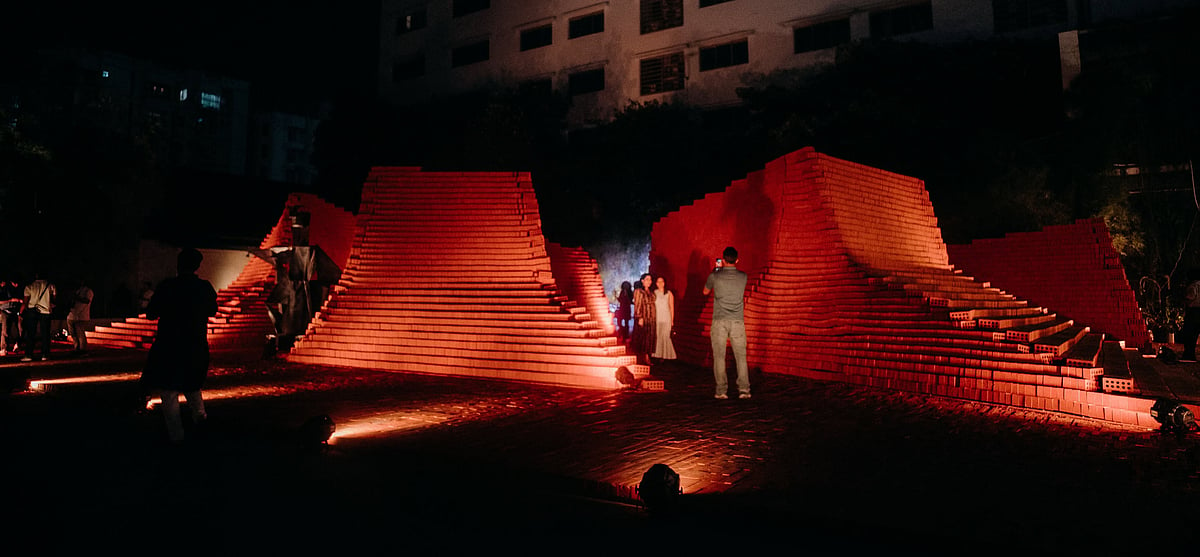
I visited Art Dhaka around midday on its final day. In the parking area, I noticed an elderly woman standing in front of an installation inspired by the architecture of Paharpur. She was walking around it, looking closely and taking photographs. She even took a photograph of herself. I was struck by her interest.
As I was leaving, I noticed another elderly woman standing in front of the same installation. She, too, was looking at it and taking photographs. They were two entirely different people. I had seen one on my way in and the other on my way out. Yet the two moments seemed connected. It felt as though a circle had somehow been completed.
I have no idea whether either of them has any regular engagement with art. But the installation had made them pause; it had aroused their curiosity. Perhaps it was the architectural form, a familiar cultural reference or simply its aesthetic appeal that drew them in. Whatever the reason, they stopped, gave it their time and captured the moment in their own way.
For me, this small experience was one of the most meaningful aspects of Art Dhaka. There is no obligation to understand everything about art. Sometimes, simply looking can be the beginning of an emotional response. A connection between an artwork and its viewer can emerge without any prior knowledge or preparation.
When curating creates a new way of seeing
The success of an art event depends considerably on its curation. The selection, arrangement and presentation of artworks, along with the conceptual flow that guides visitors from one exhibition to another, are what give an event its distinct character.
One of the aspects I particularly appreciated about Art Dhaka was the way its exhibitions were curated. ‘Narration. Thought. Chronicles’ and ‘The Still Point’ presented two distinct approaches, offering visitors different ways of experiencing art. Curated by Jihan Karim, ‘Narration. Thought. Chronicles’ explored layers of personal experience, memory and history. Meanwhile, ‘The Still Point’, curated by Nazmun Nahar Keya, offered a different reading of time, experience and artistic language through the works of artists devoted to their practice over many years.
However, the exhibition that particularly stood out for me was ‘Leaping Across Time’, curated by Mustafa Zaman. It offered an opportunity to view the evolution of modern art in Bangladesh through a broad historical perspective. From Shilpacharya Zainul Abedin’s 1943 famine sketches to the sculptures of Novera Ahmed, the emergence of subsequent generations of artists and the rise of women artists during the 1970s and 1980s, the exhibition brought together a long journey of Bangladeshi art.
By placing works from different periods alongside one another, the exhibition made it possible to experience the evolution of modern art in Bangladesh as a continuous journey. Artistic subjects, forms of expression and mediums have changed over time. Each generation has developed its own artistic language, reflecting the society, experiences and realities of its time. Yet, alongside these changes, the continuity of artistic practice was also evident. For me, one of the exhibition’s greatest achievements was the opportunity to experience this journey in one place.
Standing before works by artists such as Zainul Abedin, SM Sultan, Kamrul Hassan, Safiuddin Ahmed, Mohammad Kibria, Shahabuddin Ahmed and Monirul Islam was a particularly significant experience. There is a difference between reading about art history in books and standing before an artist’s original work, experiencing its lines, colours and expressions firsthand. For younger generations especially, such exhibitions offer a direct encounter with the history of art.
The arrangement and presentation of these celebrated artists’ works were so aesthetically compelling that the entire wall seemed to become another canvas.
Good curation does more than show artworks to visitors; it creates a new way of seeing. I felt that Art Dhaka had made a sincere effort in this regard.
As I moved from one artwork to another, I found myself forgetting the world outside for a while. Whether I understood everything or not, I was immersed in the experience of looking. Sometimes I stood before a particular artwork; at other times, another presentation drew me in. At one point, it felt like a conversation—a conversation between the exhibition and its visitors, between the artist and me. The artist may have expressed an idea in their own way, while I searched for my own understanding within it.
Rituparna Saha’s ‘The Land Within’ series particularly caught my attention. She used upcycled textiles and naturally dyed fabrics. Through the combination of stitching and fabric manipulation, the works developed a distinctive visual language. I found the use of materials and the processes behind them thought-provoking. Mujahid Musa’s ‘Uncertain Belongings’ and ‘The Elsewhere Within’, Ripon Saha’s works, as well as those by Sadatuddin Ahmed Emil, among many others, held my attention for a considerable time. On the other hand senior artist Tayeba Begum Lipi's work was aof course thought provoking.
It was fascinating to see how artists from different generations are thinking in such diverse ways. Through new materials and techniques, they are challenging established artistic languages and expanding the boundaries of our perception.
The connection between art, heritage and craft
Another aspect of Art Dhaka that made me reflect was the relationship between art and our heritage and crafts.
‘The Pavilion’, designed by architect Rashed Chowdhury, deserves mention in this context. Moving away from the conventional idea of a gallery defined by white walls, it drew on Bangladesh’s architectural and material heritage. Bricks, architectural references to Paharpur, the traditional earthen stove and inspirations from Jamdani patterns came together in the creation of a temporary structure. The plan was to dismantle it after the event and reuse its materials.
This presentation opened a broader conversation. We often regard fine art and crafts as two separate worlds. Yet both involve creativity, aesthetics, the use of materials and distinct forms of expression. Just as an artist communicates ideas through canvas, colour or sculptural materials, a craftsperson develops an artistic language through clay, thread, wood or metal.
The skills and knowledge of craftspeople cannot be confined to production techniques alone. Every motif, weave and process of making embodies artistic sensibility, creativity and knowledge shaped by generations of experience.
The creativity found in the motifs, designs and weaving of a Jamdani sari, or the transformation of clay in the hands of a potter, is also part of our aesthetic heritage.
The contemporary use of traditional materials and motifs in the Art Dhaka pavilion offered an opportunity to reconsider this relationship. Similarly, the installation ‘Protibesh’ drew attention to potters and their skills, which are gradually disappearing because of urbanisation. It also raised an important question: what place do traditional occupations and crafts have in a rapidly changing city?
Another significant contribution to this architectural expression of art was Marina Tabassum Architects’ installation, The Other Side of the Wall. Centred on the boundary walls lining Dhaka’s footpaths, the work invites viewers to rethink the city’s public spaces. It raises questions about how walls designed to secure private properties can make urban life increasingly hostile for pedestrians and street vendors. The installation also encourages reflection on the extent to which human needs and inclusivity are being considered in urban planning.
I believe there is considerable scope for a closer relationship between art and craft in the future. An exchange between the creativity of crafts in the world of art and the contemporary language of art within the world of craft could further enrich our cultural identity.
Expanding the language and mediums of art
As I walked around Art Dhaka, I felt that artistic expression was not confined to any single medium. Whether through painting, sculpture, printmaking, installation or mixed media, artists were exploring new ways to communicate their ideas.
The print pavilion titled ‘The Art of Access’, curated by Fareha Zeba, was an important addition to the event. It presented 170 works by 100 artists from different generations. With prints starting at Tk 5,000, it offered relatively accessible opportunities for new collectors to acquire artworks. The ‘Make Plate, Take Print’ section also allowed visitors to experience the process of creating an image and printing it themselves.
This brought an important aspect of the art world into focus: the opportunity to collect artworks should not remain limited to established or affluent collectors. There must also be pathways for new collectors to emerge.
Meanwhile, the works of contemporary artists explored themes such as nature, the environment, the human body, identity, personal memory, power and the challenges of urban life. These works went beyond aesthetics. They also reflected the artists’ engagement with their time and society.
Art for all: How accessible is it really?
The theme of the event was ‘Art for All’. But an equally important question is how far from this aspiration to make art accessible to everyone was realised in practice.
Admission was priced at Tk 350 on weekdays and Tk 500 on holidays. Students were offered a special weekday admission rate. Even so, it is worth considering how affordable these prices were for students and ordinary visitors who wanted to discover art for the first time.
After all, making art accessible to everyone means more than simply opening the doors of an exhibition. It means creating opportunities for people to build a lasting relationship with art.
Alongside established artists and galleries, more space needs to be created for artists from outside Dhaka, self-taught artists and relatively lesser-known creative practitioners. Building an art market is important, but so are nurturing new collectors, expanding art education and encouraging greater public interest in art. Hopefully, the organisers will consider these aspects in future editions.
Viewing art also requires a certain level of engagement from the audience. It takes time to stand before a work, observe it attentively and develop the habit of reflecting on it in one's own way. Visitors should also be mindful that photography and selfies do not disrupt the experience of others. Developing a culture of attentive art viewing among younger generations is equally important.
Art is not merely a visual pleasure or an intellectual pursuit; it can also be an element of our wellbeing. Visiting an event like this can lift one's spirits, fill the heart and offer a welcome break from the monotony of everyday life. Every exhibition has the potential to create new ripples in our otherwise still lives—sometimes through joy, sometimes by raising questions, and sometimes simply by offering the experience of seeing something new. In this way, art can contribute to our wellbeing and, at times, become a source of healing.
A five-day event, or the beginning of a longer journey?
According to figures released by the organisers, more than 7,000 visitors attended Art Dhaka over five days. More than 130 artists participated. For a first edition, this response is certainly encouraging. However, the success of an art fair cannot be measured solely by visitor numbers or the volume of artwork sold. Its real significance will be determined by its ability to create a long-term market for artists, nurture new collectors, expand art education and broaden the space for artistic practice.
Special programmes for school, college and university students, workshops, participatory activities, and longer exhibition hours and duration are some of the possibilities worth considering in the future. It is important to create opportunities for people to engage with art regularly rather than limiting their exposure to a single event.
Ultimately, I believe the greatest strength of art lies in its ability to make people pause. Sometimes it is a line, sometimes a colour, an installation or the use of a particular material that takes us, even briefly, into another world of thought. There is joy there, there are questions, and sometimes there is discomfort. Perhaps this personal conversation with art is its greatest gift.
When I entered Art Dhaka, I saw a woman standing in front of an installation. On my way out, I saw another woman in the same place. Two different moments, two different people. Yet, in my mind, the two scenes came together to complete a circle. Perhaps that is what art does: it makes some people pause, makes others think, and awakens curiosity in someone else. Not everyone needs to understand the language of art. But everyone should have the opportunity to approach it.
Art Dhaka opened a door to that possibility. The challenge now is to keep that door open and bring many more people along.
Photo: Art Dhaka's social media/writer