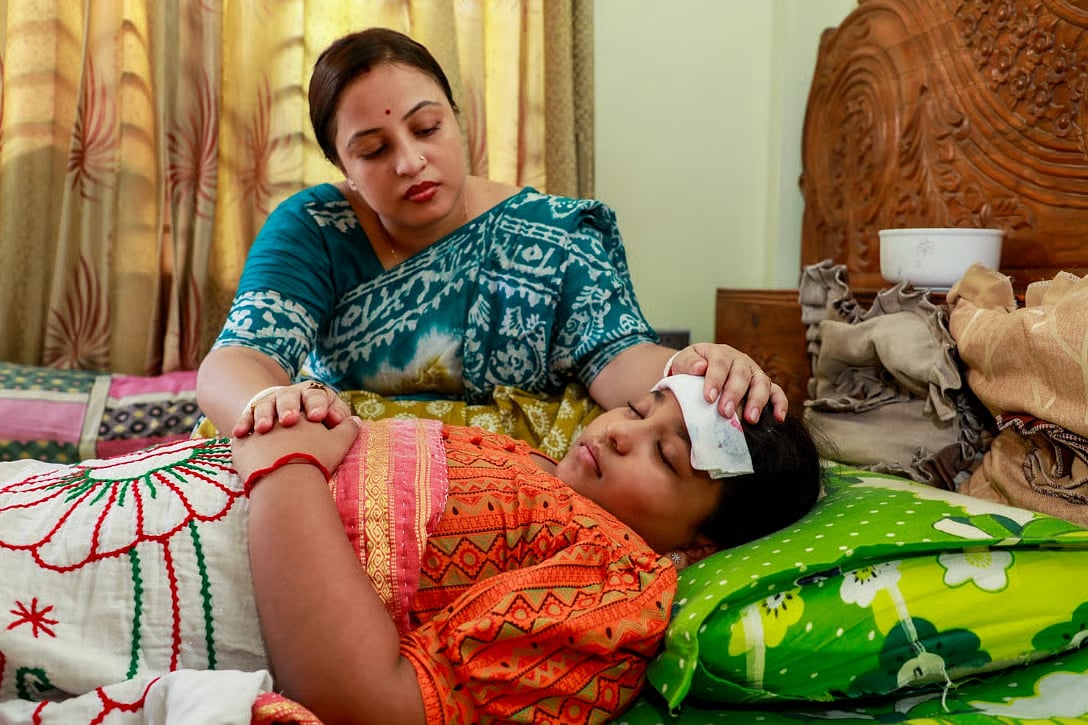
Fever in every house, symptoms that require caution
Sabrina Akter brought her five-year-old daughter to the pediatric outpatient department of Chattogram Medical College Hospital. Her daughter’s fever had not subsided for several days, which eventually left Sabrina worried.
She became particularly concerned after hearing reports about dengue and measles infections in Chattogram and began to fear that her daughter’s fever might have a serious cause.
Sabrina Akter said she initially waited for two days. However, when the fever did not subside, she did not delay any further and took her daughter to hospital.
After consulting a physician, she felt somewhat reassured. The physician told her that her daughter did not have any serious complications and would recover with regular medication and proper care.
Sabrina Akter said she had also recently suffered from a fever. At the same time, she had been regularly hearing reports about dengue and measles infections in Chattogram.
News of people dying after getting fever, particularly in September, made her even more concerned. Therefore, when her daughter developed a fever, she considered consulting a physician the safest option rather than taking any risks.
However, Sabrina Akter is not alone. Patients of various ages visit the pediatric and medicine outpatient departments of Chattogram Medical College Hospital every day with symptoms such as fever, a runny nose, cough, sore throat and body aches.
Alongside children, young, middle-aged and elderly patients are also seeking medical advice for these symptoms. Some have had fever for several days, while others have experienced fever accompanied by a runny nose, cough or body aches.
Physicians say seasonal fever, colds, coughs and respiratory infections such as influenza are common during this period.
However, as dengue and measles infections are also circulating at the same time, people should not dismiss a fever as an ordinary seasonal illness.
If a child or person of any age develops persistent fever, a cold, cough or any other symptoms, they should seek medical advice when necessary.
Why fever is more common at this time of year
Physicians say the number of patients with fever, colds and coughs increases during this period of seasonal transition.
Changes in weather, fluctuations in temperature and infections caused by various viruses can lead to different respiratory infections at this time of year.
Children, in particular, are more prone to fever, colds and coughs. In many cases, these symptoms improve after a few days with proper care and treatment.
However, people should not assume that every fever is simply a common illness. Fever is not a disease itself; rather, it is a symptom of an underlying problem or infection in the body.
In addition to viral or bacterial infections, fever can result from inflammation, various illnesses or other physical problems. In some cases, an injury can also trigger fever as a result of an inflammatory response.
Physicians say there is no need to panic when a fever develops. At the same time, people should not completely ignore it by assuming that it is merely a seasonal problem.
When someone develops a fever, they should first get adequate rest. They should also take care to prevent dehydration. Regularly monitoring body temperature and watching for any new symptoms alongside the fever are also important.
To prevent dehydration, patients can have boiled water, oral rehydration solution, soup or other fluids. Parents should pay particular attention to ensuring that children receive adequate food and fluids.
People should not start taking different medicines on their own to reduce a fever. They should consult a physician if necessary.
Dengue infection raises alarm in Chattogram
Amid fever cases in households across Chattogram, concern over dengue is also growing. The experience of Md Abu Toyeb, who is receiving treatment in the Medicine Department of Chattogram General Hospital, reflects the situation. He was admitted to the hospital with a fever after travelling from Banshkhali upazila.
Abu Toyeb said he initially developed pain throughout his body, followed by a gradual onset of fever. As the fever and body aches worsened, he eventually decided to seek hospital treatment. Tests later confirmed that he had dengue.
Conversations with several other patients receiving treatment at the hospital revealed that they, too, had various dengue symptoms alongside fever.
Some came to the hospital for tests after hearing reports of fever spreading from household to household and increasing dengue infections.
Tests later confirmed dengue in some of them. After receiving treatment, their physical condition has improved somewhat compared with before.
According to data from the Chattogram Civil Surgeon’s Office, 4,466 people in the district had contracted dengue by 30 September this year. Of them, 2,430 were infected in September alone.
Sixteen people died of dengue during the same month. By 30 September, the total number of dengue deaths in the district this year had reached 21. This means September accounted for a large proportion of the year’s total infections and deaths.
Dengue infections are also increasing in the city. Hospitals across Chattogram saw a rise in the number of dengue patients in September.
According to figures from 30 September, Chattogram Medical College Hospital admitted 31 new dengue patients that day, taking the total number of patients receiving treatment there to 87. By 30 September this year, 1,851 dengue patients had been admitted to the hospital, while 1,669 had recovered.
Amid the rising infections, Chattogram City Corporation has also been conducting drives to identify breeding grounds for Aedes mosquitoes across the city.
The corporation said mosquito-control measures alone are not enough to control dengue; preventing stagnant water from accumulating in and around homes is also crucial. Authorities have intensified special mosquito-control drives and cleanliness campaigns in high-risk areas of the city.
Growing concern over measles
Alongside dengue, parents are becoming increasingly concerned about measles as children develop rashes with fever. Children with fever, colds, coughs and rashes are turning up at various government and private hospitals for treatment. While tests have confirmed measles in some cases, many children are being kept under observation on suspicion of having the disease.
According to data from the Chattogram Civil Surgeon’s Office, 255 people suspected of having measles were admitted to hospitals across Chattogram district on 30 September.
Of them, 250 were in hospitals in the city. By that day, the number of patients admitted to hospitals with suspected measles had reached 9,006. However, tests have confirmed measles in 743 patients so far.
During the same period, 26 deaths were reported among people suspected of having measles.
A recent study conducted in Chattogram has further highlighted the reasons for concern over measles among children. The third research project of Asperia Health Research and Development Foundation collected samples from various hospitals in Chattogram, Cox’s Bazar and Cumilla.
The researchers collected 300 samples in total. Of these, 196 were samples from children only, while 104 were samples from mothers and children.
One of the concerning findings of the study was that 59.4 per cent of children with measles were found to have contracted the infection while staying at a healthcare centre or hospital. The researchers said a shortage of beds and multiple children staying in the same space at hospitals could increase the risk of infection.
Among the infected children, 46 per cent were under nine months old. In other words, they contracted measles before reaching the scheduled age for the first measles vaccine under the routine immunisation programme.
For this reason, the research team recommended lowering the age for measles vaccination to six months. The study also found that 51 of the 196 children, or 31 per cent, had moderate to severe malnutrition.
Lead researcher Kamrun Nahar said, “In the case of measles, not only the infection but also a child’s nutritional status is associated with the severity and complications of the disease. The study found moderate to severe malnutrition in a large proportion of the affected children. Therefore, alongside vaccination to prevent measles, greater emphasis should be placed on ensuring adequate nutrition for children and providing regular vitamin A capsules.”
Neither panic nor neglect
According to physicians, the cause of fever can vary from person to person. In some cases, it may be part of a common seasonal infection, while in others it may indicate dengue, measles or another illness.
Therefore, it is important to pay attention not only to the severity of the fever but also to other accompanying symptoms and how long the fever has persisted.
Physicians say people should first monitor their physical condition rather than panic when they develop a fever.
However, if symptoms such as breathing difficulties, extreme weakness, repeated vomiting, seizures, unusual drowsiness, bleeding, reduced urine output or a rash develop alongside the fever, they should seek medical advice without delay.
Children showing these symptoms require even more prompt medical attention.
Kazi Ashik Aman, resident medical officer (RMO) at Chattogram General Hospital, said, “There is no need to panic simply because you have a fever. During the first two to three days of fever, you should monitor other symptoms. You should consume adequate fluids during this period. If necessary, you should undergo tests and receive treatment after consulting a physician. Do not take any medicine on your own.”