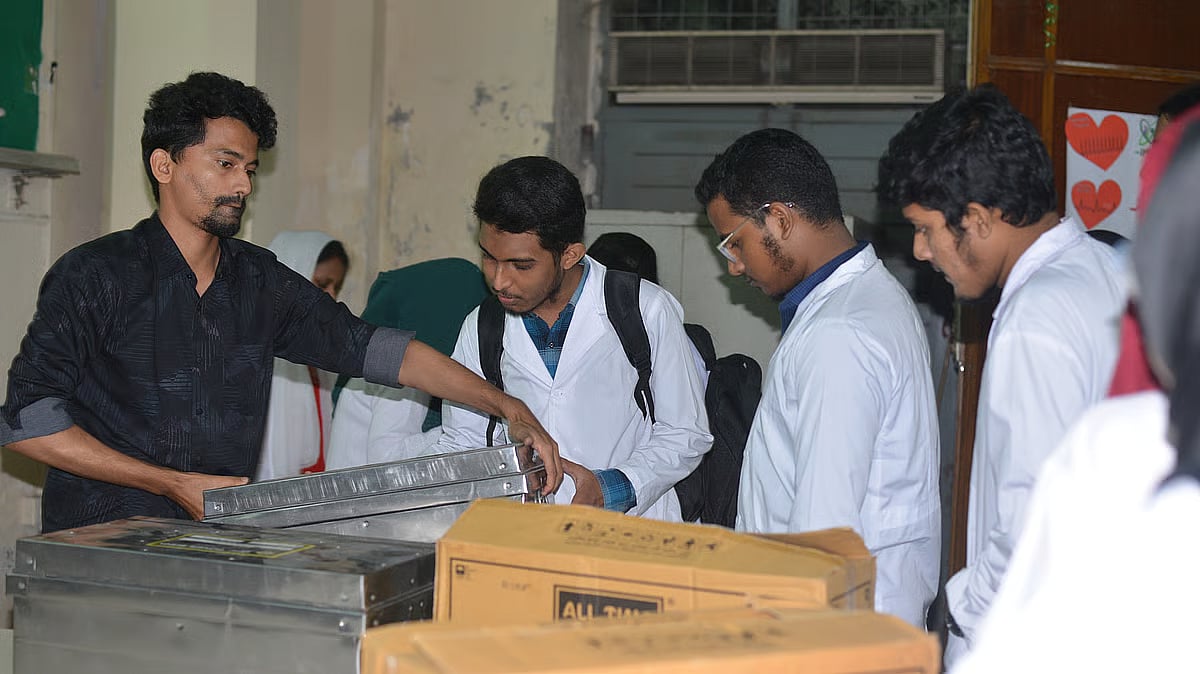
Dhaka Medical College students establish a ‘Bones Bank’ to prevent human bone trade
In order to become physicians, medical students must acquire a proper understanding of the human body. For this purpose, they require human bones and other organs of the deceased. In many countries, teaching is conducted with the aid of dummy or artificial bones. In Bangladesh, however, adopting such an approach immediately is challenging, as it would require establishing institutional mechanisms. Therefore, human skeletons remain the primary resource.
The bones and organs of those who donate their bodies for the welfare of humanity serve students for many years. Yet, such donations do not fully meet demand. Consequently, many students end up using bones from individuals who had never consented to donate their bodies. This has given rise to an illicit trade. Most alarmingly, in order to supply bones, unscrupulous individuals resort to grave robbing.
To curb the buying and selling of human remains as commercial products, students of Dhaka Medical College have taken the initiative to establish the DMC Bones Bank.
Circulation of Bones
Traditionally, a student who begins their academic journey with a set of bones sells it to a junior batch once their course is complete. Over time, the price of these sets has risen. For students from ordinary backgrounds, the cost is particularly burdensome. A set of bones costs between Tk 30,000 and Tk 35,000, while even an incomplete set costs at least Tk 25,000. In principle, however, no part of the human body should be subject to such trade. If, instead, institutions collected the bone sets used by graduating students, they could be preserved and utilised free of cost by future students for years to come.
This idea led Enamul Karim, a student of the K-78 batch of Dhaka Medical College, to propose the creation of a “Bone Bank.” When he shared the concept in a Facebook group, several friends, including Ehtesham Sami, responded enthusiastically. The idea soon resonated across other batches as well.
Overcoming Obstacles
Initially, the idea of establishing a Bone Bank could not progress very far. At that time, the trade in bones was linked to members of the Chhatra League. According to Enamul and Ehtesham, it was nearly impossible to remove the business from political circles and give it a humane form. However, the scenario changed after 5 August 2024. There was no longer fear of intimidation.
During this period, students of the K-78 batch posted the idea of a Bone Bank on the official group of Dhaka Medical College. The initiative was warmly welcomed by students from other batches. Alumni also came forward with different forms of support. As the K-80 batch had recently completed their first professional examination, they possessed the largest number of bone sets and contributed most of them to the Bank. Others also participated. Artificial bones were purchased to replace missing parts in incomplete sets. With contributions from senior alumni, small trunks were also bought for storing the bone sets.
A structured bank
On 13 August, in the presence of Professor Dr Md Kamrul Alam, Principal of Dhaka Medical College, Vice-Principal Dr Faruk Ahmed and other faculty members, the Bone Bank was officially inaugurated. A total of 41 bone sets were handed over to 124 students of the newest K-82 batch. The Bank also has an excellent website, developed by Sifat Bin Siddiq of the K-79 batch, accessible at https://dmcbonesbank.org/ The site maintains records of which student has received which bone set, as well as whether the sets are returned properly. Halima Tus Sadia, a student of the K-80 batch, mentioned, “At one point, we hoped to replace all the bones in the Bank with artificial bones.” Ehtesham added that arrangements would also be made to respectfully bury the bones of deceased individuals in due course. This represents a collective pledge to put an end to the degrading trade in human remains.