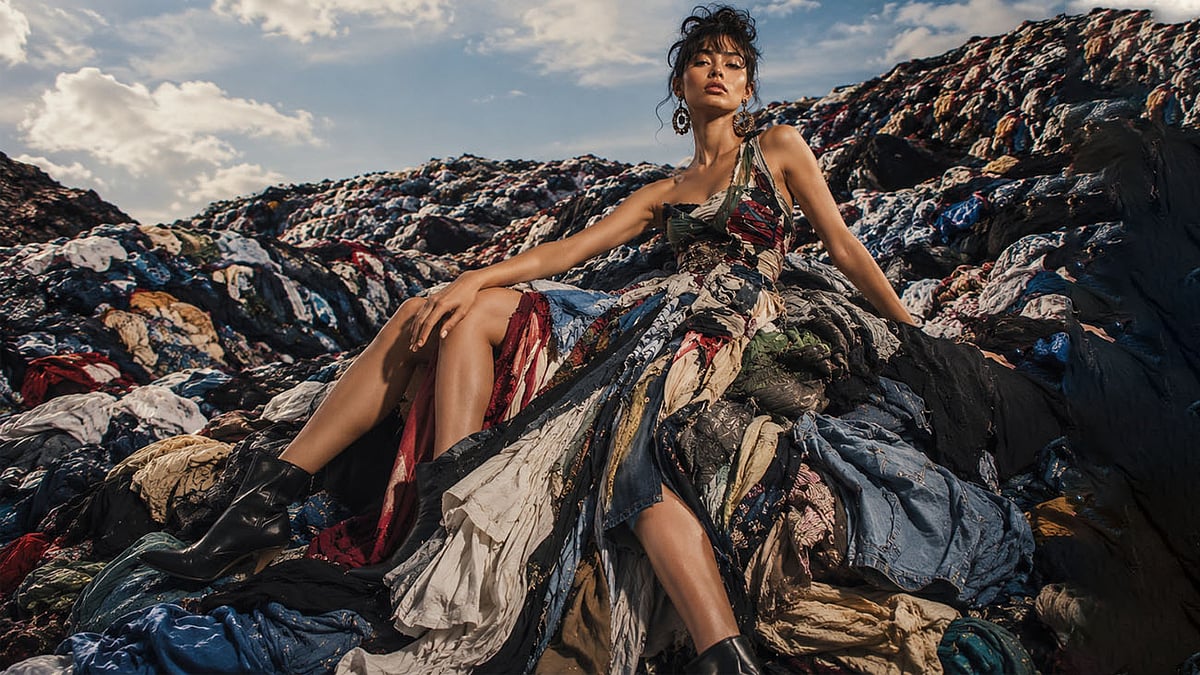
The European Union has ushered in a major shift in the fashion industry by banning the destruction of unsold clothing and footwear. The new regulation is expected to transform global supply chains and business strategies while creating a new reality for Bangladesh’s ready-made garment (RMG) industry.
For years, destroying unsold clothing was an uncomfortable yet widely accepted practice within the global fashion business. To protect brand exclusivity, clear warehouse space, or reduce excess inventory, companies routinely destroy brand-new products. As astonishing as it may sound, this practice had long been embedded in the business strategies of both luxury labels and fast-fashion retailers.
Yet every garment represents far more than fabric. Long before it reaches a store shelf, enormous amounts of cotton, water, energy, chemicals, labour, and transportation resources have already been invested in its production. When that garment is never worn but instead destroyed, it is not merely a product that is wasted, it is the entire chain of resources behind it.
It is this reality that the European Union (EU) seeks to change. Its ban on destroying unsold apparel and footwear is more than a new regulation; it marks a fundamental shift in the philosophy of the fashion industry. The impact will extend well beyond Europe, influencing global supply chains, manufacturing practices, and garment-producing countries such as Bangladesh.
Why is this law so significant?
Under the EU’s Ecodesign for Sustainable Products Regulation (ESPR), large companies are no longer permitted to destroy unsold clothing, footwear, and certain fashion accessories as part of their routine business operations. The regulation began taking effect in 2026, with a clear objective: extending product lifecycles and reducing unnecessary waste.
This is not simply environmental law. It forces the fashion industry to rethink its entire business model, from production to sales. The question is no longer limited to how a garment is made, but also what happens if it remains unsold.
Where do all those clothes go?
The fashion industry has long relied on a strategy known as overproduction—manufacturing more products than are likely to be sold. For decades, the environment has paid the price for this approach.
Brands rarely know with certainty which products will become commercial successes. To minimise the risk of stock shortages, they have traditionally produced more than market demand.
The problem is that a significant portion of these products never finds a buyer. Some remain in warehouses, some are sold at deep discounts, while many are ultimately destroyed.
European policymakers argue that such waste is no longer acceptable at a time when fashion has been identified as one of the world's most environmentally damaging industries.
More than an environmental issue
Destroying unsold garments is not simply about wasting clothes.
Every discarded product also represents wasted freshwater used to grow cotton, electricity and fuel consumed during manufacturing, chemical dyes, countless hours of labour, and extensive transportation costs.
In other words, burning or destroying a garment means wasting every resource invested throughout its production journey.
How will brands respond?
With the new EU regulations in force, fashion brands will need to rethink their business strategies. Instead of relying on overproduction, companies will increasingly prioritise accurate demand forecasting, smarter inventory management, and alternative uses for unsold products.
Rather than destroying excess stock, brands will be expected to resell, repair, reuse, upcycle, or recycle their products. Many international fashion companies have already begun incorporating these circular practices into their long-term business strategies.
This transition is already underway. Patagonia has operated its Worn Wear programme for years, encouraging customers to repair and resell used garments. Zara and H&M have introduced pre-owned fashion initiatives in several markets, while Oxfam in the United Kingdom continues to promote second-hand clothing as a mainstream consumer choice.
The rise of circular fashion
For decades, the fashion industry followed a linear model: make, buy, use, and discard. That model is gradually being replaced by circular fashion, where the life of a garment does not end after its first use. Instead, products are repaired, resold, reused, upcycled, or recycled to keep them in circulation for as long as possible.
This transformation has accelerated the growth of resale platforms, clothing rental services, repair businesses, and upcycling brands across Europe. The goal is straightforward: maximise the lifespan of every garment while reducing the need for new production.
What does this mean for Bangladesh?
This is perhaps the most important question.
Bangladesh is one of the world's largest exporters of ready-made garments, with the European union serving as one of its most significant markets. Consequently, the EU's new regulation will not remain confined to European brands; its effects will ripple throughout global supply chains, reaching factories in Bangladesh.
As the regulation takes effect, international buyers are expected to demand greater accountability from their suppliers. In the years ahead, competitive advantage will no longer depend solely on price, production capacity, or delivery schedules. Buyers will increasingly ask:
• How much excess inventory is being produced?
• What happens to unsold products?
• Are recycled or sustainable materials being used?
• Can products be fully traced throughout the supply chain?
• What measures are being taken to reduce carbon emissions?
For manufacturers, answering these questions convincingly will become essential. Sustainability is rapidly emerging as the new language of global competitiveness.
More than a regulation—A shift in mindset
At its core, the EU''s new law challenges one of the fashion industry's long-held assumptions: should a brand-new garment be considered so disposable that destroying it becomes the easiest business solution?
Or should equal value be placed on the water, raw materials, energy, craftsmanship, labour, and environmental resources invested in its creation?
The European Union's answer is unequivocal. The value of a garment extends far beyond its retail price; it encompasses its entire lifecycle—from design and production to use, reuse, repair, and eventual recycling.
In many ways, this marks a transition from the traditional "take–make–waste" economy toward a truly circular economy, where products are designed to remain in use for as long as possible and waste is treated as a resource rather than an inevitable outcome.
The future of fashion
The next decade will redefine success in the fashion industry.
Competition will no longer be measured simply by who produces more garments or launches more collections. Instead, leadership will increasingly belong to those who create greater value with fewer resources and generate less waste throughout the production cycle.
Industry experts describe this transformation as a shift "from waste to wardrobe," a future in which discarded materials are not viewed as the end of a product's life but as the beginning of another.
This vision is already reshaping the priorities of global fashion brands, policymakers, investors, and consumers alike.
For decades, success in the fashion industry was measured by three indicators: producing more, launching new collections faster, and selling more products.
The European Union's new regulation challenges that model.
The question is no longer how many garments can be manufactured, but how many can be kept in use for longer.
The future of fashion may not be defined by the relentless pursuit of new production, but by the industry's ability to extend the life of every garment, conserve valuable resources, and embrace a genuinely circular business model.
For Bangladesh, whose economy is deeply intertwined with the global apparel trade, this transformation should not be viewed merely as another regulatory requirement. It is an opportunity to strengthen its position as a responsible manufacturing hub by investing in transparency, resource efficiency, circular production, and sustainable innovation.
The global fashion industry has entered a new era—one in which the true measure of success is not how much we produce, but how little we waste.
References: European Commission (Ecodesign for Sustainable Products Regulation – ESPR); Official Journal of the European Union; European Environment Agency (EEA); United Nations Environment Programme (UNEP); Ellen MacArthur Foundation; McKinsey & Company; The State of Fashion (Annual Report); Textile Exchange.
Photo: AI, Prothom Alo, Wikipedia, Instagram