Significant weakness persists in studies from Class 8 to 12
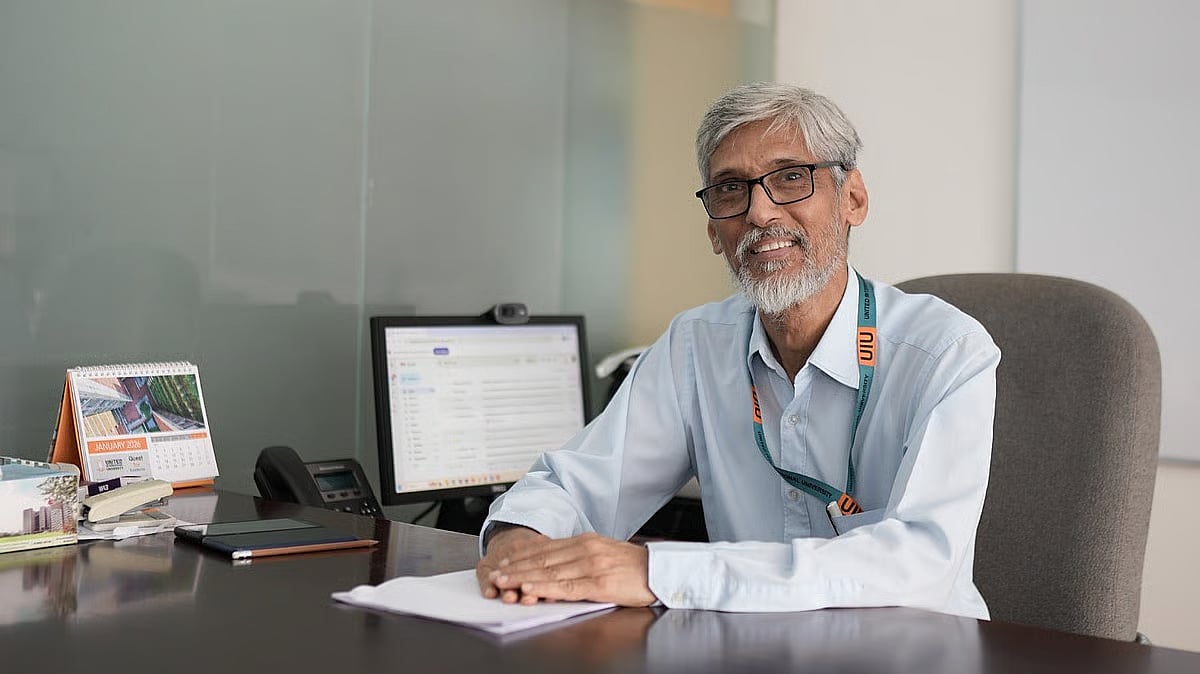
Emeritus professor of the Department of Electrical and Electronic Engineering at United International University and executive director of the Institute of Advanced Research, M Rezwan Khan, speaks to Md Saifullah in an interview with Prothom Alo.
How much opportunity and how much risk do you think artificial intelligence is bringing for engineers and engineering students?
M Rezwan Khan: There is no doubt that within the next five to 10 years, artificial intelligence will bring a major transformation to our education sector. Like any tool, if it is used properly it can be highly beneficial, but if used incorrectly it can also cause harm. I believe we need to focus on how we can use technology in a positive way. For example, there is a lot of fake news circulating these days, does that mean you should stop doing your work altogether? Certainly not. It is true that a significant change in engineers mindset will be required, but I do not think job opportunities will diminish. Over the next few years, everything will change very rapidly, and we must be prepared for that change.
If we talk specifically about your university, how are you preparing?
M Rezwan Khan: First of all, we are trying to integrate AI into all courses. Not only in science or engineering, everyone needs to have an understanding of AI. Suppose the company you work for asks you to prepare a report, whether it is a finance, management or marketing report. If you attempt to do the task without knowing AI, someone else will complete it in 1/10th of the time. As a result, you could lose your job. That is why we are incorporating AI into all areas of the curriculum where it may have an impact. Not only in teaching, but we have also begun using AI in the university’s day-to-day operations. For instance, if you want to recruit someone and receive 700 CVs, it is not feasible to analyse each one manually. So we are developing a system where, once the CVs are fed into AI, it will generate a complete table showing who has what CGPA, what experience they have, and all other relevant details.
Recently I read a report stating that due to AI, students are no longer practising deep thinking and that their critical thinking skills are declining. Do you agree with this?
M Rezwan Khan: No. In my opinion, it only appears that way at the moment. This is because AI is evolving so rapidly and we have not yet been able to redesign our curriculum accordingly. We have also not been able to develop appropriate methods for assessing students. In our time, we used slide rules for calculations. When calculators were introduced, even complex calculations could be done in two minutes. Did anyone then say that because of calculators we could not learn mathematics? No, because after calculators were introduced, we changed the nature of the questions. In our time, there was something called mental arithmetic, doing calculations in one’s head. Today’s students may not even have heard of mental arithmetic. Does that mean they are less intelligent? Does it mean they are learning less mathematics? No. They are simply using their brains in a slightly different way. Their brains are developing differently.
In the present context, collaboration between industry and academia is extremely important. What kinds of initiatives are you taking in this regard?
M Rezwan Khan: Whenever we introduce any change to our curriculum, it is mandatory to take the opinion of BAETE (Board of Accreditation for Engineering and Technical Education). They want to know whether we are equipping our graduates with the skills and competencies demanded by industry. Therefore, we constantly try to keep ourselves updated. Another important aspect is that UIU’s Institute of Advanced Research (IAR) has Memoranda of Understanding (MoUs) with a number of companies. When they approach us with specific problems, we work together to find solutions. For example, we are working on neuromarketing. Suppose you are advertising a mobile phone and install a large billboard showing a model holding the phone. Will your potential customer notice the phone, or will they focus on the model? Analysing this is what neuromarketing is about.
On the other hand, we are also working with satellite and drone imagery. By analysing images of crops, it becomes possible to determine crop yield, whether fertiliser is required, whether pests have affected the crops and so on. So yes, we are improving both our research activities and our curriculum.
Compared with engineering graduates from neighbouring countries, where do our graduates stand? Are we able to make an impact globally, in your view?
M Rezwan Khan: You would not be able to imagine the level of demand for BUET (Bangladesh University of Engineering and Technology) graduates abroad. Not long ago, someone emailed me from the United States saying, “Give me two students from BUET.” Engineering universities other than BUET are also doing well. However, there remains a major weakness in education from class eight to class 12. One of the key reasons BUET performs so well is that it selects only the best students. But hundreds of thousands of students achieve GPA 5, while only a few thousand gain admission to BUET, where do the rest go? I often see students who come to university with GPA 5 but cannot correctly answer even basic questions in mathematics or physics. Because the foundation is weak, we fall behind in higher education. We are a country of nearly 180 million (18 crore) people; many more talented individuals should have emerged from this population.
So what would your advice be for students and parents?
M Rezwan Khan: I used to tell my own children to study their textbooks from the first page to the last, rather than relying on exam suggestions. I have seen many students in class who cannot perform basic integration, because in the examination system integration was optional alongside differentiation. You can achieve GPA 5 without knowing integration, but you cannot become an engineer that way. Students must take the initiative to learn two subjects very well, mathematics and English. I emphasise English because it is essential to survive and compete at the global level. Studying only for examinations is not enough; mathematics and English must be studied with genuine interest and enjoyment.