What makes Jamalpur's Nakshi Kantha unique?
The city’s winter has suddenly faded, and in a few days blankets and heavy quilts will be packed away. In this mild chill, a quilt still brings comfort—and if it is a nakshi kantha, its rural scenes or floral and vine motifs are a delight to the eye. But in the rush of urban life, even if one longs for a nakshi kantha, who has the time to stitch it? Buying one becomes the easy solution. Jamalpur’s traditional nakshi kantha offers both warmth and comfort, and today its embroidery patterns are also appearing on clothing and other products.
There are several reasons why Jamalpur’s nakshi kantha is considered unique.
“The women of Jamalpur district are skilled in needle and thread work. That is why Jamalpur’s nakshi kantha is unmatched. They are more artistic than nakshi kantha from any other district,” said Delowara Begum, owner of the Jamalpur nakshi kantha proprietorship Dipto Kuthir. Nakshi kantha is made in all upazilas of the district. The district administration has branded Jamalpur through its nakshi kantha. Jamalpur’s nakshi kantha also received UNESCO GI product recognition in February 2024.
Shahinur Rahman began working with nakshi kantha in 1996. His initiative has now grown significantly, with two organisations: Shotodal and Karukala.
He said, “There are now over two thousand entrepreneurs in the district. There are around 200 shops. The tradition of making nakshi kantha in Jamalpur is 100–150 years old. Back then, the whole thing was purely for personal delight. As a business, it has existed for about 50 years.”
For Aarong, BRAC’s Ayesha-Abed Foundation first produced nakshi kantha. They employed women in their offices to make nakshi kantha. Others appoint team leaders in different areas to enable rural women to work from their homes. The SME Foundation has clustered nakshi kantha-making in Jamalpur. Team leaders operate in different upazilas including Sadar, Sarishabari, Madarganj, Melandah, Islampur, Dewanganj, Bakshiganj, and in areas like Nandina, Narundi, Bhatara, and Beltia.
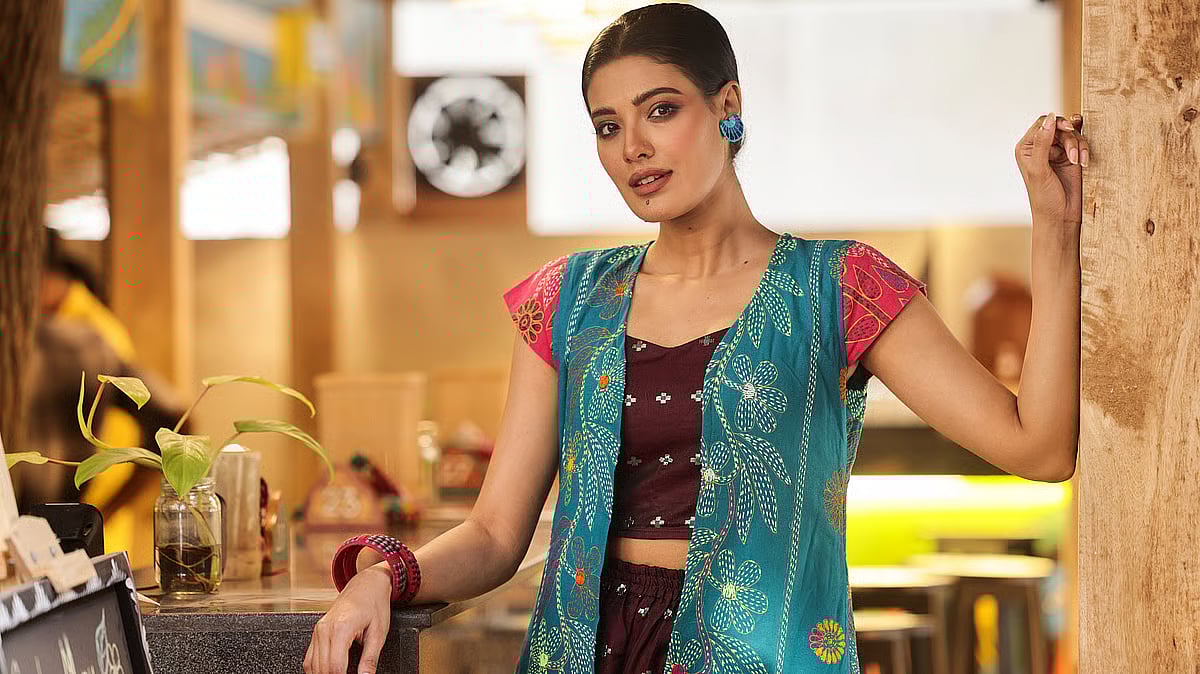
Over time, nakshi kantha has evolved. Product types have changed. Shahinur Rahman said, “Besides nakshi kantha, we now make bed sheets, cushions, boys’ and girls’ panjabis, wall hangings, wearable shawls, wall mats, salwar kameez, pillow covers, and more. Designs are now simpler. Jamalpur’s special feature is dense embroidery, though less work is done across the entire surface now.”
“Actually, the type of work we do and the products change according to market demand. However, the original nakshi kantha remains unchanged. Its motifs are used in other products,” said Delowara Begum. She added, “We do both light and heavy work. Our initiative started in 2001 with only Tk 5,000 as capital and has now grown into a large establishment. Designs change according to customer demand. Now, human and animal figures are rarely used; we mostly focus on flowers, vines, and alpana designs.”
Most Jamalpur nakshi kantha shops operate from the entrepreneur’s home. They run showrooms in their front yards and workers across the district stitch nakshi kantha from their homes.