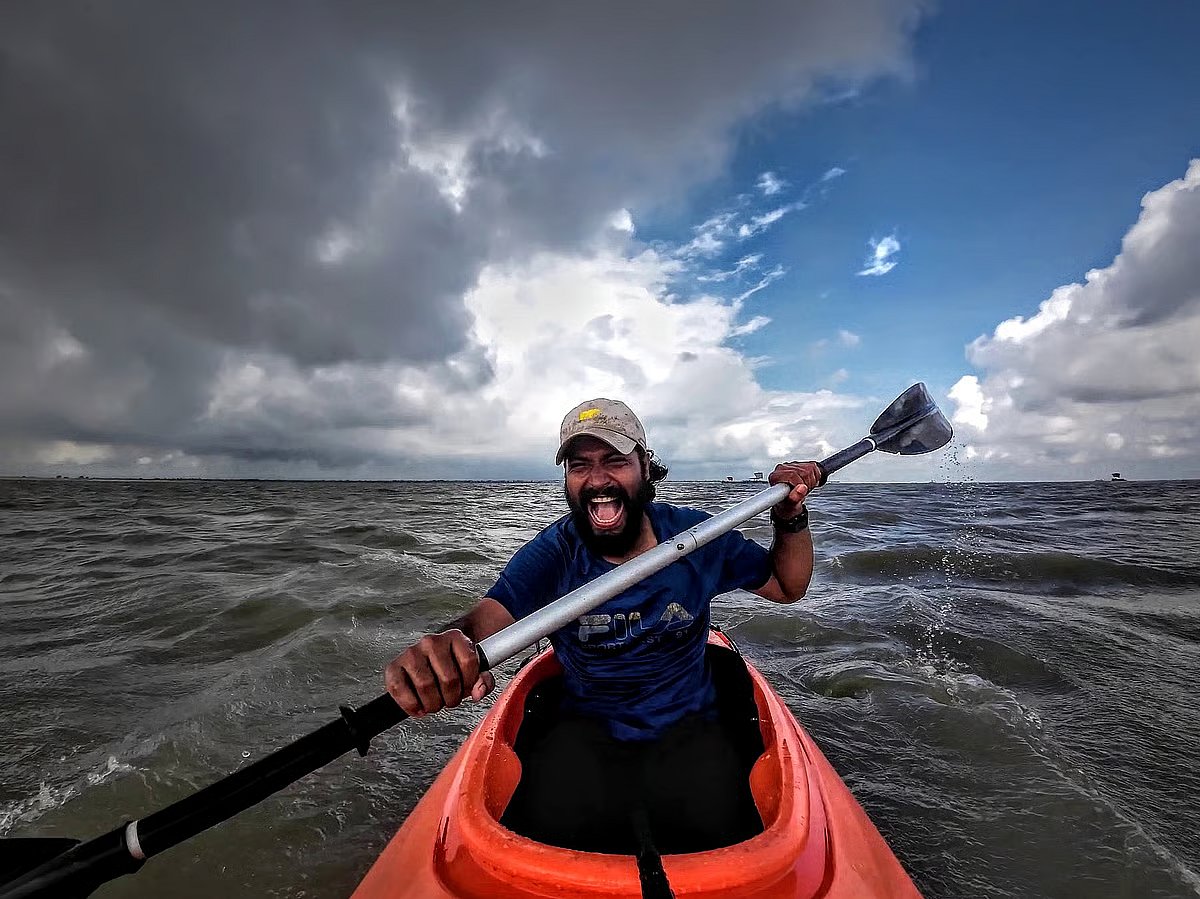
Padma Paddler: The epic journey of a solo kayaker, Intiaz
I am a mountain lover. I have spent a lot of time in my life roaming the mountains. But how many mountains are there in our country? When reaching the mountain peaks of India, Nepal, and even Bandarban became difficult, the idea of rivers came to mind. This is a country of rivers after all, so why not go to the river?
This idea first came to my mind in 2023 when I visited Sunamganj. My friend Munim and I sailed a boat from Sunamganj to Brahmanbaria on the Surma River. After this amazing experience, 'kayaking' permanently got into my head. I learned the tricks of kayaking little by little.
After a couple of years of short trips on rivers around Dhaka, from Bhairab to Ashtagram in Kishoreganj, Kaptai to Chittagong on the Karnaphuli, and Sadarghat to Chandpur on the Buriganga, I started dreaming about the Padma River.
I decided to travel the Padma River from Chapainawabganj to Chandpur. I plotted the entire route on Google Maps and found that it was over 300 kilometers long. The first hurdle was to arrange a good quality kayak. After two or three more months of preparation, I finally went for it during the long Eid-ul-Azha vacation. On 10 June, I convinced my friends Munim and Jisan to board the local bus to Rajshahi.
The plan was for them to be my support team. We would share our locations on our phones, and they would travel along staying close by on road and we would meet at the campsite every night. Initially, we were supposed to start our journey from Chapai, but due to two critical points on the Indian border, we had to scrap that plan. We got off from the I-Badh in Rajshahi.
The first day was a clear sign of what was to come. The sun was so hot that my body felt like it was on fire. The intense heat was the main challenge until I got to the place where the Jamuna River meets the Padma. After just two days, Munim and Jisan had to turn back from Shialdaha area, defeated by the scorching sun.
From that moment, my trip became a solo mission. Wherever I spent the night, I had a tent, food, and lodging. I kayaked for about 8-10 hours every day. At first, I was a little worried about safety. But that went away in a day or two.
Life on the river
On a rainy day in Manikganj, I was called over from a house right by the river. As soon as I sat in the yard, a woman appeared with a plate full of food. I hadn't eaten anything that morning. The night before, I had stayed in a rundown mosque right on the riverbank in Daulatdia.
There weren't any shops or houses nearby. I had dinner with Sobhan Bhai, a school employee who had lost his home to river erosion. I didn't want to trouble his family in the morning, so I left without eating.
It's difficult to find a good food shop by the river. Since I was alone, it was also tough to leave my kayak and go somewhere far away to buy something. On days like that, I relied on instant noodles, nuts, and chocolate. So, I was surprised and a little embarrassed by the kind woman's hospitality. With shining eyes, I took the plate. Just by looking at my face, she must have understood how hungry I was.
Listening to their stories after the meal, I learned that almost everyone at least once had lost their home to the Padma River. The woman who offered me food had lost hers four times. There are no significant dam projects in this area, and since it's a remote village with no major establishments nearby, there's no one to advocate for them. So, every year, the authorities simply fulfill their duty by dumping a few dozen sacks of sand.
While talking about her lost home and farmland, my host started crying. She now lives on someone else's land, having lost her own home. She doesn't even know if this house will last through the season. Her son works as a brick kiln laborer. A cow she had raised with so much hardship died this year. A few days ago, her husband also passed away. Now, she's just counting her own days.
Listening to the life story of this generous yet extremely poor woman, I felt so small. I felt a sense of guilt thinking about my own life. I know it doesn't matter and won't change anything, but I couldn't move my hands after leaving that house. I had never heard the suppressed cries of the people living on river banks from so close before. So, I stopped my kayak and sat for a while, just staring at the gentle flow of the Padma's water.
For me, this expedition was as much about seeing the Padma as it was about getting to know the people living on the Padma up close. Music sessions by the river in Kushtia, spending time on a fishing boat with fishermen, catching shrimp at night with local boys in Shilaidaha, hospitality on a dredger, lunch under the shade of a banyan tree in the green wilderness stretching out to the horizon, so many colorful experiences!
Every afternoon, I would look at the map to see where everything was. As I went, I would look for a place to stay on the banks of the river. Every day, something would be arranged. I think I spent the most beautiful night in a dredger near Malifa village in Pabna. It was a magical moonlit night among a few pure and kindhearted people on the river.
An unrestricted world
My purpose of this trip was to kayak the entire length of the Padma River, from its beginning to its end, to gain experience for a much larger expedition. Simultaneously, I wanted to immerse myself in the beauty of the Padma. My route was Rajshahi, Veramara, Shilaidaha, Pabna, Daulatdia, Mainat Ghat, Lauhajang, Sureshwar, and Chandpur.
During this journey, I navigated through the labyrinth of sandbars, long stretches of uninhabited areas, and two large river confluences—Jamuna-Padma and Padma-Meghna. After enduring scorching sun in the first half, I was greeted near my destination by the wildly turbulent form of the Padma in a storm and relentless rain from morning till night.
It took me a total of 10 days to get from Rajshahi to Chandpur, from 10 to 19 June. Nine days were spent kayaking, with one day of idling around. I spent the eight nights in eight different places: sometimes at someone's house, sometimes at mosque-madrasa, local club room, on a dredger, a bulkhead, or at a dam construction site.
But despite all this, what ultimately left a lasting impression was the people of the Padma riverbank and their selfless hospitality, the genuine love I received here and there, the excitement of the children by the river, and the deep blue color of the Padma. Over a journey of nearly 300 kilometers, I met at least 300 different kinds of people.
It was as if I had entered a different world, not the country filled with the hatred and violence seen on TV and in newspapers. The constant fear in my mind, 'What if something happens?' slowly vanished. The stormy wind of the Padma blew away all my anxieties about someone somewhere might catch me or harm me. Instead, many colorful memories settled in my mind.