Bangladesh is so politically divided that if you ask two citizens the same question on any particular issue, you will receive diametrically different answers. You can ask, “How is the country faring?” One will answer, “The country is faring very well. There was never such an open democracy in the country ever before. The economic indicators are shooting up!” The other will respond, “There is no democracy whatsoever in the country. Corruption and money laundering has destroyed the economy. If this government remains in power much longer, Bangladesh will become another Sri Lanka.”
Even in the recent survey run by the Washington-based International Republican Institute (IRI) came up with contradictions. It showed that 63 per cent of the people had support for the opposition. Then again, 70 per cent of the people said Sheikh Hasina did well as head of government.
Bangladesh’s politics is said to be centered on the individual or leader-centric. The parties are run on the orders to the top leader. In that sense, BNP has no ‘leader’ for the past five and half years. The party chief Khaleda Zia is imprisoned on corruption charges (though presently at home on the government’s executive orders). Tarique Rahman, who was made the party chairman in her absence, has been abroad since September 2008. He has been convicted in several cases. Yet despite being out of power for 17 years, BNP has made its presence felt on the streets, much to the credit of its general leaders and activists.
Awami League leaders had so long been derisively saying that BNP didn’t have the gumption for a movement. That derision has been flung back into their faces. In the past, anti-government movements meant hartal (general strikes), blockades and sieges. Both Awami League and BNP have been following that trend since 2015.
BNP leadership, however, has noticeably brought about a change in their political programmes in recent times. Their peaceful programmes have spread from the cities down to the union level and people have responded. As things stand now, whenever BNP calls for a programme, Awami League stages an almost identical programme on the very same day. The argument that Awami League leaders offer to justify this is ridiculous. Are the government’s law enforcement agencies so weak that they cannot tackle the so-called violence and terrorism of BNP-Jamaat?
If BNP calls for hard-hitting programmes in the future, like hartals and blockades, will Awami League follow suit? Awami League’s fight with BNP at the moment is over the election system. We have such wise and great leaders, yet they have failed over the past 52 years to come up with a way of holding the elections. When in power, they say nothing could be better than the caretaker government system. Some had even suggested that they import this model overseas. The very same leaders, once in power, say there must be no mention even of a caretaker government system. The highest court has abolished it. But in its ruling the court had said that if the parliament so wanted, two elections could be held under this system. The leaders even interpret the constitution as they want.
When BNP brought about the 14th amendment and extended the retirement age of judges, Awami League opposed it. That objection, I feel, was justified. Now Awami League is touting the court ruling about the 15th amendment, but says nothing about the court’s ruling concerning the abolition of the 16th amendment.
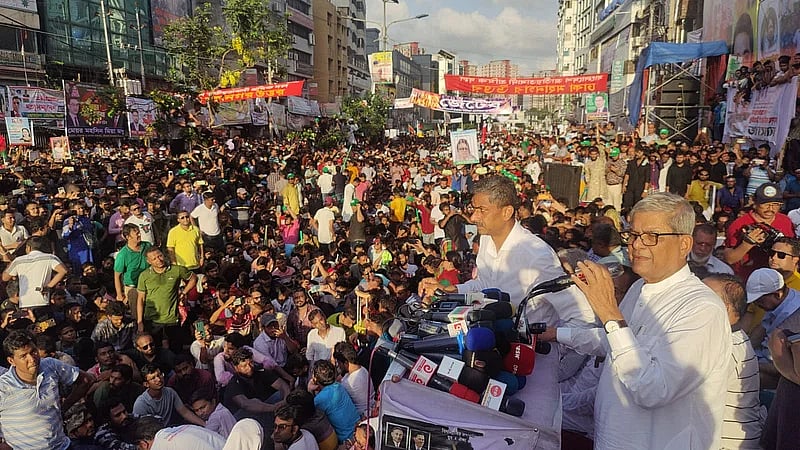
Despite the government’s repressive stance and the ruling party’s counter progammes, the gatherings at BNP’s recent events have been increasing. The party leaders see this as a success of their movement. But will they be able to take this success to the final stage? In BNP’s words, the final stage means the government stepping down before the election and handing over power to a non-party government.
If BNP thinks that the US will remove Awami League from power under pressure or by imposing sanctions and will bring them to power, that seems to be unrealistic.
There are only give months left for the election. The election commission has said that the election schedule will be announced by the end of October or the start of November. Are the BNP leaders prepared to, in their words, settle things on the streets by then? Democratic rights in the country are constricted, money laundering and corruption has increased. The people, under pressure of mounting living costs, are undoubtedly irate with the government. But how far will the opposition manage to use this anger?
People have supported the peaceful movement, but will they be there for the final stages of the movement? People viewed BNP’s 29 July sit-in programme at Dhaka’s entry points as clashes between the two sides. They were unwilling to take sides.
There have always been two trains of thought within BNP concerning the programmes of their movements. On 10 December last year, though most of the BNP leaders were willing to acquiesce to the government’s proposal and hold their rally at Suhrawardy Udyan, they failed to do so because of the hardliners. The hardliners from back then had declared a frontline fight against the government.
This time too, certain leaders within BNP feel that a few heated programmes will lead to a mass uprising. They reason that the government has no alternative but to resign, given the pressure being applied by the US. I asked several leaders of BNP how they would achieve their one-point demand. Wait and see, was their reply. By this, they hinted at some new sanctions from America.
There is no precedent in Bangladesh of any government easily resigning in face of any movement. In 1990, Hussain Muhammad Ershad was forced to resign because the entire administration as well as political and social forces went against him.
In 1996, despite the opposition of Awami League, the left parties, Jatiya Party, Jamaat-e-Islami and all parties, Khaleda Zia went ahead and held the 15 February one-sided election. Later when the administration withdrew their support, she was bound to resign. In 2006 too, the ‘logi-boitha’ (oars and paddles) movement of the Awami League ‘mahajote’ (grand alliance) could not prevent the 22 January election under Iajuddin Ahmad’s caretaker government. That election was later cancelled in the backdrop of the 1/11 change in scenario.
If BNP thinks that the US will remove Awami League from power under pressure or by imposing sanctions and will bring them to power, that seems to be unrealistic. In fact, there is little likelihood of the US visa policy being implemented before the election. The US has always spoken of democracy, fair elections and human rights. But tucked behind these words, or the parallel truth, are geopolitical interests. If BNP is running its one-point movement depending on foreign powers, they are making a mistake. They must depend of the people of the country.
* Sohrab Hassan is joint editor of Prothom Alo and a poet. He can be contacted at sohrabhassan55@gmail.com
* This column appeared in the print and online edition of Prothom Alo and has been rewritten for the English edition by Ayesha Kabir