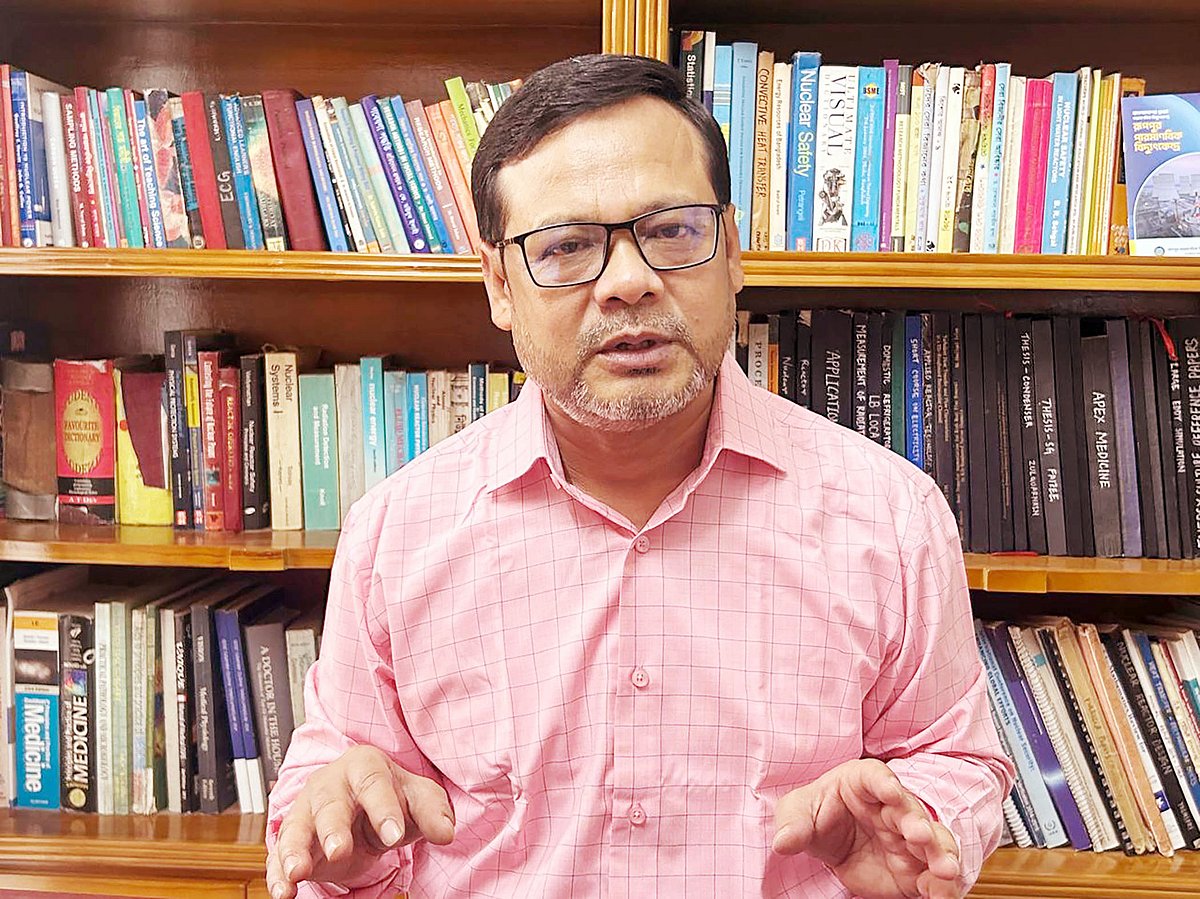
Exclusive interview: Md Shafiqul Islam
Economic and security risks of the Rooppur project are increasing
Dr Md Shafiqul Islam is a senior professor in the Department of Nuclear Engineering at the University of Dhaka. He has worked as a visiting professor in the Department of Nuclear Science and Technology at the Massachusetts Institute of Technology (MIT), USA. He has been engaged in education and research on nuclear technology for nearly 30 years. He has received advanced training on nuclear safety in the United States, Japan, Austria, Italy, Russia, and China. He spoke to Prothom Alo about the economic and security risks of the Rooppur Nuclear Power Project, geopolitical challenges, project weaknesses, shortcomings, and other issues. Kazi Alim-uz-Zaman and Monoj Dey took the interview.
The Rooppur Nuclear Power Plant is the most expensive project in Bangladesh’s history. Although it was supposed to go into production in December 2022, it has been pushed back several times. Now there is hope of starting experimental electricity generation from the first unit this December. Recently, some equipment brought for Rooppur was burned in a fire at the cargo village of the airport. Considering everything, is it realistic to remain hopeful about the project starting this December?
Md Shafiqul Islam: The government is saying that experimental electricity generation will begin from the first unit of the Rooppur Nuclear Power Plant in December. But in reality, this is not the start of electricity generation—it is only the process of loading fuel into the reactor. This is just an important step in generating electricity. After that, a long period of testing will begin—such as checking the reactor’s criticality, system integration, and safety verification. Without completing these tests, electricity cannot be supplied from the reactor. Usually, it takes at least a year after fuel loading to begin stable electricity production.
Considering the current state and level of preparation, completing all installations, tests, and commissioning and supplying electricity to the national grid from Rooppur’s first unit at full capacity may take more than another year.
Recently, a fire at the cargo village of Shahjalal International Airport damaged some equipment brought for Rooppur, leading the Russian contractor to declare force majeure. This clearly indicates that if alternative supplies are not arranged quickly, the project’s progress will be affected.
Considering all aspects, the idea of “launching in December” should not be viewed as a political or promotional promise but rather as a statement grounded in the technical realities of the project’s current progress.
When the project was undertaken in 2013, the geopolitical context was very different. Competition and conflict among global and regional powers like the United States, Russia, China, and India are more intense now than ever. In this context, how much security risk do you think Bangladesh faces with a strategic installation like a nuclear power plant?
Md Shafiqul Islam: If the project is operated in compliance with international safety guidelines and all safety protocols are strictly implemented, then even if geopolitical tensions rise, the direct security risks do not necessarily increase significantly. However, caution is essential. Regional instability, third-party threats, internal or cyberattacks—all these risks must be considered.
Due to Western sanctions on Russia, certain sophisticated and tried-and-tested equipment cannot be procured directly. I have learned that alternative sourcing is under way. If the performance and reliability of such equipment are not adequate, that too could create safety risks.
Due to the Ukraine war, the West has imposed various sanctions on Russia. After Donald Trump returned to power in the United States for a second term, new sanctions have been imposed on Russia. Bringing in parts and equipment and conducting financial transactions with Russia have become challenging. In this context, what does the future look like for the second unit?
Md Shafiqul Islam: The challenge applies equally to both units, not just the second one. The impact of the Russia-Ukraine war on the Rooppur project began on the very day the war started on 24 February 2022. Some essential equipment used in the project’s safety systems—such as certain pumps and motors—were manufactured directly in Ukraine. Once the war began, these could no longer be procured. Additionally, some components were being manufactured in European countries, particularly Germany. Even though these items were ready for dispatch, they could not be shipped to Rooppur due to sanctions by the US and the EU. As a result, critical supplies are being obstructed, and finding alternative sources is taking considerable time. There is another reality: during the construction of the first unit, many parts were damaged and had to be replaced by removing parts from the second unit. From a project management standpoint, this practice is highly inappropriate and is delaying the progress of the second unit. Moreover, since the war began, sanctions on Russia have severely affected technology transfer, banking, and international financial flows. Because of this, procuring equipment and technical services for Rooppur has become much more complicated than before. Unless an effective supply chain is arranged immediately for the second unit, we may have to wait a long time to bring it online.
Extending the project timeline means increasing costs. The delays have also caused major financial losses. In that case, the narrative of producing cheap electricity also becomes weaker…!
Md Shafiqul Islam: This is partially true. According to the project agreement, the construction cost of the Rooppur plant is USD 12.65 billion. But due to the devaluation of the taka against the dollar and other realities, the projected cost of electricity per unit from Rooppur has increased by nearly 50 per cent compared to the feasibility study. The project has already been delayed by about three years. Due to this delay, additional loan repayments are required, the lifespan of installed equipment is being reduced, and extra salaries and allowances for staff must be paid. If the project had started on time, our reliance on fossil fuel imports would also have decreased. Overall, Rooppur’s economic risks are increasing day by day. However, opportunities still exist. With proper and healthy management, the project can still be made profitable in the long term.
For such a large strategic project, we are almost entirely dependent on Russian parts and technology. After the plant starts operating, if any part or technical support is urgently needed, will it be available on time? This is a major concern. What should be done?
Md Shafiqul Islam: This is indeed a real challenge. Many critical components and technical services for the Rooppur project come from Russia. After the plant becomes operational, if any part or technical support is urgently needed, there is uncertainty about timely availability—especially because of geopolitical competition and the difficulty in procuring certain equipment through alternative channels. We need special planning for this: ensuring alternative sources, maintaining adequate stock, enhancing local capabilities, and implementing risk management within the supply chain. Direct agreements with designers and manufacturers are also a useful option. Additionally, a technical support agency should be established in the country. This agency would work in coordination with Russian institutions and relevant international bodies, adhering to their rules, regulations, and standards.
After the Fukushima disaster, the public holds deep concerns about nuclear safety. Some believe that if a nuclear accident can occur in a country like Japan, how safe can Bangladesh be? You have worked on nuclear safety in the US, Russia, China, and Japan. How risky is Rooppur? What would happen if a major earthquake struck?
Md Shafiqul Islam: Bangladesh’s situation cannot be compared to Japan’s. Rooppur’s reactor uses third-plus-generation technology, while Fukushima used second-generation reactors. Rooppur is built with multiple layers of modern safety barriers. It has been designed to withstand earthquakes, floods, and even terrorist attacks. If a major earthquake occurs, the reactor will automatically shut down, prevent radiation release, and activate emergency response systems. From a technological and structural standpoint, Rooppur is highly safe.
However, public concerns must be addressed through educational outreach, transparent information, and regular safety reviews. With proper management, construction quality, testing, training, and long-term planning, risks can be reduced to near zero.
The technology may be advanced, but what about the people responsible for operating such a sensitive installation? How skilled, competent, and dependable are they? In many cases, lack of skill creates more risk. What do you think?
Md Shafiqul Islam: Nuclear safety depends heavily on the skills and experience of operators and maintenance staff. Long-term training and international-standard competency assessments must be ensured for Rooppur’s operators and maintenance crews. Unskilled operation and maintenance can create major risks, so technology and training must go hand in hand. Everyone must adhere to a strong safety culture.
We have seen discontent and even protests regarding recruitment at the Rooppur plant. There are allegations that during the previous government, political favoritism was prioritised over skill and merit. What kind of challenges and risks does this pose?
Md Shafiqul Islam: If there are flaws in management and recruitment, dissatisfaction will naturally arise. If hiring is influenced by politics, nepotism, corruption, or a “yes sir” culture instead of merit, it will be impossible to operate a nuclear power plant smoothly. Unless this is addressed with utmost seriousness right now, the plant may become a major liability instead of a national asset.
If such problems persist in management and operations, what risks might arise?
Md Shafiqul Islam: If the Bangladesh Atomic Energy Regulatory Authority has internal weaknesses, it could create serious safety risks. Russian contractors might take advantage of this and compromise on technical standards. This could affect safety, radiation control, and emergency responses at Rooppur. We see that the regulatory board has still not developed the necessary rules, regulations, or standards for operating a nuclear plant. They do not have their own experienced technical team. For all inspection-related tasks, they rely on Russia’s regulatory body. We must understand that a country’s nuclear safety culture is fundamentally built on its regulatory framework. This appears to be missing in Rooppur. The government should not keep this institution under the Ministry of Science and Technology but rather place it under the Prime Minister’s Office. This would free it from conflicts of interest and enable it to work independently.
What steps do you think are necessary to overcome the weaknesses and deficiencies of the Rooppur project?
Md Shafiqul Islam: The first step to solving any problem is to acknowledge that the problem exists. Firstly: Move beyond the “sensitive project” excuse and form an independent expert technical panel to assess progress and weaknesses, then prepare urgent recommendations and a realistic action plan. Secondly: Build a competent, experienced, and effective project management team. Thirdly: In coordination with Russia, ensure the rapid completion and supply of sensitive equipment that is still unfinished. Fourthly: Strengthen the regulatory authority’s capacity. Also ensure transparent hiring, regular audits, proper management, continuous training and competency checks, and adherence to safety culture.
Thank you.
Md Shafiqul Islam: Thank you as well.