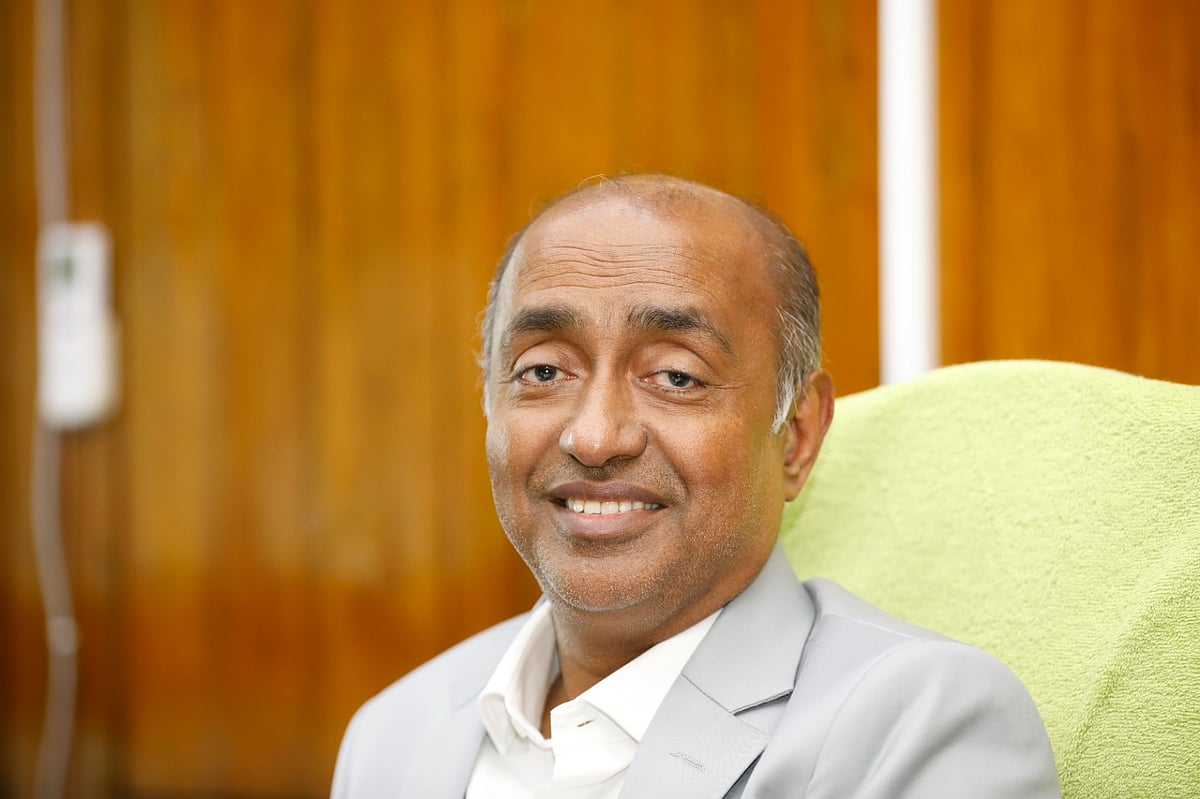
Special interview: Law Minister Md Asaduzzaman
Property transfer act will not prevent anyone from following their religion
The 1882 ‘Transfer of Property (Amendment) Bill’, concerning the transfer of property, was passed in parliament last Sunday with a provision allowing donors to continue enjoying property they have donated for as long as they remain alive. Various religious organisations, individuals and the Opposition have opposed the law. Law Minister Md Asaduzzaman spoke to Prothom Alo about the issue at the parliament office on Monday. Selim Zahid and Riadul Karim took the interview.
Why was there a need to change the law?
Md Asaduzzaman: The main purpose of enacting the law is that we are witnessing parents becoming helpless in their old age in this society. Even after children have had property transferred to their names, parents are being forced out of their homes. It is from the idea of protecting parents in such situations that this law has been enacted for them.
We are witnessing many parents in society being forced out of their homes after giving their property to their children. Some are suffering from cancer and have property, but the parents are unable even to enjoy their own property. Several years ago, a case came to my attention in which, after a retired major general died, his children had the property transferred to their names. One week later, they threw their mother out of the house.
There are many such small incidents. There are also cases where, after someone dies, other heirs come forward and engage in lawsuits. As a result, while elderly people need protection on the one hand, on the other hand, we are also trying to work on the various avenues for litigation and how such lawsuits can be prevented. It is with this in mind that we brought the law to parliament.
The Opposition said something on Sunday—the Parents’ Maintenance Act of 2013 already exists. So why was this needed again?
Asaduzzaman: This has been introduced anew. The reason is that under the Maintenance Act, parents have to file a case in court. Given our social culture, parents do not easily want to lodge lawsuits against their children. So we do not want to put parents in such a vulnerable position in the later stages of their lives. From the Islamic perspective as well, respecting and taking care of parents is one of the fundamental responsibilities of children.
Here, there are two things in the law. One is the corpus, which we refer to as the principal or ownership. Ownership, however, is being transferred to the child, who is the recipient. The other is usufruct. The literal meaning of usufruct is to enjoy or use someone else’s property. In other words, once the gift is completed, the child becomes the owner. The parents will enjoy the property as the usufructuary. This is permitted in Islam.
As the law minister, what do you consider the most important change in this bill, and what direct impact will it have on people’s lives?
Asaduzzaman: I am receiving calls and messages from many people. They are saying that this is a landmark law. The way this law has been enacted to protect helpless elderly parents in Bangladesh means it will be remembered as a landmark law. It is also a progressive law. Even Shishir Monir, a Jamaat-aligned lawyer, sent me a message about this.
What did he send?
Asaduzzaman: He said that he personally did not find anything wrong with this law.
But the Opposition raised a debate over the bill in parliament on Sunday, saying that it is contrary to the Quran and Sunnah. They are saying that Islamic laws relating to inheritance, wills and hiba will all be affected.
Asaduzzaman: It is specifically mentioned in Section 122 (A)(4). Regardless of whether there is a hiba, gift or any other format under other laws, it will not be affected or restricted by this law.
Bangladesh is home to people of various religions, including Muslims, Hindus, Buddhists and Christians. Will the law apply to people of all religions?
Asaduzzaman: Yes, that is why it has been enacted. It will apply to Bangladeshis. It will apply to matters concerning property in Bangladesh.
Property and inheritance laws differ among religions. Will there not be any contradiction in applying the law to everyone?
Asaduzzaman: There will be no contradiction. If someone wants to follow their religion, the law will not stand in their way. Anyone who wishes to do so can. An option has been kept in the law. We have also specifically mentioned that in the sub-section 4.
Did you consult or speak with Islamic scholars at any stage before enacting the law?
Asaduzzaman: We spoke informally with a few people. I even spoke with the person from Jamaat whom I mentioned, Shishir Monir—he is a good lawyer. I spoke with him as well. He also said, “I do not see anything wrong here.”
You said in parliament that this law does not touch upon Muslim law. What will be the difference between hiba, which is customary among Muslims, and a gift under this law? Will hiba remain?
Asaduzzaman: Of course, hiba will remain. I have stated that in the law itself. Section 122(A)( 4), clearly states this. It will not only leave hiba untouched; it will also not affect the personal laws of other religions. Everything is protected.
The Opposition is opposing this law, and other religious organisations, including Hefazat-e-Islam, have also issued statements expressing their reactions. Are you feeling any religious pressure over the law?
Asaduzzaman: I do not see that as pressure. They have given their interpretations. I think it is their misinterpretation. On the one hand, they are saying that this law is against Islam. On the other hand, they are saying that an amendment should be brought to include a provision that the 1937 law will also apply here.
But the Opposition said on Sunday that the government is giving a misinterpretation.
Asaduzzaman: I do not think so. We have spoken with references. On this particular point of the law, we have given references to laws from around the world. We have cited references from Malaysia, Jordan, Saudi Arabia, the UAE (United Arab Emirates), the Privy Council, the Indian Supreme Court and the Pakistani courts. We have made this clear.
Suppose a father gives his house as a gift to his son. But under the new law, the father will use the house while he is alive. So who is the legal owner—the father or the son?
Asaduzzaman: The son. The moment the gift is made, the son becomes the owner.
What happens if the son does not allow the donor to exercise the right of usufruct?
Asaduzzaman: We have kept an option there. He can directly file a petition with the district judge.
So then, just as they have to go to court under the Maintenance Act, they would have to go to court here as well...
Asaduzzaman: That will be very rare because this law has been made so clear that no son will be able to take advantage of that opportunity.
Can the donor later sell, mortgage or otherwise transfer the property they have given away to someone else? If so, where would the recipient’s rights stand?
Asaduzzaman: No, they cannot. They can only enjoy the property. This is where the difference from hiba lies.
Is there a concern that someone could use this law to bypass inheritance laws and devise a new way of distributing property during their lifetime?
Asaduzzaman: I do not see that at present.
If a father gives all his property to one child while retaining the right to enjoy it during his lifetime, will the other children still have an opportunity to inherit?
Asaduzzaman: That is also possible under hiba. If a father decides to give all his property to one son, he can do that under hiba as well.
Would this contradict Islamic law, meaning the inheritance law as it exists in our country?
Asaduzzaman: It does not contradict it at all. As an example, we have said that the Muslim Family Laws Ordinance of 1961 introduced several changes. They were landmark changes. Suppose I have an only child. My child dies before me. If I had died first, that child would have inherited under Islamic law. But if the child dies first, their children, the minor children, would not receive my share. They would not receive what their father would have inherited from me. In 1961, the law states – no, the share that child would have received will go to their children.
Then, suppose under Islamic law, saying “three talaqs” orally results in a divorce. The 1961 law said – no, saying three talaqs does not mean that the divorce will take effect immediately.”
Third, suppose a husband and wife get divorced. If they wanted to marry each other again, there was a provision requiring a halala marriage. The 1961 law said – no, there will be no such thing as a halala marriage. The divorce has become final. If they wish to do so later, they can marry each other again.
If the law applies equally to Muslims, has any special protection been included in the bill to avoid potential conflict with Muslim inheritance law?
Asaduzzaman: Yes, it has.
What is that?
Asaduzzaman: The provision in Section 122(A)( 4), says that none of those laws will in any way be obstructed by this law.
The opposition alleges that Shariah provisions are being bypassed in an attempt to solve a social problem.
Asaduzzaman: That is incorrect. An opposition MP sent me an opinion from a scholar today (Monday). The opinion says that conditions cannot be imposed on hiba. I am also saying that no conditions can be imposed on hiba. That is why I am leaving hiba untouched. This is Islamic law—I have not interfered with it.
Now, regarding this property that will be given under the new provision, there is the existing practice of giving property through hiba. What will be the procedure for giving it?
Asaduzzaman: It will have to be registered, in the same way as hiba is registered.
What will this registration be called?
Asaduzzaman: That will be a gift. In English, it is called a ‘gift’.
Some people are also concerned that the new provision could lead to an increase in property-related lawsuits in the courts.
Asaduzzaman: It will reduce them further.
Is there any explanation for how the number of property-related lawsuits will decrease?
Asaduzzaman: Because when it is clearly stated that the donor will retain the right to enjoy the property during their lifetime, the children, when they see it that way, will not dispute it. Since the ownership has already been decided, the number of lawsuits over this will not increase in any way. They will be discouraged from going to court.
Have references from other countries around the world been incorporated into this law?
Asaduzzaman: We have included references from other countries. We have said that provisions for such separate gifts, outside hiba, exist in various Muslim countries around the world. For example, we have cited Saudi Arabia, Malaysia and the UAE. The Privy Council even addressed this in 1922. It was not about a law of this kind; rather, it said that if a person retains a usufruct right at the time of making a hiba, that would not make the hiba invalid.
Would you like to say anything to those opposing this law or to Islamic scholars?
Asaduzzaman: I would tell the Opposition: Please read the law carefully, understand it properly, and recognise that the responsibility of children towards their parents is gradually declining. Come back from the position of giving an misinterpretation of this law, which has been introduced specifically to protect parents from this declining sense of responsibility.
My message to Islamic scholars is very clear. You are saying that hiba has been touched by this law—I am saying that hiba has not been touched. Please look carefully at Section 122(A)(4). It clearly states that this law will neither affect nor touch hiba, or the mode of transfer under Islamic or other religions, or any other method provided for under other laws.
Do you think any changes or additions to this law are necessary?
Asaduzzaman: At present, I do not see any. If any problems arise in the practical field in the future, we will look into them then.
If any proposal comes from the Opposition as well, will there be an opportunity to include it in this case?
Asaduzzaman: If something positive comes up and we feel that there is scope to consider it from a legal perspective, it will certainly be taken into consideration.
Thank you for giving us your time.
Md Asaduzzaman: Thanks to Prothom Alo as well.