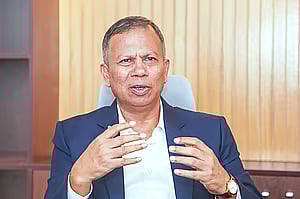
Exclusive Interview: Md Mahfuzur Rahman
Now we need reform in security and defence sectors
Lieutenant General (Retd.) Md Mahfuzur Rahman is the former Principal Staff Officer of the Bangladesh Armed Forces Division. He is currently the Chairman of the Osmany Center for Peace and Security Studies. He spoke to Prothom Alo about the role of the armed forces in the 2024 uprising, the need for military reform, accountability in the appointment of service chiefs and the DGFI chief, and the possible role of the armed forces in the upcoming election. AKM Zakaria and Monoj Dey took the interview.
Prothom Alo: The July mass uprising has brought about a historic shift in Bangladesh’s political landscape. The significant role of the armed forces in this uprising has been widely discussed. On 3 August, the Army Headquarters issued a clear statement declaring that soldiers would not open fire on protesters. This undoubtedly played a major role in changing the course of the movement and paving the way for the uprising. How do you assess the role of the armed forces in the July mass uprising?
Md Mahfuzur Rahman: If we compare our July mass uprising with the Arab Spring, we’ll see that only in Tunisia and Egypt were the uprisings truly successful. The main reason was that the armed forces in those two countries refused to fire on the protesting people. As a result, Ben Ali’s 23-year authoritarian rule in Tunisia and Hosni Mubarak’s 30-year regime in Egypt came to an end.
In my view, the decision on 3 August by Bangladesh’s armed forces not to fire on students and civilians was the final nail in the coffin of Hasina’s rule. That said, I commend the military command chain for two reasons. First, they were able to understand the broader sentiment within the armed forces. Second, one of the pillars of our national defence policy is that the military must be people-friendly. The armed forces gave due importance to this principle.
Therefore, it is both natural and expected that the military would reflect the will of the people in times of national crisis. And that’s exactly what they did.
Prothom Alo: At various times in Bangladesh’s history, we have seen the military play roles in major political transitions. During the 1990 mass uprising, the army ultimately refused to support the autocratic ruler Ershad. It is said that alongside the mass movement, the military’s withdrawal of support was a key reason Ershad could no longer hold on to power.
Later, during the political crisis over the caretaker government at the end of 2006, the resulting unrest and violence led to military intervention in politics. The army played a significant role, and the subsequent government that took office was widely seen as a military-backed caretaker administration. How do you interpret this ongoing and consistent role of the military in Bangladesh’s politics?
Md Mahfuzur Rahman: The primary responsibility of the armed forces is to protect the sovereignty and territorial integrity of the country. When the nation’s core values and interests come under threat—and when other institutions or bodies fail to address the crisis—the armed forces step in as part of their duty.
The origin of Bangladesh’s armed forces is also relevant here. The military was born out of the Liberation War, rooted in and centered around the people. One of the key strategic elements in our defence doctrine is the use of "population depth"—the idea that the people are an integral part of national defence. Taken together, it’s only natural that Bangladesh’s armed forces ultimately prioritise public interest.
If you look at history, you’ll see that the armed forces of Bangladesh have consistently stood with the people. To put it another way, when natural disasters or man-made crises strike, the military responds as part of its responsibility. Sometimes, political crises in our country escalate to a level where they pose a serious threat to public interest and core national values. In those moments, the armed forces naturally side with the people.
In the July uprising, the military, at a certain point, stood with the people—but crucially, it stayed away from taking power. In doing so, the armed forces showed respect for civilian governance.
Prothom Alo: After the fall of the government on 5 August amid a political vacuum, the armed forces played a noticeable role in facilitating dialogue, negotiation, and the formation of a new government. How do you view this role?
Md Mahfuzur Rahman: In my view, the role of the armed forces became important after the fall of the government on 5 August for two main reasons. First, a vacuum had emerged—no state institution was in a position to function effectively. Second, most of the government institutions had, until the very end, operated in support of authoritarian rule, which caused them to lose public credibility.
In contrast, the armed forces, in the final stages of the movement, stood with the students and the people, which earned them legitimacy. As a continuation of that, the responsibility of assisting in the formation of a new government and re-establishing administration naturally fell on the armed forces.
In a democratic framework, the armed forces operate under political authority, which is guided by the will of the people. However, during the critical juncture of 2024, the armed forces played a supportive role in the formation of an interim government. As a result, the dynamics in this case were somewhat different.
Prothom Alo: The interim government formed through the mass uprising is now overseeing a transitional period toward democratic political transformation. How effectively is the relationship between the government and the armed forces functioning during this interim phase?
Md Mahfuzur Rahman: In a democratic framework, the armed forces are subordinate to political authority, which in turn is guided by the will of the people. However, during the critical juncture of 2024, the armed forces played a supportive role in the formation of the interim government. So, the dynamics in this case are somewhat different.
Given this unique context, while the armed forces are formally under the authority of the government, there may be a psychological perception of them as a partner institution. But that is just my personal observation.
Prothom Alo: Some differences in tone have been noted in the army chief’s statements regarding the government’s stance on various issues, particularly on the call for a quick election, granting a humanitarian corridor to Myanmar, and broader national security matters. How do you interpret this position?
Md Mahfuzur Rahman: Over the past one and a half decades, the previous government weakened the institutional capabilities of the army, much like other institutions. Efforts were made to move the army away from professionalism. Training, manpower, equipment, and evaluation of merit—elements that strengthen the core of the army—were neglected.
In this context, the current army chief undoubtedly understands well where the weaknesses of his force lie. I believe the chief is likely trying to reorganize and consolidate his troops and bring the army back to the barracks as soon as possible. This means he wants to return his force to its fundamental duties.
Regarding national security issues, it is natural for the armed forces to have a significant opinion, but I see this as a difference of opinion rather than a conflict.
Prothom Alo: In the post-uprising political reality, many consider the close relationship between the interim government, student leadership, and the military to be very important. However, there may also be divisions or misunderstandings. Some student leaders have at times raised accusations against the military, and even against the army chief. What are your comments on this situation?
Md Mahfuzur Rahman: Among the three parties you mentioned, each has different expectations from and experiences with the others. I believe this is primarily responsible for the current situation. Because all of us had sky-high expectations from each of these groups. Yet, none of them had sufficient prior experience to fully perform the responsibilities they received. Many of the respected advisers had little experience in running the country. The students lacked prior experience in providing political leadership at the national level. The military, like other law enforcement agencies, had no prior experience managing law and order on the ground during such a fragile situation.
Moreover, sixteen years of fascist rule had rendered the entire state machinery ineffective. Within this broken system, without prior experience, these parties tried to do as much as they could. But understandably, they could not fully succeed in achieving the desired goals, neither for us nor for themselves.
If the appointment of the heads of the armed forces, as well as the DGFI and NSI chiefs, remains in the hands of the President or the executive branch, there will be no significant qualitative change. For example, we can look at the previous administration. Even if the power to appoint the heads of the forces had been with former President Abdul Hamid, would such appointments have been possible in practice without the consent of the then prime minister?
Prothom Alo: Bangladesh’s experience shows that political loyalty often plays a significant role in appointments to various posts in the armed forces, including the army chief. Initially, the National Consensus Commission proposed the formation of a national constitutional council for appointments to several constitutional posts, including the chiefs of the three military branches.
However, political parties rejected this, and the proposal was dropped. Later, the commission suggested giving the President independent authority to appoint the chiefs of the three armed forces (Army, Navy, Air Force), as well as the Directorate General of Forces Intelligence (DGFI) and National Security Intelligence (NSI), among 12 key institutions. But major political parties, including BNP, preferred to keep these appointments under the executive branch. What is your stance on appointments to these key armed forces positions? How should they be made?
Md Mahfuzur Rahman: If the appointment of the heads of the armed forces and the chiefs of DGFI and NSI remains in the hands of the President or the executive branch, there will be no significant qualitative change. For example, looking at the previous administration: even if former President Abdul Hamid had the power to appoint the chiefs, would such appointments have been possible without the consent of the then prime minister?
What we now need is reform of the armed forces and the sector as a whole. We need changes in the appointment process. At the military strategic level, the Chiefs of Defence Committee or the Chief of Defense Staff Secretariat should prioritise a panel for appointing the three service chiefs and then forward it to the President for approval or to the executive branch for recommendation. For the DGFI and NSI chiefs, the top-down appointment system must be avoided. When these two positions become vacant, the forces should submit proposals.
However, most importantly, promotions or appointments up to the rank of three-star (Lieutenant General) should remain with the service selection board or the forces themselves. In this way, the selection of officers up to three-star rank will be based on merit, capability, and reputation. Consequently, regardless of the procedure followed, the appointment of the armed forces’ chiefs will automatically be from among qualified individuals.
Prothom Alo: Not only during Hasina’s tenure but also in previous governments, military and state intelligence agencies such as DGFI, NSI, and DB have been used for partisan purposes. During Hasina’s time, DGFI’s secret detention centre ‘Aynaghar’ became involved in suppressing dissent through enforced disappearances and covert torture. What kinds of reforms do you think are necessary to prevent such agencies from being used for political aims or repression of their own citizens in the future? What could be the framework for accountability?
Md Mahfuzur Rahman: As I said earlier, reform of the security and defence sector is necessary. DGFI is the intelligence agency of the armed forces. It provides operational and administrative intelligence support during peace and wartime, especially combat intelligence, which is extremely important.
To prevent DGFI from being controlled by politics or used as a tool for repression, it must be kept within the command structure. DGFI should work under the military strategic command—that is, under higher defence organisations such as the Chief of Defence Staff (CDS) headquarters.NSI can work under the wartime National Security Council and, during peacetime, under the executive branch. However, the Detective Branch (DB) should remain under the command of the home ministry. These agencies must move away from a culture of working under the executive branch or directly under the prime minister’s command.
Prothom Alo: Since 5 August, the armed forces have been deployed in the field to maintain law and order. They are operating with magistracy powers. However, over the past year, one of the biggest concerns for citizens has been the security and law-and-order situation. There doesn’t appear to have been any significant improvement in this regard.
Md Mahfuzur Rahman: Despite the armed forces being present in the field since the uprising, the law and order situation has not returned to a satisfactory state, which is indeed a cause for concern. In the past, the armed forces, acting as a supporting force to the civilian administration, were able to visibly improve the situation by enhancing the effectiveness of the law enforcement agencies on the ground. However, the police and Ansar forces still haven’t become fully operational or effective. Taking advantage of this, criminals have increased their activities.
The army, alongside performing its core duties, has managed to deploy around 30,000 personnel in the field. It is difficult to match the effectiveness of 200,000 police personnel with just 30,000 soldiers. Intelligence support from police and RAB agencies is crucial for identifying hardened or serious criminals and intercepting crimes before they occur.
But even these intelligence agencies have not yet become fully active on the ground. I believe the armed forces are also likely exercising caution in using their magistracy powers, perhaps to avoid misuse or overreach. Due to all these limitations, the law and order situation has not reached a satisfactory level. This is a matter of concern for everyone.
Prothom Alo: In the wake of the government’s fall on 5 August, the armed forces have been deployed to maintain law and order, wielding magistracy powers. Yet, over the past year, public concern about the security situation remains high. Given the current capacity of the police, how much and what kind of role should the army play in ensuring a fair and safe election environment?
Md Mahfuzur Rahman: A free and fair national election is everyone’s expectation. Under the current neutral government and with the election commission’s oversight, it is widely hoped that the armed forces will play a strong supporting role in the upcoming election. I believe the armed forces, led by the army, should act as the lead institution among all law enforcement agencies to create a secure electoral environment. We’ve already learned that the army has indicated it can provide around 80,000 personnel for this purpose.
Prothom Alo: The current Representation of the People Order (RPO) doesn't include the army as part of election “law enforcement agencies.” While the army can be deployed as a striking force for security when needed, this must be done per administrative decisions and the election commission’s requests. In the last three elections, the army hasn’t played any meaningful role. If you want the military to have an active and direct role, won’t the RPO need revision? What’s your opinion?
Md Mahfuzur Rahman: Indeed, the election commission has already initiated efforts to amend the RPO to include the armed forces and the Coast Guard among law enforcement agencies. I hope the interim government will adopt this proposal, allowing the army to play an active and effective role in ensuring a fair election.
Prothom Alo: How would you evaluate the current capability and competence of the armed forces?
Md Mahfuzur Rahman: In 2016, Myanmar’s junta sent nearly 90,000 Rohingyas into Bangladesh, and the world—and even Bangladesh itself—simply protested. It revealed that Bangladesh lacked credible deterrence capabilities. Then in 2017, Myanmar pushed an additional 700,000–800,000 Rohingyas across the border. There are still many more in Rakhine, and future waves cannot be ruled out. Myanmar’s military, which had previously bullied us, now faces threats from the militant Arakan Army. This shift is because Bangladesh lacks reliable defence deterrence.
Over the past 15 years, we've failed to recognise and promote merit within the armed forces. When the force lacks talent, it cannot outwit its adversaries. At times, deals have been made for vested interests, which hindered our ability to build strength.
But there is a positive side. Our army has proven its capability in counter-insurgency operations in the Chittagong Hill Tracts and in UN peacekeeping missions. In other words, the core strength of our forces is intact. Now, it's crucial to conduct operational and logistical audits to assess ‘strengths and weaknesses.’ The forces should be given autonomy in command to allow them to adequately prepare.
Prothom Alo: Thank you.
Md Mahfuzur Rahman: Thank you.