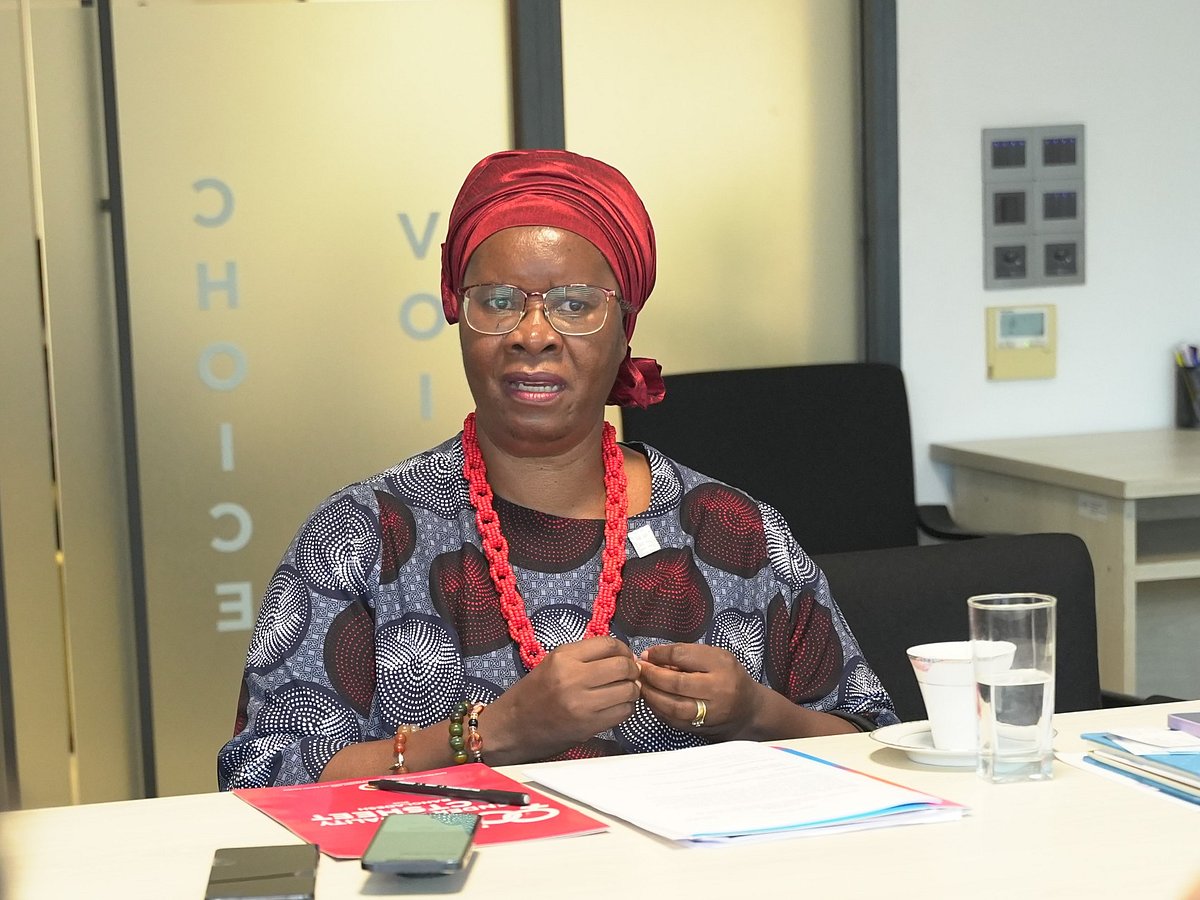
Interview: Nyaradzayi Gumbonzvanda
Women's empowerment must be given priority
Nyaradzayi Gumbonzvanda, Deputy Executive Director for Normative Support, UN System Coordination, and Programme Results, visited Bangladesh from 16–21 May this year. During her visit, she travelled to Dhaka and Cox’s Bazar and engaged with key UN Women partners, including government counterparts, civil society organisations, and development partners, to discuss both opportunities and challenges in advancing gender equality in Bangladesh.
In an interview with Prothom Alo, Gumbonzvanda speaks on gender equality issues and ways to strengthen collaboration to accelerate the implementation of international and national commitments on gender equality. She was joined by Christine Arab, Regional Director, UN Women Regional Office for Asia and Pacific. The interview was taken by Ayesha Kabir.
Prothom Alo: Welcome to Bangladesh. You have had a very busy visit in Bangladesh. What are your takeaways from this trip, and what opportunities do you see for advancing gender equality here?
Nyaradzayi Gumbonzvanda: We have come here together with the regional director to understand and support UN Women's effort in Bangladesh. We are here to support the country, the government, the civil society.
We had an opportunity to meet with the Foreign Ministry, the Ministry of Women and Children Affairs and with the Elections Commission. These gave us a perspective on where the country is three months after the elections.
Bangladesh is one of the countries that have ratified many international conventions and treaties that advance women's issues including the Convention to End Discrimination Against Women CEDAW). There's still a little more to do like lifting the reservation on Articles 2 and 16 of the Convention.
The country has some solid policies but the critical action is around implementation. In our meetings with the government, the emphasis was around implementation of existing policies and scaling up some of the innovations and creative ways to address social protection issues like the family card, the farmer's card.
There is also acknowledgement that the area of women in decision making is not satisfactory in terms of the numbers that were achieved in the elections, in terms of women's participation in the elections. There are seven women who are directly elected and there are 50 who are through the quota system. Bangladesh is a member of the United Nations has a commitment to gender parity, so there's still more work to be done. We are looking forward to the forthcoming municipal elections and local elections. That can be a start to build a solid base for increasing women's participation and also participation of women as voters. We heard how some women were not able to register to vote. There were social norms that limit their participation. Women's political participation is as candidates, as voters and in the administration of the election. So it was good to meet with a woman who is in the Election Commission.
We had engagement with the women of this country, the women's rights organisations, the wider civil society organisations, the young women, women with disabilities, women who were involved in the July uprising, And what we heard are issues that have regional and global perspective.
Access to services is critical. Shifting social norms is important for us to reduce gender inequalities, for us to empower women, to have rights of women. It's also important to understand the diversity of the country. When we met with the indigenous women or women in rural areas, some of their issues are the same as others, but they are also extra issues, land rights issues. So we had a very good interaction in terms of the levels of poverty, economic empowerment, sexual gender-based violence and violence against women.
There are unacceptable levels of what is called child marriage which I call child rape. Sexual exploitation and abuse is 50 per cent. That is very high. One is too many but 50 per cent is unacceptable.
We also cry with one eye, but smile a bit with the other. We are deeply hurt when we see the conditions of women refugees. They just want peace and to go back home, but they also want to live in safety where they are now. They also want skills and education for themselves, for their children.
We really appreciate that Bangladesh is hosting 1.2 million. We also appreciate the hospitality of the host community and of the people of Bangladesh and the donors who continue to support and the partners to hold this work together.
Why do I smile with another eye? It's because I saw women with courage, women who are refugees standing up to find solutions, to build skills. They are creating women's groups in order to show leadership, give hope to themselves and their children. They're giving psychosocial support and UN Women is there with partners like Action Aid. They have a multi-purpose center. We need this multi-purpose centers to be replicated over and over. While we work for long-term durable solutions, there are certain things that can be done in the moment. That was the experience from Cox Bazar.
I'm very pleased that we have a strong UN Women presence in the country in order to be the voice within the United Nations system itself. So when other UN agencies are doing their work, we are there to advise them to also carry the focus on women within their work. So that is our voice within the system. We also have our relationship with government. UN Women as an intergovernmental body has direct engagement with the state. We can advise, we can co-convene. And lastly, our relationship with the women's organisations has certainly been an experience.
I think the last experience is just the wonderful food in this country and to know that every bowl of rice has a woman's hand in it. The woman farmer is providing the nourishment of what we what we enjoy every day. It is women feeding the nations. It's women's economic empowerment, working with women farmers within the value chain and not just for production, for survival of their households but also for export and trade. This has been my broad impressions here.
Christine Arab: Just to give an overview, last year was the 30th anniversary of Beijing platform for action. That remains the seminal statement of the member states on their commitments to gender equality. It's the most wholesome declaration and when we measure it every five years across Asia and the Pacific, we see important gains. We see greater depth of services for gender-based violence across the region, a higher push to get more women into the labour market. But the overall percentage point movements of labour force participation of women and men remains a relatively low. The Pacific has some of the lowest rates of women in elected office in the world. South Asia has the second largest number of femicide related crimes in the world.
The engagement of women in disaster risk reduction and in climate mitigation strategies and in green-friendly approaches is significantly increasing. UN Women has played an important part within governments who are all openly asking how to engage more women in communities that have so much disaster.
The single biggest request that UN Women gets is support with the changing demographics in Asia and the Pacific and need for the care economy to respond to that. The second ask is how we deal with cyber security and tech facilitated violence because we have a large peace and security mandate. We deal both with the broader concept of cyber security and with tech facilitated gender-based violence which is so prevalent. That's the regional context.
Prothom Alo: Bangladesh has made important gains on gender equality, but what do you see as the most pressing gaps and unresolved challenges that need urgent attention?
Nyaradzayi Gumbonzvanda: It's important to address the question of social norms in a bold but clear way. Negative social norms can confine women to their space and result in certain protection behaviour. Social norms define how we are supposed to present ourselves in public and in private. At the same time, we need the transformation of the positive social norms and also to say our religions and our cultures start from the foundation of affirming love. We have the convention of the United Nations on social, economic and cultural rights. Culture is respected, but respect of culture should not result in the undermining and the oppression of women, or in justifying rape of our children. When a 10-year-old is married an older man of 40 or 50 years, that's rape. Our respect for our cultural and religious institutions should not result in the violations of women. It requires our work together with faith communities and faith leaders so that the transformation is from within the institutions and by the leaders themselves.
It's one thing to say we have an education policy which gives equal opportunities. It's another thing to have a school which is close enough where the girls don't have to walk long distances so they won't be abused on the way to school. Services which are accessible and affordable are very important. As UN Women, with our mandate on SDG, we look at the accountability of the state. It is our governments which have to provide social services, social protection. That is at the heart of transforming societies.
There must be zero tolerance. Where there is impunity there is perpetuity of violations. It is very clear that we need to address the issues of impunity and the issues of access to justice. This is why the 70th Session if the Commission on the Status of Women, which was adopted this March, was fundamental because it gave a whole range of actions that are needed to address the prevention side and also access to justice.
Christine Arab: In the case of South Asia, when one thinks of care the immediate focus often is on child care. But it is increasingly an issue of elderly care and care to persons with disabilities, mental or physical. We see a lot of interesting innovation within the private sector across the regions including in Dhaka, in Kathmandu, Islamabad, Delhi, Colombo, everywhere. The ministries dealing with women and children want enhanced care policies and they're already moving in that direction.
One of the biggest challenges is that care involves multiple government entities. In the countries that have really robust social welfare nets and social security, the public-private partnership is why it's sustained. There's no illusion that government resources should be wholly financing this. But private sector can do more. And embedded in that is domestic workers either migrating to be domestic workers or they've migrated and are domestic workers in the country. How do we keep that dialogue going so that it's safe and protected and formalised. All of the SAARC member states, excluding Afghanistan because the de facto authorities are not recognised, recognise the complexity of the domestic workers and how to do better in protecting them.
Prothom Alo: What priority areas specifically could help further accelerate Bangladesh's progress on gender equality and women's empowerment?
Nyaradzayi Gumbonzvanda: If we are to accelerate implementation and transformation, there are a couple of things that needs to happen. First is the intentionality of the government. This is a government which is three months on the road. So the intentionality to put the issue of women's empowerment and gender equality at the heart of the government, is very important because that would send a cue to the various ministries in terms of what they need to do. That is one thing.
The second to really accelerate the implementation is women's economic empowerment at the community level. We need to work with private sector, big businesses. Women want to own land, to have the necessary skills to be able to address the barriers to production. We had discussions around the impact of the regional dynamics of the war on women farmers who have to produce. Fuel is expensive. It's really about putting resources to the economic empowerment and skills for women. It is really important is to support women's organisations and networks.
When we met with the women's groups, it was very evident that there is less resources to women's organisations, but they are not giving up. Women never give up, whether it's the women journalists, the women working on gender-based violence, the women's rights organisations and the researchers.
Yesterday we experienced a very exciting approach in Cox's Bazar -- the integrated multipurpose empowerment center which is delivering services to the Rohingya refugees and especially women. Those one-stop centers with integrated services for women can actually be replicated throughout the country. A woman comes in, she gets information, she gets counseling, she gets legal assistance and if she needs a little bit of skills, she can get the skills there. If she needs support around maternal-health related information, she can get advice there and she can have a place for her little kids if they are not at school. So this one-stop center is an integrated multipurpose centre. These models can be scaled up. I also feel we talk so much of the rural context. We need to address the issues of urban poverty. Urbanisation is not equal opportunities for everybody. It is important for all women and girls to have opportunities to live in safety, to equally participate politically.
Christine Arab: In the case of Bangladesh, in addition to the priorities just mentioned would be statistics. We have the fact sheets of last year. The UN developed with the government a prevalence survey on violence and there's the multi-indicator cluster survey that gives you some of your most recent statistics on child marriage and other harmful practices. Those statistics are crucial right now because of the way that the government is grappling with the impact of the Middle East conflict on Bangladesh's economy and the trajectory of graduation from least developed to middle income. It's crucial to understand where the communities are impacted.
The second issue is we do a lot of work with women on environment. We do this jointly with the UN environment program. We look at it from a few angles. For example, if I'm starting a small business, how do I make it green and friendly? How do I market that? How can I capture some of the climate-related financing that's out there which private sector benefits from?
Then the other issue is the mitigation strategies, social cohesion, keeping a multi-ethnic community working well and living well together.
But statistics are crucial. Bangladesh is doing better than some of its neighbours in North Asia and Southeast Asia on this, but they need more. In our meetings with the government this came up. They want to deepen their understanding of the bottlenecks in women's formal labour force participation. A perfect example is the implications of the fuel prices to the readymade garment industry. There is a direct implication. It's the same with rice harvesting.
The other point that's come up is inheritance land. I work the land. Do I own the land? Can I draw a loan from the bank from the land if I work it and harvest it?
Prothom Alo: What enabling conditions and reforms could further strengthen women's political leadership in Bangladesh?
Nyaradzayi Gumbonzvanda: First, the political environment is regulated by the electoral laws. So the electoral laws need to be able to facilitate the participation of women. That is a constitutional right.
Second are the laws within the political parties. In many countries including in Bangladesh, it's possible for women to run as independent candidates but it's tougher to be an independent candidate because the political parties have a system of support. If you're an individual candidate, you can run for public office but the persons in political parties have the whole infrastructure. At times the discrimination and the violations and the exclusions happen within political parties. So reform within the political parties and clear guidance from the electoral commissions are very important.
It's a contradiction that women's participation in social civic engagement might not immediately translate into political numbers. That's where the frustration is. We also need to finance women. Running a campaign is expensive. The support around women's electoral engagement is important. We understand that there are discussions in the country around the quota system and the direct election. We need both.
Affirmative action or special measures or quotas for us in the UN, are part of the mechanisms that are established in order to accelerate women's participation because women face different barriers to men. If we have to reach gender parity we actually need the quotas. What is important is within each country's own jurisdiction, is how those quotas are managed. When we look at the situation in South Africa where you have affirmative action, a quota system is a measure of direct interaction and engagement with the community.
We also need young women. It's a little bit easier for young men to engage in in politics, but we need young women. For young women, it's very tough. A boyfriend can say, "Hey, now you want to leave me and you're busy running away with the politicians and I thought I was going to marry you. What would my mother think about a daughter-in-law who is running around saying political things!" A young woman with little kids has to make a decision on whether to put money to the school fees for the kids or to a campaign. Increasing young women's participation requires understanding the barriers which young women face, technology-facilitated violence, online violence, body shaming. Older women will just be told, why can't she go and rest? What is Old Mama wanting to do? For the young women, it's more sexualized messages. It could result in stalking and a range of other abuses. So we need to have multiple layers of interventions. The law is not enough by itself without changing the social norms and creating support for the enabling environment.
Christine Arab: The local elections are great opportunities. We worked closely with the electoral commission and UNDP and UNESCO and went really well with the national elections in terms of tracking hate speech, contradicting false narratives and false information, trying to avoid harassment and physical intimidation of women voters. You need community dialogue, make sure youth stay closely engaged. We have met with some of the women youth leaders. They don't have a voice right now when they were a crucial part of the results. It simply is not right. Multi-party community-led dialogues on inclusion are crucial.
Prothom Alo: How can Bangladesh continue strengthening protection against sexual harassment to ensure safe workplaces and public spaces for women?
Nyaradzayi Gumbonzvanda: The sexual harassment law must be passed. It's long overdue. Women have told their stories. You want not to be touched when you are in a bus and the person who sits next to you touches you. UN Women has been working very strongly on the safer cities program with other organisations like UN Habitat, but the country must pass the law because this also would align with the Resolution 190 of ILO which addresses the issues of harassment in the workplace. There is the code of conduct of the private sector, the women's economic empowerment principles. As UN Women, we really want the private sector to sign up to these principles.
When we do gender responsive procurement, we are not just looking at whether a company has female shareholders, buying from women, but we are also looking at what is the company's policy on sexual harassment at the workplace, to have a few points in considering a tender because that starts to transform the attitudes of the private sector around workplace behaviour in relation to accessing opportunities for contracts. There are many tools that can be taken but the most important is accountability of the service provider. We may have the sexual harassment law passed which is important because then it creates the benchmark, but the accountability of the service provider would require a massive campaign of awareness on the sexual harassment law and to understand the consequences of abuse and harassment of women in public places.
It has been 80 years of the United Nations. That charter says people are born with inherent dignity and rights. Dignity means living in public spaces with safety and freedom. Dignity means knowing that you can be respected in every environment. So for us as UN Women, this issue is a charter issue. It's a UN charter rooted around sexual harassment in public places because it limits women's participation in public office but also in just accessing services. It's urgent that Bangladesh signs the sexual harassment clause.
Prothom Alo: When the workplace is somebody's home, then how do you actually enforce a sexual harassment policy? How do we protect informal sector women workers like domestic workers from sexual harassment of the workplace?
Nyaradzayi Gumbonzvanda: The informal sector is an organised sector, it's just not registered. Every market has its own social informal rules. So how we work with those informal sectors includes having to identify partners who actually work in the informal sector, who understand the dynamics of the informal sector, the residents associations, the transport network. So it demands us to insist on zero tolerance and address impunity. I have full confidence that we can prevent and reduce sexual violence and harassment in in the informal sector. It's just the approaches that we need to take in in addition to the sexual harassment.
Prothom Alo: Thank you so much.
Nyaradzayi Gumbonzvanda and Christine Arab: Thank you so much.