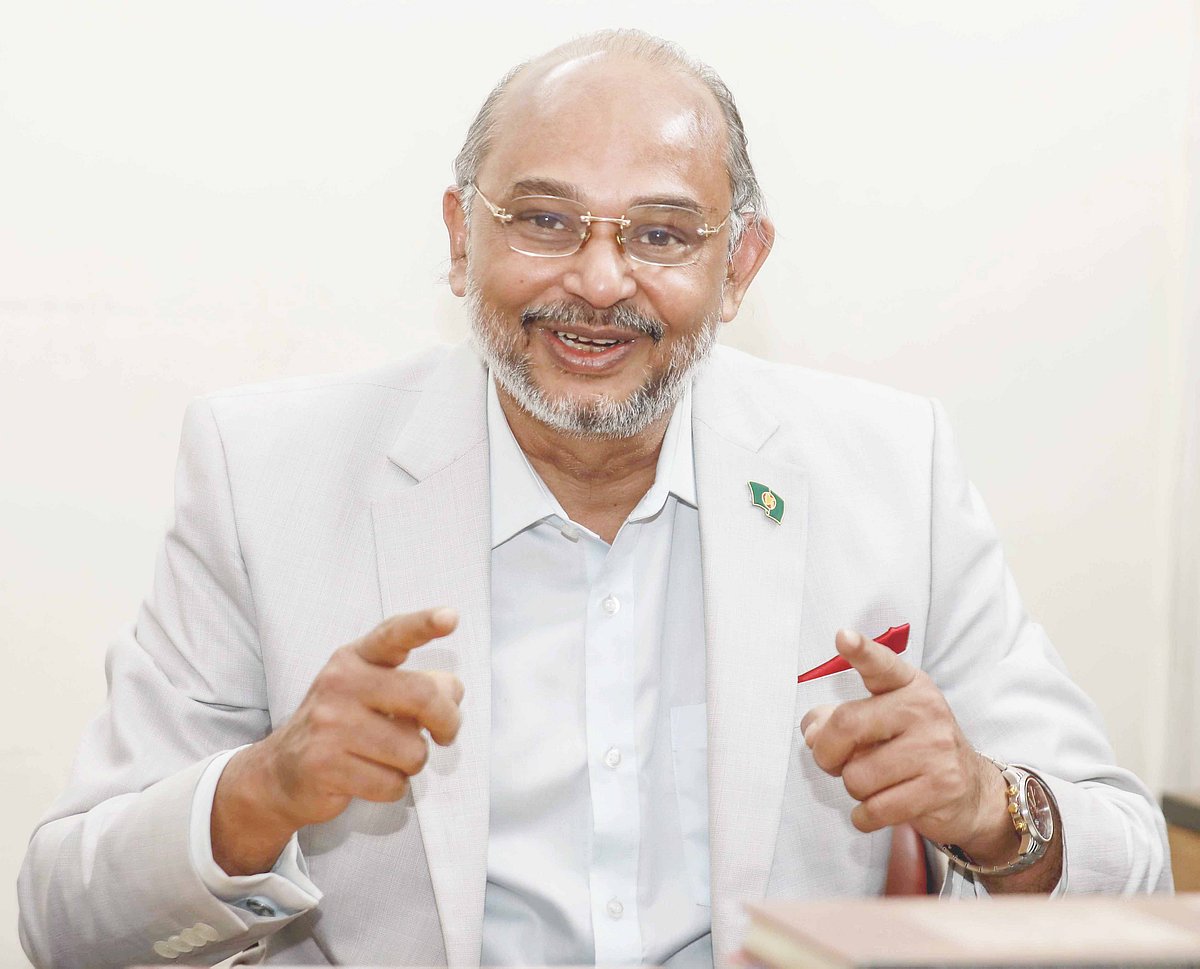
Exclusive Interview: Rashed Al Mahmud Titumir
BNP has presented a realistic plan
Rashed Al Mahmud Titumir is a professor in the Department of Development Studies at the University of Dhaka. He has spoken about various aspects of the BNP's manifesto. The interview was conducted by AKM Zakaria and Monoj Dey.
The country has gone through a prolonged authoritarian regime before the mass uprising. The corruption and misgovernance of the Awami League had surpassed all limits. After the mass uprising, the interim government ran the state for about a year and a half. What kind of challenges will the BNP face if it wins the election in such a reality? Which aspects have been emphasised in the manifesto to tackle these challenges?
Rashed Al Mahmud Titumir: The fallen oligarchic and fascist government left behind a decaying state, society, and economy infested with unaccountability, authoritarianism, patronage-based practices, and the rot of corruption. The challenges are mountainous. Therefore, the main subject of this time’s BNP manifesto is to reform the state to strengthen good governance, eliminate inequality, increase state capacity, regenerate and rebuild a fragile economy, ensure balanced regional development, and achieve national unity through active public participation in sports, media, and culture while maintaining religious-ethnic harmony. The BNP has presented a framework for implementing realistic, accountable, welfare-oriented progress, a prosperous Bangladesh considering historical experiences and present-day needs.
Political parties always give such good promises before elections. The question is, what is unique about the BNP's manifesto this time? And how attainable are these promises? What are the paths or strategies for implementation?
Rashed Al Mahmud Titumir: The BNP manifesto includes the strategies, timelines, and indicators for policy implementation. A few examples from the manifesto can be mentioned. Proposals for constitutional, parliamentary, judicial, public administration, local government, and police reforms and tackling corruption have been clearly and feasibly outlined.
Regarding the economy, a target of a trillion dollars by 2034 has been set.
This projection aligns with other international organisations. Detailed strategies for achieving this are mentioned. A model of ''economic democratisation'' has been given by reducing poverty and increasing the middle class population. Not just strategies for increasing domestic and foreign investments have been set, but targets have also been defined.
Implementing these requires skilled human resources.
Therefore, indicators of education, technical education, good health, and targeted programmes for youth development have been mentioned. At the same time, specific and actionable proposals for ensuring energy security and establishing a multifaceted communication system have been proposed. In other words, one of the aims of the BNP is to create employment opportunities for millions nationwide. The manifesto outlines policies, strategies, and methods to achieve this target.
Poverty, lack of employment, and low income are forcing a major portion of the population to live a tough life. What are the core promises of the BNP targeting this population? What is the strategy to save the poor populace from inflationary pressures?
Rashed Al Mahmud Titumir: Considering the unbearable life the public is currently enduring, the manifesto has presented some actionable plans. It has pledged to waive loans up to Tk 10,000 with interest for farmers, livestock farmers, and fishermen, and to repay one year’s installment for registered small loan institutions. Similarly, it has proposed increasing overseas manpower by enhancing skills.
The manifesto includes various actionable labour welfare proposals such as wage adjustments with the cost of living, reopening closed industries, and introducing a six-month leave policy in all sectors, which have long been demanded by labourers. To ensure social security, several cost-effective signature plans have been announced, including raising the current allowance, family cards, farmer cards, and the development of slum dwellers in urban areas. Women are at the centre of the BNP's agenda. Children, the elderly, widows, and people with disabilities have also been prioritised in the party’s manifesto.
Effective proposals have been made to save most of the populace from inflationary shocks. Measures against middlemen standing between producers and consumers will ensure fairness for both. Investment will increase if interest rates are rationalised. Assisting small and medium enterprises will reduce production costs, lowering the prices of goods. If anarchy in the banking sector is stopped, interest rates will decrease. Proposals to prioritise infrastructure development and make production materials easily accessible to reduce production costs have been made. It has been mentioned that increasing the capacity of various regulatory bodies will solve oligarchic conditions. Implementing such multifaceted measures will lower prices, bringing relief to public life.
Also mentioned are topics like reducing ongoing regional disparities by increasing agricultural processing and exports in the northern region, constructing the Teesta Barrage, turning Chattogram into a commercial capital, developing the blue economy, conserving rivers-canal-haor-baor-beel across the country, and constructing the Padma Barrage. So a practical manifesto has been presented by considering every aspect and sector for everyone without decorating it with false hopes.
So many promises require a lot of funding for implementation. How will these resources be arranged?
Rashed Al Mahmud Titumir: This question is also recurring among the country’s people. The manifesto sets a tax-to-GDP ratio of 15 per cent by 2035. Achieving 10 per cent in the medium term has been discussed. Considering calculations from international organisations and others, it will be seen that these targets are realistic. It has been specified where the quick realisation of 2 per cent tax will come from without increasing any tax.
Emphasis has been placed on ending wastage, not on austerity measures, by considering the ongoing strain of inflation and the sufferings of the people. Tested strategies such as activating the investment-production-employment-tax cycle have been chosen as a strategy for increasing revenue.
The BNP has spoken about programmes like family cards and farmer cards. In Bangladesh, various cards have been introduced before to aid the poor population. But due to political considerations and corruption, the full benefits have not reached the poor population. What guarantees that the same will not happen with the BNP’s proposed cards?
Rashed Al Mahmud Titumir: In Bangladesh's reality, such questions are normal and logical. Currently, social security programmes are scattered and fragmented. There are more than 100 programmes. The person who is supposed to get it is not receiving it, and the one who is not supposed to is listed due to political reasons. Although the currently existing NID database is under the Election Commission, it is being used in other areas. There's a kind of inter-operability, but there are questions about the security of this database. In other words, personal and business confidentiality is not protected.
There’s no data on those below the voting age. Other than that, there is a database on vital statistics like birth, death, etc., under the Local Government Division. To coordinate, the Cabinet Division works on ''citizen registration and vital demographic statistics and statistical systems.''
Therefore, the BNP has proposed an integrated national data centre as a digital public infrastructure to identify and overcome various errors. Consequently, there should be no chance of the public being deprived of the specified opportunities.
Thank you
Rashed Al Mahmud Titumir: Thank you too.
#The interview, originally published in Prothom Alo print and online editions, has been rewritten in English by Rabiul Islam.