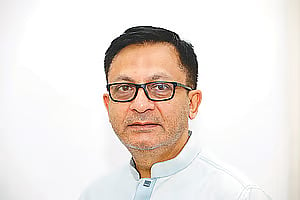
Special Interview: Khandakar Abdul Muktadir
Efforts are underway to sign as many trade agreements as possible before LDC graduation
Commerce, Industry, and Textiles and Jute Minister Khandaker Abdul Muktadir spoke with Prothom Alo about investment, industrialisation, energy, export diversification, LDC graduation, trade agreements and state-owned factories. The interview was taken by Special Correspondent Fakhrul Islam.
Prothom Alo: You currently hold the charge of three interdependent ministries. Commerce, Industries and Textiles & Jute. Since taking office, what do you see as the three main weaknesses of the country's production and trade sectors?
Khandakar Abdul Muktadir: These problems did not emerge overnight. For an investor, a vast part of the world is open. I am speaking of foreign investors. The World Bank used to publish an 'Ease of Doing Business' index, which they no longer publish. However, even when it was last published, Bangladesh was in the lower tier. This is our inherent weakness.
New investors need guaranteed energy. Similarly, the procedural complexities in business and investment need to be reduced. Increasing the overall efficiency of the government and reducing supply chain costs are encouraging factors for investment.
Another important issue is policy consistency. If you adopt a policy today and change it after six months or a year, it creates difficulties for investors. Obtaining licenses, permits and clearances easily is difficult here. Furthermore, uninterrupted fuel supply is not guaranteed and supply chain costs are not competitive. There is a lack of policy consistency. I have identified these weaknesses and am working to overcome them.
Prothom Alo: What are you doing to address this?
Khandakar Abdul Muktadir: Analysing various events, I have seen that if a new investor wants to establish an institution in Bangladesh, it takes 355 days just to reach the stage of opening a Letter of Credit (LC) for importing machinery. The process has been made so complicated that investors lose interest after trying for a while. We are bringing this journey down to 14 days. By 14 days, I do not mean obtaining all final clearances or licenses. It means that within this timeframe, an investor will receive the necessary documents based on which they can open an LC.
We are simplifying the process so that the conditions for obtaining the final fire safety license or environmental clearances can be coordinated from a single place, like the Invest Bangladesh authority. Once the work is done, the resulting system will be comparable to other well-functioning systems around the world.
This is one aspect. We know about the energy problem. The production capacity of Bangladesh’s gas wells is continuously declining. We extract nearly 1.7 billion cubic feet of gas from the wells. And we bring in gas from abroad through two floating LNG terminals, which have a combined capacity of about 1.1 billion cubic feet. From this, we get about 950 million cubic feet of gas. Combining all sources, we supply 2.6 billion cubic feet of gas.
If we want to provide gas to everyone interested in new investment at once, more terminals must be built, which is not possible in a single day. After placing an order for a floating terminal, it takes two years. Again, it also takes time to connect the pipeline from the terminal under the sea to the main gas grid. The government is working to ensure that multiple floating terminals can be built within the time it takes to develop the infrastructure. The Prime Minister is regularly monitoring the matter. After that time passes, I hope there will be no shortage in gas supply. Alongside existing electricity generation, about 2,000 megawatts will come from solar and nuclear power.
Prothom Alo: What is Bangladesh's final position regarding LDC graduation? If the graduation time is extended by three years, which reforms must be completed within that period?
Khandakar Abdul Muktadir: We have a detailed plan in this regard.. A monitoring framework has been formed at the national level, headed by the Finance Minister. I am part of it, along with other ministers. LDC graduation will happen at some point. We want the transition to be smooth so that our business and trade do not face a major shock. If we get three additional years, we can use that time in a planned manner. First, we will simplify business and trade processes and remove barriers to investment. Second, we will ensure energy security. Third, we will improve the overall efficiency of the government and digitise those public services that can be delivered digitally without requiring people to be physically present. Our biggest priority will be to retain duty-free market access. Discussions on trade agreements are underway with various countries.
Prothom Alo: How many countries are in discussions?
Khandakar Abdul Muktadir: Discussions for Free Trade Agreements (FTA) or similar trade agreements are ongoing with eight to ten countries. It may be possible to finalize agreements with some countries this year. Some might extend until the middle of next year. Discussions with the European Union (EU) will also progress. Our effort will be to complete as many important agreements as possible before graduation. Because when an investor sets up a factory in Bangladesh, they won't just look at the Bangladeshi market, they will look at how easy it is to take products from Bangladesh to other markets in the world. We want investors to view Bangladesh as an export platform for investment.
Prothom Alo: To retain benefits in the EU market, Bangladesh is moving along both the GSP Plus and FTA paths. They are talking about labor rights, environment, good governance, government procurement and reducing tariffs?
Khandakar Abdul Muktadir: Government procurement, good governance, transparency—these must be done for our own sake. The EU is our large export destination. To increase the export of leather, jute, agricultural products and other goods alongside garments, this market is important. Therefore, a relationship of trust and transparency must be built with them. We signed an agreement with South Korea a few days ago. Bangladesh will get benefits in nearly 97 per cent of products from Korea. And Korea will get benefits in 87 per cent of products. An agreement will also be reached with the EU, where we will desire everything to be win-win.
Moving forward positively regarding labor rights is also necessary for our own interest. During the tenure of this government, we passed the Labor Law in the first session of parliament. In March, ambassadors from several countries, led by the EU Ambassador, met with me. They gave a long list of non-tariff barriers. I have held meetings with the ministries to remove these. The purpose of saying this is that our efforts in terms of business environment, investment environment and earning the trust of the EU and other countries of the world are very firm.
Prothom Alo: What impact do you think the new tariffs imposed by the US on Bangladeshi products will have on the country's consumer demand and Bangladesh's exports?
Khandakar Abdul Muktadir: Due to the imposition of tariffs, the price of products that the US imports will increase. Due to the extra price, the purchasing power of US consumers will shrink. If exports shrink, Bangladesh will be affected. If the monthly income of an ordinary working person in the US is 3,500 dollars, a portion of that is spent on consumer goods. If the price of every product increases, they will have to spend from their savings. If there are no savings, they will have to reduce spending. As a result, it will have an impact on all types of products.
Prothom Alo: The agreement with the United States has not yet officially come into effect. Yet, Bangladesh is making purchases according to the agreement's commitments. What is your stance on the agreement?
Khandakar Abdul Muktadir: So far, three such agreements have been made. The agreement with the United States cannot exactly be called a Free Trade Agreement or a Comprehensive Economic Partnership Agreement, like the ones made with Japan and South Korea. You could say that some matters are being complied with as part of various conditions of what has been agreed with the United States. It is difficult to directly oppose it. However, the agreement has not yet been approved in parliament. The steps required to regularize and formalize it have also not been completed. So, the agreement is not officially effective yet.
Prothom Alo: But in reality, it is effective.
Khandakar Abdul Muktadir: In reality, it cannot be called fully effective. For example, there are two major companies in the world that sell airplanes—Boeing and Airbus. If you want to buy an airplane, you essentially have to buy from one of these two.
Prothom Alo: Even leaving aside airplanes, we are buying more wheat, cotton, edible oil and LNG from the United States.
Khandakar Abdul Muktadir: Regarding the purchase of wheat, there is a Cabinet Committee on Government Purchase, of which I am also a member. We consider many factors when buying wheat. For example, the wastage rate is lower for US wheat. Regarding LNG, we have made a long-term agreement with a US company until 2038. That company will supply a total of 117 cargoes of LNG. Fourteen cargoes will arrive at specified times during the first two fiscal years, and the rest will arrive later. If we average the pricing model of the agreement, the price per MMBtu stands below 10 dollars. For this reason, it seems to be a good agreement. Because we are forced to buy LNG from the spot market at higher prices.
Prothom Alo: Many state-owned enterprises under the Ministry of Industries and the Ministry of Textiles and Jute have been incurring losses or remaining closed for a long time. What is the plan regarding this?
Khandakar Abdul Muktadir: There are 50 factories. 25 jute mills and 25 textile mills. Among these, some have been given long-term leases under Public-Private Partnerships (PPP). Several more are in the leasing process. However, everything is being done through a transparent bidding process. The fertilizer factories of the Ministry of Industries will be run by the government itself, subject to gas availability. A huge amount of fertilizer has to be imported from abroad. If these factories can be made fully operational, perhaps not a single ounce of fertilizer will need to be imported. Rather, we will even be able to export if there is surplus production.
We are undertaking a pilot project regarding sugar mills. An attempt will be made to produce sugar from beets instead of sugarcane there. Land has to be used almost year-round for sugarcane production, yet the sugar mills mainly run for a few months. Due to population density and land limitations, using land this way is not economically very sustainable. In the case of beets, it takes less time, leaving the opportunity to grow another crop on the same land in a year. If the project is successful, such initiatives can be taken in other sugar mills in phases.
Prothom Alo: You have set a goal to transform the jute sector from the current nearly one billion dollars into a five to seven billion dollar industry. How will you do this?
Khandakar Abdul Muktadir: The hundreds of thousands of bales of raw jute we produce annually have remained stagnant for several years. A portion of this used to be exported to India or other countries as raw jute. Later, they would add value to that jute and sell it at a higher price. Raw jute export is now completely stopped. In the coming days, the export of sliver (a step before making yarn) will also be stopped.
Our goal is to export value-added jute products. Discussions are ongoing with a country for this purpose. If possible, a joint laboratory will also be established. We want an increase in jute productivity through improved quality seeds. If the seeds are good, production on the same land will increase by 20 to 25 per cent. Then farmers' interest in jute cultivation will also increase.
Prothom Alo: India has maintained anti-dumping duties on Bangladeshi jute products since 2017. If it is not resolved through bilateral discussions, will Bangladesh approach the WTO's dispute settlement mechanism?
Khandakar Abdul Muktadir: The biggest weakness of the WTO is its dispute settlement mechanism. This mechanism is primarily two-tiered. If a member country files a complaint, a panel first reviews evidence for and against the complaint and issues a ruling. Following the ruling, the normal process is to appeal. But the WTO's appellate system has been non-functional for several years. This system became ineffective primarily due to US objections regarding the appointment of members to the Appellate Body. Consequently, even if a ruling is obtained in the first step by filing a case at the WTO, the matter becomes complicated because there is no effective opportunity for a subsequent appeal. We have to see what outcome could be achieved if a case is filed and how that outcome could be effectively implemented in reality.
Prothom Alo: The price of soybean oil was recently increased. Before this, oil almost vanished from the market. After the price increase, all the oil returned to the market. What is the explanation for this?
Khandakar Abdul Muktadir: The government does not directly determine the price of any product except soybean oil. My personal opinion is that it was not right to keep the pricing of soybean oil in the government's hands either. It should have been left to the market earlier. We have to hold meetings almost every month for this. Meanwhile, traders say they are running their businesses at a loss and if this continues, no one will import. There is some reality behind this statement of theirs, I must admit.
Prothom Alo: Allegations of dominance by a few large institutions in the essential commodities market are long-standing. What are you thinking about as a solution to this?
Khandakar Abdul Muktadir: The nature of each type of business is different. The characteristics of some imported goods are such that it is difficult to do without large capital. For instance, a ship brings in 12,000 tons of sugar. It is not possible for everyone to supply such large capital. Moreover, a businessman won't just import one ship of sugar and sit idle. He has to regularly rotate capital and continue the business.
Our job is not to look at how many people are doing business, but also to monitor whether they are abusing their power in the market. That is possible to do. We are planning to make the entire market monitoring system reliant on artificial intelligence in the coming days. Furthermore, we have kept agricultural products on the sensitive list; they will also be monitored so that abnormal price hikes do not occur due to seasonal variations.
I have requested the Ministry of Agriculture to work on the matter. The Agriculture Minister has said they will take up a project. If it can be brought under an artificial-intelligence-reliant system, it will be understood in advance what steps need to be taken and when to keep the market stable throughout the year.
In the coming days, some products imported by TCB will be released into the market at market prices. The program currently running for low-income people will also remain in place. Beyond this, some products will be sold at market prices so that supply remains adequate in the market. We also want to involve the private sector in this import process. If 20, 50, or 100 business owners from the private sector want to import together with TCB, they can join as partners.
Prothom Alo: After five years, through which three measurable indicators would you like the success of your three ministries to be judged?
Khandakar Abdul Muktadir: In the case of jute, I want to establish a joint laboratory. Research will be conducted there on jute productivity, new jute products, value addition, and the market. We have communicated with China for a Memorandum of Understanding regarding this. Another major goal is to become self-sufficient in jute seeds. The country needs about 5,500 to 6,000 tons of jute seeds annually. We produce only about 1,200 to 1,400 tons. I want to set up a skill center for developing designs for jute products and handicrafts. It could be operated with the assistance of an international organization.
And the curriculum of the textile institutes will be modernized. There is an initiative to sign a Memorandum of Understanding with a polytechnic university in China. There are also plans to send teachers to China for training and to bring teachers from there to train at our institutions. If there is any procedural problem in the industry, the university or institute will conduct research to solve it. One university in China works with two to four thousand factories. We must establish such a system as well. There are many technical institutions that are practically unnecessary or not yielding adequate results. Some of those will have to be closed or merged to properly utilize resources.
We want to focus on industries that do not require much energy. Many factories under the Ministry of Industries are also old. Many of them have large lands, but the investments were made in the mid-1950s. The type of industrial structure needed then is not equally effective now. Therefore, these resources must be used for new investments and new employment. Large industrial conglomerates in the private sector are interested. Interested investors are being found in almost all sectors. They will be given opportunities through transparent bidding processes.
Prothom Alo: Thank you for your time.
Khandakar Abdul Muktadir: Thank you too.