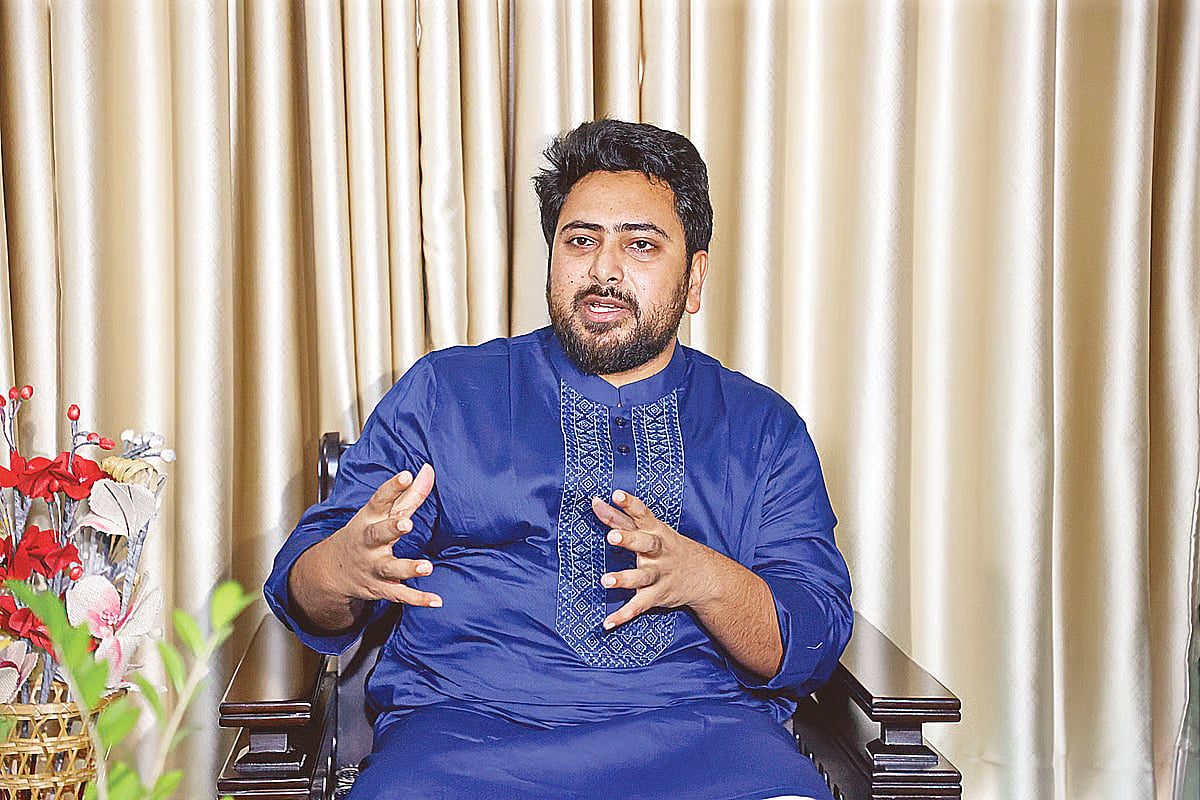
Special interview: Nahid Islam
Interim govt might have found it tough to survive had student representatives not joined
Nahid Islam was one of the leading figures of the July Mass Uprising. Following the uprising, he served as an adviser to the interim government. He currently serves as Convener of the National Citizen Party (NCP) and as Chief Whip of the Opposition in the Jatiya Sangsad. In an interview with Prothom Alo, he discusses the fall of the Awami League government on 5 August, the formation of the interim government and a range of other issues surrounding that period. The interview was conducted by Asif Hawlader.
On 3 August, at the Central Shaheed Minar, you announced a one-point demand calling not only for the fall of the Sheikh Hasina government but also for the dismantling of what you described as the "fascist system". Had you discussed this with political parties, academics or members of civil society?
Nahid Islam: Many people were already demanding Sheikh Hasina's resignation. But we did not believe that simply removing Sheikh Hasina would transform the state. We wanted systemic change, not merely a transfer of power.
We believed that the constitutional, political and economic structures that had brought Bangladesh to this point required fundamental reform. In our view, an authoritarian system had developed since the Liberation War, becoming particularly entrenched during the Awami League's 16 years in power. That is why we called for the dismantling of the fascist system and the establishment of a new political order.
At the time, many different proposals were being put forward, and we reviewed them. The common ground among all sides was the removal of Sheikh Hasina. There was even debate over whether the demand should be for her resignation or her removal. The BNP and its allied parties were already campaigning on a 31-point reform agenda. That means, state reform had become the central political aspiration. We expressed that aspiration in our own language by calling for the dismantling of the fascist system.
In the final phase of the movement, you announced on the afternoon of 4 August that the "March to Dhaka" programme would take place on 6 August. Later that day, Asif Mahmud announced that it would instead be brought forward to 5 August. What prompted that decision? Did you consult any political parties or civil society groups?
Nahid Islam: There was very little opportunity for extensive consultation at that stage. Some decisions were discussed; others were not. Sometimes we made decisions ourselves, and everyone later endorsed them.
Our original thinking in setting the programme for 6 August was to give people time to prepare. We had already announced workers' and women's rallies for 5 August. Later on 4 August, however, the authorities announced a curfew, and we received information that mobile internet and other communications would be shut down, similar to the blackout of 20–21 July.
At that point, we realised that if another communications blackout occurred, we might not even have the opportunity to issue further instructions. We therefore decided to bring the programme forward. We concluded that our final call should be on 5 August—that whatever was going to happen should happen that day. Had we waited until 6 August, the government might also have gained additional time to prepare. Those considerations led us to move the "March to Dhaka" forward by one day.
As I was at Shahbagh at the time, I believe Asif Mahmud Shojib Bhuyain, Abu Baker Majumdar and Mahfuj Alam coordinated with others before making the final decision.
Were there any other considerations behind bringing the programme forward?
Nahid Islam: The key concern was that if we delayed any longer, we might lose the movement's momentum and no longer remain organised. By 3 and 4 August, we had managed to regroup and rebuild our organisational strength. We needed to preserve that momentum and announce the final programme without delay. Even a single day's delay could have caused us to lose it. That was why the programme was brought forward to 5 August.
Your colleague, Asif Mahmud, wrote a book on his experiences during the uprising, where he mentioned that the idea of the movement taking an armed turn was on both your minds. You had even prepared a video message. What exactly did you say in that message, and under what circumstances was it meant to be released?
Nahid Islam: On 4 August, I stated at Shahbagh that if taking up arms became necessary, we would do so. The army’s ultimate stance was a crucial factor. If the military took a position against the people, the movement would inevitably head towards an armed conflict. We had initially planned non-violent non-cooperation programmes. However, we had a contingency plan in place to call for a violent or armed resistance if things reached a tipping point.
What was the essence of that message? Do you still have that video recording in your possession?
Nahid Islam: Before stepping onto the streets on 5 August, we were uncertain about the army's role that day. The message was simply this: we are currently conducting a non-violent non-cooperation movement. However, if shots are fired at us today (5 August 2024), or if a massacre takes place, we call upon you to take up arms from wherever you are to initiate an armed movement and resist. As for the current whereabouts of that video recording, I am not sure.
How did your day begin on 5 August—the day the government fell? How and when did you personally confirm the news of Sheikh Hasina fleeing the country, and what was your immediate reaction?
Nahid Islam: On the night of 4 August, I stayed at the residence of one of my university teachers. From the morning of 5 August, we were constantly gathering information on the situation across the country, particularly in Dhaka. Our plan was to assemble at Shahbagh and issue further instructions from there. However, we received reports that the army was stationed around Shahbagh, the Central Shaheed Minar, and adjacent areas, preventing people from gathering.
Although I attempted to leave the house in Dhanmondi several times, my fellow activists held me back for safety reasons. Once Shahbagh was cleared, the military withdrew, and the public took over the streets, I was brought there. I reached Shahbagh around 12:00 pm; the teacher with whom I was staying drove me as far as possible.
As we led a procession from Shahbagh towards Farmgate, passing Banglamotor around 1:30 or 2:00 pm, we received the news of Sheikh Hasina’s fleeing through several journalists. Even after receiving news from reliable sources, I remained cautious, fearing it might be a trap—knowing what Sheikh Hasina was capable of. Therefore, we felt it was unwise to abandon the streets or celebrate prematurely. Furthermore, we had to remain mindful of the immediate vacuum that would follow the government's fall.
It was heard that from the afternoon of 5 August, intelligence agencies were making phone calls indicating that the military wished to meet with political leaders, and that they were also looking for you. What can you tell us about that?
Nahid Islam: No contact was made with us—at least, not with me. The idea of going to the cantonment never entered our minds. I only learned late that night that a meeting with political leaders was taking place at the cantonment. I heard that the army chief was addressing the nation. Meanwhile, after concluding our press conference at the Channel 24 office, we moved inside the Curzon Hall at Dhaka University to hold our own discussions.
But the leaders of the country's major political parties did go to the army headquarters that day.
Nahid Islam: They made a mistake by going there. To us, the true seat of power and the epicentre of this movement rested on the mandate of the people. The political leaders, however, perceived the military cantonment as the centre of power, which is why they went. Even if we had been invited, we would not have attended. When we were summoned to the cantonment the following day, we declined again. That is precisely why we later went to Bangabhaban. We were reluctant to go to Bangabhaban as well, but ultimately went there solely to deliberate on forming the new administration.
Reports suggest you had a virtual meeting with Tarique Rahman, the then-acting chairman of the BNP (Bangladesh Nationalist Party), on the night of 5 August, where you proposed forming a national government. What was his response?
Nahid Islam: We discussed matters concerning a national government, constitutional reform, justice, and systemic transformation. They (the BNP) advocated for a caretaker or interim government that would conduct elections within three to six months, leaving it to an elected administration to implement reforms.
Did any other issues arise during that discussion?
Nahid Islam: At the time, it was primarily a moment of celebrating victory, so high-level, serious negotiations were minimal. He [Tarique Rahman] congratulated us, and we expressed our desire for his return to the country so we could rebuild the nation together. As an immediate step, we stated that we wanted Professor Muhammad Yunus as the head of government, and that it should be a national government. They [the BNP] clarified that they would not join a national government.
A meeting at Curzon Hall on the night of 5 August has also been reported.
Nahid Islam: Professor Asif Nazrul joined us there and conveyed certain messages on behalf of the military, among other matters. Frankly, many details from that chaotic time are difficult to recall vividly.
Whose idea was it initially to nominate Professor Muhammad Yunus as the head of government?
Nahid Islam: It is difficult to attribute it to a single individual now, as many lay claim to it. However, contact was established with Professor Yunus shortly after 3 August. These communications were primarily managed by Asif Mahmud and Mahfuj Alam.
After 5 August, when Mahfuj Alam assumed the role of head of the Liaison Committee for the Anti-Discrimination Student Movement, he coordinated the overall process of government formation. Asif Mahmud also maintained contact with various stakeholders and personally spoke with Professor Yunus. My first direct conversation with him took place on the evening of 5 August.
What transpired during your conversation with Professor Yunus then?
Nahid Islam: We spoke for a few minutes. I requested him to take charge of the nation given the critical circumstances, stressing that the country required his leadership at that precise moment. Detailed discussions were subsequently handled by Asif.
What considerations led to selecting Professor Yunus to head the interim government?
Nahid Islam: We considered Professor Yunus as the most suitable candidate overall, and all factions endorsed him at the time. No alternative name was put forward by anyone else. His international standing, the prevailing economic crisis, and the fact that he was himself a victim of fascism made his nomination natural, securing widespread support.
At 3:00 am on 5 August, you, Asif, and Baker went live on Facebook to announce that Professor Yunus had agreed to serve as the chief adviser.
Nahid Islam: On 5 August, in the absence of a functional government, widespread propaganda was circulating, creating an anarchic situation. Alongside the misinformation, panic was spreading among the public.
We sensed that various factions were beginning to maneuver for their own interests and agendas. It was crucial to send a clear message regarding who would assume leadership and how we envisioned the transition. That is why we promptly made the public announcement.
You were three student representatives in the advisory council of the interim government. How did your inclusion in the administration come about?
Nahid Islam: Since a national government failed to materialise, we felt student representation within the interim government was vital to grant it political legitimacy. Professor Yunus was also of the view that students should participate.
Following discussions among the coordinators and consultation with the Liaison Committee, we initially considered nominating five individuals. After further deliberations, this was narrowed down to two. On the morning of 8 August, we held a meeting at the TSC (Teacher-Student Centre) in Dhaka University with the available coordinators to inform them of the decision regarding two representatives. The oath was administered that very night. About 15 to 20 days later, Mahfuj Alam joined the government.
Could you share details regarding your meeting with the three armed forces chiefs at Bangabhaban on 6 August?
Nahid Islam: The army chief had previously met with political leaders, but in our absence, nothing definitive was achieved. Our meeting with them primarily focused on the framework of the government—specifically, the structure and mandate of the interim administration. The central point of debate became the selection of the head of government. Following the proposal of Professor Yunus's name, the military sought an alternative candidate, leading to extensive discussions and negotiations before they eventually acquiesced to his appointment.
What were their reservations regarding Professor Yunus?
Nahid Islam: They [the military] preferred a traditional caretaker government format. Given Professor Yunus's firm stance against the Awami League, they expressed concerns whether it would be perfect to appoint him. Consequently, they urged us to consider alternative options.
Did they put forward any alternative names?
Nahid Islam: They were unable to offer specific suggestions. We subsequently persuaded them by presenting arguments on how Professor Yunus’s leadership would stabilise the country and facilitate essential structural reforms.
How was the list of advisers for the interim government drawn up? Were there consultations or meetings with political parties?
Nahid Islam: Members of the Liaison Committee of the Anti-Discrimination Student Movement engaged with various stakeholders and gathered recommendations. The final deliberations took place directly with Professor Yunus upon his arrival at Dhaka Airport.
Who else was consulted regarding the composition of the advisory council?
Nahid Islam: The primary responsibility for drafting the council rested with the Liaison Committee. While many details escape me, I distinctly recall that the list was essentially finalised at the airport following Professor Yunus’s arrival. He offered a few suggestions over the phone, which were discussed with the BNP, with Jamaat-e-Islami via (Islami) Chhatra Shibir, and with academics like Professor Tanzimuddin Khan.
What unfolded during that meeting at the airport?
Nahid Islam: We reviewed the proposed list of advisers, and it was finalised right there. A few names were dropped during those discussions. The then Cabinet Secretary was present, and we provided him with whatever contact details we had available. One wonders if a government has ever been formed in such a manner in the history of Bangladesh or the world... (laughs).
In a recent interview with Prothom Alo, BNP Secretary General Mirza Fakhrul Islam Alamgir stated that they were in regular contact with you prior to 5 August. What is your side of the story?
Nahid Islam: Up until 5 August [2024], we never held formal discussions with any political party—at least I certainly did not. Discussions took place exclusively between student leaders. Dialogue occurred with student wings, such as BNP's (Jatiyatabadi) Chhatra Dal and Jamaat's (Islami) Chhatra Shibir, who may have consulted their respective parent parties. Direct discussions with political parties, particularly the BNP, commenced only after 5 August.
Following the uprising, consultations were held on various occasions. Prior to taking any major national decisions, we accorded due importance to the BNP; however, we never received a reciprocal response. We never sought anything for ourselves. Most of our proposed reforms and structural changes were flatly rejected by them. They opposed the July Declaration and engaged in political drama over it for months. They played similar games regarding reforms, blocked the removal of President Mohammed Shahabuddin, and ultimately acted dishonestly regarding the referendum.
The BNP frequently claims that they view you with respect and esteem...
Nahid Islam: On a personal level, that respect is there. However, when it came to the restructuring of power, they refused to yield an inch if it compromised their interests. None of our proposals regarding state governance frameworks were accepted. The BNP will eventually suffer the consequences of this approach.
Prothom Alo: You served as an adviser in the interim government for nearly seven months, alongside two other student representatives from the Anti-Discrimination Student Movement. What initiatives did you champion from within the administration to achieve the "new settlement" promised during the uprising? Looking back, what was the government's greatest success, and what was its biggest failure?
Nahid Islam: Firstly, we sought to rewrite the constitution, believing a new constitution was essential to establish a genuinely new order. Subsequently, reform commissions were established for each sector in response to our demands. In hindsight, instituting reform commissions was a flawed approach.
Whatever transformation we managed to articulate, and whatever degree of accountability we enforced on the government, was only possible because of our declaration on 3 August demanding the abolition of fascism and a new settlement.
The interim government drafted certain proposals and held a referendum, yet it relied far too heavily on political parties. This reliance was a mistake; the government should have executed its mandate independently, leaving subsequent elected governments to decide their own course.
The primary success of the interim government lies in facilitating a transition—holding an election, restoring parliament, and initiating judicial proceedings. Managing this transition remains its key achievement, even though it failed to deliver fundamental structural changes.
You mentioned that forming reform commissions was a "flawed approach." Why do you say that?
Nahid Islam: To achieve a new settlement, we advocated for constitutional change or a complete rewriting of the constitution. Transforming the political framework through constitutional change would have paved the way for meaningful economic reform.
In the 13th Parliamentary Election, your party, the National Citizen Party (NCP), entered into an alliance led by Jamaat-e-Islami, securing six parliamentary seats. How do you evaluate this alliance in the post-election context?
Nahid Islam: This alliance created a significant political realignment through the election. The strong mandate delivered in favour of the referendum was largely influenced by this coalition. To act as a check and balance against a party like the BNP—which holds a two-thirds majority—and to hold them accountable, I believe this alliance was a necessity.
When you decided to form this alliance, it drew criticism from various quarters and led to resignations within your party. What guided this decision—ideological compromise or pragmatic strategy?
Nahid Islam: Ideology played no role here. It was a strategic unity forged specifically around the imperative of reform.
Some of your well-wishers recently suggested that joining the government was a mistake. How do you view that criticism?
Nahid Islam: From a certain perspective, one could argue that, but without our participation, the interim government would have struggled to survive at that critical juncture.
As we mark two years since the July Mass Uprising, to what extent has the country transformed, and how far have the desired changes materialised?
Nahid Islam: No fundamental transformation has occurred in the country. The present government has swiftly replaced the previous authoritarian regime and appears inclined to replicate their conduct—signs of which are already visible.
We sought accountability and a balance of powers; instead, we ended up with a two-thirds majority, further concentrating power in the hands of the prime minister, including control over local government and presidential appointments. In many respects, power has become even more centralised. A lingering impulse of the mass uprising or revolution allows us to witness a semblance of democracy today, but it is not sustainable.
Expressing frustration over the lack of desired progress, some participants of the July movement claim its aspirations have failed.
Nahid Islam: I hold the BNP politically accountable for this outcome. As the largest party, they assumed power; they did not align themselves with the core vision of the uprising. While they agreed on the fall of Sheikh Hasina, they distanced themselves from every subsequent demand. Secondly, the civil-military bureaucracy, the business elite, mainstream media, and civil society were equally resistant to genuine change.
The structure of power remains unyielding; only the political leadership has shifted, with the BNP stepping into that vacuum. Much remains unachieved. Nevertheless, it is incorrect to label the uprising a failure.
Diverse groups participated, each interpreting the movement through their own lens. Today, interpretations of the July Movement reflect individual political agendas.
In my view, every political entity—the BNP, Jamaat, Hefazat, various left-leaning factions, and students—have taken advantage of the uprising. Some may refuse to acknowledge it, while others express gratitude, but the general public has not reaped the fruits of that transformation, leading to widespread disillusionment. I believe a new movement will eventually emerge from this discontent.
A final question: If you could return to those four days between 5 and 8 August and alter a single decision, which one would you change, and why?
Nahid Islam: I do not believe any catastrophic mistake was made. However, rather than placing our trust in established political parties, we ought to have organised ourselves rapidly into a distinct political party.
Thank you for taking the time to speak with us.
Nahid Islam: Thank you as well.