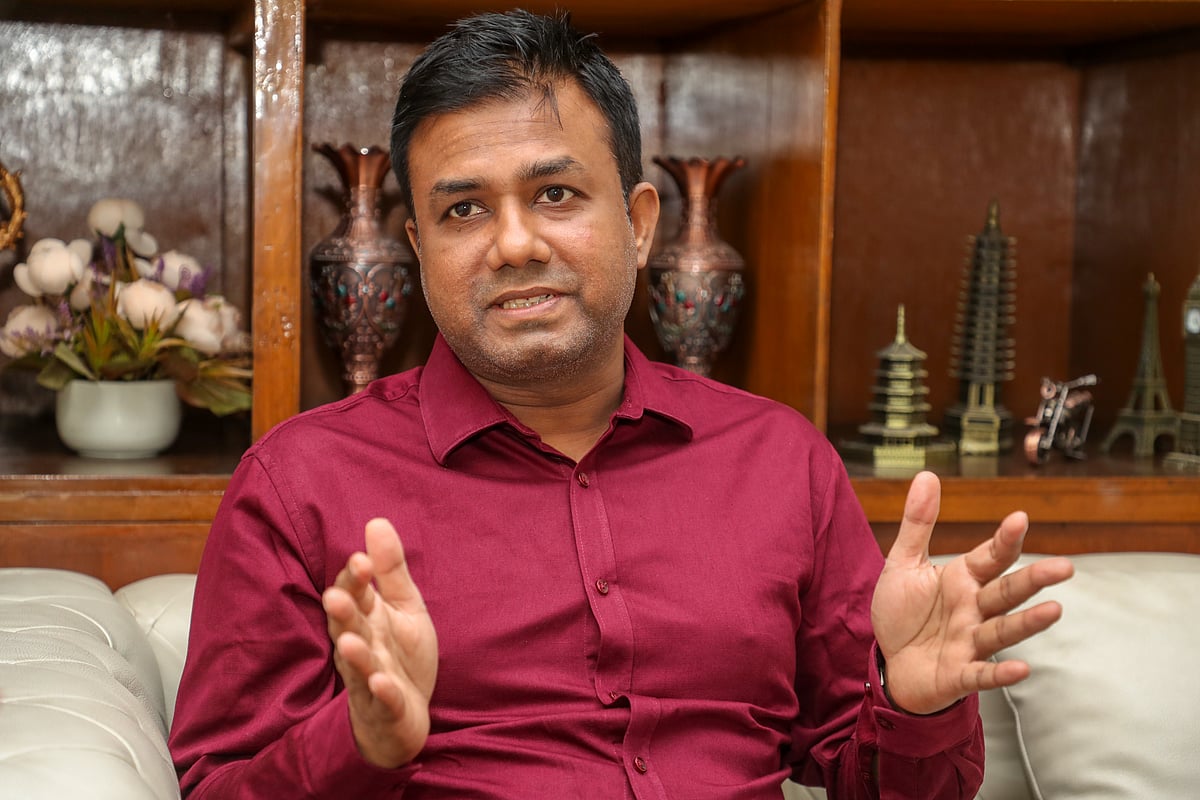
Exclusive Interview: Professor Md Hadiuzzaman
Auto-rickshaw cannot be given blank cheque as it cannot be stopped
Professor Md Hadiuzzaman is a communication expert and the former director of BUET's Accident Research Institute. He discussed issues such as road anarchy and accidents, the automated signal system in Dhaka, the rickshaw problem, and the risks of the expensive metro rail with Prothom Alo. The interview was conducted by Monoj Dey.
Prothom Alo: In the last one and a half decades, there has been a significant investment in the road infrastructure sector in Bangladesh. So why do road anarchy, accidents, and the procession of deaths keep increasing despite this?
Md. Hadiuzzaman: Over the past one and a half decades, we have upgraded many roads from two lanes to four lanes, built expressways, constructed numerous flyovers, and even built tunnels under rivers. However, accidents are not solely related to infrastructure; they are a multidimensional issue.
We have seen that infrastructure has been built focusing mainly on infrastructure and speed. It has been claimed behind every infrastructure development that it will save time and ease travel. But to reduce accidents, it is not enough to have a safe road; safe vehicles, skilled and safe drivers, and safe land management around roads must be ensured as well. Simply building infrastructure is not enough to reduce road accidents.
We have not been able to produce good and skilled drivers. We have repeatedly emphasised scientific and safe vehicles. Unfortunately, the number of unscientific and unsafe vehicles currently outweighs scientific and safe ones. If a country has more illegal vehicles than legal ones and more unskilled drivers than skilled ones, it is not surprising to see upward statistics in road accidents.
We have built expressways, but we have not been able to control land management around the roads. Over the past decade, despite repeated discussions about controlling markets, several dozen new markets have been added by the highways. As a result, the speed we tried to increase by building infrastructure has now, in many cases, turned into an uncontrollable pace. Frequent accidents occur on expressways.
Creating skilled drivers, deploying safe and quality vehicles on roads—these are matters of policy decisions. Yet, we have repeatedly stumbled in this regard. Instead of focusing here, we have chased mega projects and mega investments.
Prothom Alo: Two years ago, you told Prothom Alo in an interview that our road's problem is political, not technical. The government has changed twice since then. If asked to evaluate the problem of our roads two years later, how would you assess it?
Md Hadiuzzaman: I would say that we are still in the same situation. Many researches, using public funds, have been conducted to treat the problem of the road system. Technical studies have been done, especially under the leadership of the DTC to bring discipline to public transport management. But there has been no change.
If it had been a technical issue, the many studies should have brought about change. Since there has been no change, it is certainly not just a technical issue; it is a political problem.
The ideal model of public transport we talk about—bus route franchising or bus route rationalisation—is a globally tested model. It is an effective prescription for scientific public transport management. Such a system is successfully running in the neighbouring Indian city of Kolkata. The fact that we haven't managed it indicates how political the problem is.
Keeping the road and public transport system as disorderly as possible benefits many people around it. As long as the system is disorderly, it creates various types of positions and political opportunities for many. But if it comes within discipline, aligns with scientific management, adopts the bus route franchise model, or launches company-based management, many of these positions will no longer exist.
All the technical studies done on our public transport system outlined what needed to be done, how to do it, and how much investment was required. The amount of necessary investment is not very high. Compared to the amount we have invested in or will invest in mega projects in the future, the required funds for reforming the public transport system is like taking a drop of water from the sea.
Therefore, it's not an investment or technical problem. If you ask the same question two years later, I will give you the same answer.
Prothom Alo: During the interim government, a BUET advisory committee was formed regarding Dhaka's roads and management, and you were a member. What were the main suggestions, and how much has been implemented?
Md Hadiuzzaman: Some recommendations have been implemented. The interim government had a short mandate. We made some recommendations that could be implemented in the short term. However, the government doesn’t act on its own; it consists of many arms and organisations. How much they have helped is a big question.
We proposed controlling small vehicles like easy bikes and auto-rickshaws on Dhaka's main roads, stopping buses from picking up and dropping off passengers at intersections and junction points, limiting signal times to a maximum of two minutes at small intersections and three minutes at larger intersections, quickly restoring police morale and work environment, and forming eight vigilance teams for the eight traffic divisions of Dhaka to take prompt action in case of congestion. Good progress has been made in the signaling system, and vigilance teams have been established.
Our main proposal was that discipline in public transport management was required to save Dhaka. We are constructing metro rail. With the proposed six metro rails, a spider web-like network will develop in Dhaka. Five to six hundred thousand crore investments are planned behind it. We said if only five thousand crore were invested in reforming the public transport system, a significant change could be achieved.
If we transport 15 per cent of passengers through the metro rail with an investment of five to six hundred thousand crore and 40 per cent through the reform of the bus system with an investment of five thousand crore, then economically and commercially, which is more profitable?
Our proposals weren't big issues. They were mainly about goodwill, initiative, and the coordination of agencies working together. If the institutions had at least provided the necessary help to the government, then there would have been an opportunity for change. We couldn't take advantage of that opportunity.
Prothom Alo: Automated traffic signals have been introduced at some intersections in Dhaka. Traffic discipline has somewhat returned to these intersections. Is it possible to bring the entire Dhaka under this management?
Md Hadiuzzaman: First, I would like to thank the interim government and the current government for the continuity. The most important part is that we have managed to do this using domestic technology or 'homegrown knowledge'. There are multiple benefits to this. Time and again, we have brought signal system technology from Europe, Asia, or other countries. However, our experiences with these technologies haven't been very positive.
The Honourable Prime Minister has appointed me as the focal point for the entire Dhaka city’s signal system. At the moment, we are working with 60 junctions. I believe, once the work on these 60 junctions is completed, almost three-fourths or more of the important intersections of Dhaka city will be covered.
Domestic technology is significant here to save costs. Even our experience with Asian technology has shown that the cost of providing technical assistance to a single junction—speaking only in terms of technology, excluding physical infrastructure, poles, or wiring—is equivalent to handling 20–25 intersections under our current system using foreign technology. Our capacities and capabilities are increasing as well as costs decreasing. Most importantly, by having the opportunity to use domestic technology, we can gradually improve it.
While we are reducing technology costs, we are also researching reducing infrastructure costs. Here we have made significant progress. We have developed domestic technology capable of reducing construction costs in addition to technology. We hope to introduce this automated signal system in Chattogram, Cumilla, and Mymensingh in the future.
However, it must be clarified that the signal system is not a 'panacea' or a solution to all problems. Traffic congestion cannot be entirely addressed through signals alone. Still, many policy measures must be taken alongside the signal system to reduce congestion. The number of small vehicles must be reduced from major roads, public transport must increase, and there needs to be an improved compliance tendency toward traffic laws.
To increase compliance, AI cameras have also been added to the signal system. We see a significant cultural change among city residents. Researchers studying the effectiveness of the signal system shouldn't evaluate this change only in terms of traffic congestion reduction. There is also a large value to this cultural shift.
I believe that the signal system can be effectively operated as the city residents, two city corporations, BUET, and traffic police work together cooperatively as a team.
Prothom Alo: Dhaka is one of the slowest cities in the world. Battery-operated rickshaws have become a major cause of disorder in Dhaka. What is the path to bringing battery-operated rickshaws under control?
Md Hadiuzzaman: I would say the issue of rickshaws has become very complex now. Simply banning it is not a solution anymore. We have long passed that time. Now it must be brought under control. Since all vehicles on the road operate within a systematic framework, rickshaws must also be brought through a process of legality.
While we cannot eliminate rickshaws, we must also avoid giving them a blank check. I would say, in this case, the government has already prepared a regulation. It is awaiting vetting and approval. From my understanding, it is a good regulation. From the perspective of rickshaw production, its area of movement, number, registration process, and charging infrastructure—scientific analysis has been done on each aspect.
With the number of rickshaws in Dhaka having increased significantly, they have gone beyond the capacity of the roads. This regulation attempts to bring that number under control.
Prothom Alo: Do you have any statistics on how many rickshaws are currently operating in Dhaka?
Md Hadiuzzaman: Providing accurate statistics on illegal vehicles is very difficult. However, I estimate that approximately 2. 5 million rickshaws are currently operating in Dhaka. Every day, an additional one to one and a half thousand rickshaws are joining. This is a kind of uncontrolled birth. That is why we are talking about control.
Under no circumstances should rickshaws be allowed to compete with public transport on major roads. The main road should be considered the backbone of our road system. Public transport will operate there.
Rickshaws will serve as a complement. This should be the core philosophy of our transport system.
Prothom Alo: In a city of nearly thirty million people like Dhaka, there is no bus-centric public transport system. Why is the globally tested route franchise model failing in Dhaka?
Md Hadiuzzaman: Dhaka’s public transport network is also tiny. The main roads encompass only about 200 kilometers, where public transport can operate. For this 200 kilometers of roads, significant investment is not needed; much can be achieved with modest investment. We see that the government is thinking of buying electric buses. But it should be remembered that public transport is not just a bus; it is a complete system. It needs to be coordinated and integrated, determining which routes the bus will run, where the stops will be, and how the ticketing system will work.
If good buses are deployed while old, derelict buses continue to operate, the good buses cannot survive competition. Such pilot projects have been undertaken at two to three routes at different times in Dhaka. Each time, it has failed. It is bound to fail.
I believe it's done knowingly in such a manner to say later that the bus route franchise doesn’t work in Dhaka. If there is money, buses can be bought, even by taking loans if necessary. But some policy issues need to be resolved first. How will the company be formed, what will be its business model, and how will the current bus owners be involved in this system—these need to be decided beforehand.
All parties, including transport owners, leaders, workers, and passengers, must be part of this system. The vision of company-based public transport must first ensure everyone concerned agrees. Without building this consensus, simply bringing in buses will be futile. The mistakes will repeat.
We are already providing considerable subsidy for the metro. More metro rail lines are coming in. In the future, how much this subsidy will amount to must also be thought of. Nearly all big cities in the world subsidise public transport. Hence, the government must develop a robust and sustainable business model for public transport. Current bus owners must be given assurances that they will remain within this framework and not incur losses. Such a system is possible. A new system must be set up while retaining current owners within this ecosystem. Otherwise, it won’t be implementable in reality.
Prothom Alo: There are significant concerns about the expenditure on Dhaka’s first metro rail. Recently, the government has decided to implement three metro rail projects at a cost of Tk 2,500 billion. How rational is spending so much on the metro rail?
Md Hadiuzzaman: There is no doubt that the metro rail has created some change and transformation in the transportation system of Dhaka city. However, the question is, how rational is the increase in costs from 2019 to the revised DPP in 2026?
The reason given for the increase in costs includes the rise in the price of the dollar, the increase of construction material prices, construction in line with Japanese standards, and the lengthening of some stations. I cannot fully agree with these arguments.
It is said that station lengths have increased. This was known at the time of the feasibility study and conceptual design in 2019. It’s not that suddenly the station length increased in 2026. The Japanese standard is mentioned. However, standardisation is one thing, and how it’s followed during construction is another.
We have already seen several defects and deviations in Line-6, even though it was built following Japanese standards. We still don’t have an explanation for that. Another aspect is unclear to me. How these changes in the yen and exchange rate with the taka have impacted costs should be clarified.
In a broader sense, I am not fully convinced by the arguments behind the cost increase in the revised DPP. However, there is another consideration we should have had earlier.
We see that at the same time, an electric train project has been approved from Narayanganj to Joydebpur. It is approximately 52 kilometers in length. Electric multiple unit or EMU type trains will run here. Perhaps its speed is less than a metro, but the cost is much lower. It’s only Tk 45 billion. Is it necessary to have both metro rail and electric train on the same corridor?
To understand if the costs are rational, examples of many projects in the countries being compared have both increased costs and timelines. However, we also have examples of many metro systems with comparatively lower costs. Even excluding India's examples, we can speak of other countries.
Hanay’s metro construction costs in Vietnam are around $200 million per kilometer. In contrast, our proposed cost is reaching about $315 million per kilometer.
It should be remembered that the expenditure of the revised DPP is not the actual project cost yet. After the tender, the contractor will take the work and start in the field. The actual expenses may increase depending on the kind of challenges arise in real situations. Our experience shows that many large projects in Bangladesh experienced cost increases of 60 to 70 per cent, along with time extensions.
Prothom Alo: What are the technical and financial risks with the new metro rail?
Md Hadiuzzaman: There is much more risk. The entire section of Line-6 is elevated, making construction relatively easy. Construction is much more challenging along underground routes. I think we should have undertaken a project underground first to gain experience.
The debt agreement doesn't mean significant progress in the project; there's no reason to believe that progress is that advanced. So far, no significant progress has occurred; a little work has been done on depots, but beyond that, very little.
Taking on three projects together risks creating an imbalance in administration. There’s also a risk of Dhaka being immobilised for several years. Decisions shouldn't be taken merely by saying, “We've taken loans, so what can we do?”
We see various problems in operating and managing overhead metro rail. The challenges will be greater underground. The underground metro rail needs much more secure safeguards and management systems from the first day. Strong systems will be needed for lighting, ventilation, oxygen, fire safety, and emergency handling. Consequently, its operational costs could be several times higher than overground lines. How will fares be set for a metro rail with such enormous construction costs? Will this fare remain within reach for the common people?
We are already providing annual subsidies of about Tk 7-8 billion for the metro. How much this subsidy will become in the future also needs to be considered. By 2033, maintenance costs, and the pressure to pay off the loan’s principal and interest will become more pronounced.
Along with more large projects like the Rooppur Nuclear Power Plant, the Karnaphuli Tunnel, the Dohazari-Cox's Bazar railway line, and the new metro rail, it will require around 8-10 billion dollars annually to pay interests and principal of these large projects. For this, our GDP growth needs to consistently be above 8. Otherwise, there is a risk of economic bankruptcy.
Construction risk, cost escalation risk, operational risk, and debt repayment risk—all things considered, I can't comprehend on what grounds we are risking the future of our new generation by venturing into this large-scale metro rail construction.
Prothom Alo: Statistics from recent years indicate that accidents and fatalities on motorcycles are the highest. Is there a way out of this alarming situation?
Md Hadiuzzaman: There is no effective public transport system in Dhaka city. The buses we see on the roads do not fulfill the standards of public transport.
In such a situation, people have leaned towards motorcycles for quick travel for various needs. Consequently, the number of motorcycles has increased significantly. Given that, the number of accidents will also be somewhat high. This needs to be accepted. Unless a large segment of the population is brought to public transport, the exposure of motorcycles will not decrease. And as long as exposure doesn't decrease, accident numbers won’t reduce.
However, at this moment, we can reduce the number of fatalities in accidents. A significant portion of individuals who die in motorcycle accidents succumb to brain injuries. Thus, government policy should prioritise this. I have repeatedly said that the demands from motorcycle manufacturers and users to the government should be for easier availability of good quality helmets rather than an increase in engine capacity, reduction in taxes, or lowering registration fees.
In developed cities with disciplined traffic systems, lane-based operations, abundant public transport, skilled drivers, and scientific signaling systems, motorcycles are 30 times riskier compared to four-wheelers. Then, one can easily imagine what our scenario might be.
The licensing process needs to be made scientific and drivers must be directly observed to see whether they understand road rules, lanes, signals, how they drive, and how much they adhere to traffic laws; only after that should they be given a licence. The licensing procedure should not just remain in the hands of BRTA; a provision for testing through third parties, similar to developed countries, could ensure an effective 'check and balance'.
Prothom Alo: If we talk about solving transportation sector grievances, what are the three priorities you would emphasize?
Md Hadiuzzaman: The first priority for the government should be contemplating whether Dhaka—burdened with the pressure of vehicles and people—can accommodate the infrastructural pressure anymore.
With flyovers, expressways, metro rails, and various infrastructures, Dhaka can no longer handle this load. Therefore, we must actively think about whether to continue investing in Dhaka or channel those investments into divisional and district towns.
I think it must be understood that traffic congestion is not our only problem. Pressure on Dhaka’s people, infrastructure, traffic, everything has increased altogether. Simultaneously, we are encouraging people to move towards Dhaka. People come to Dhaka for livelihood and employment. As a result, we face many more challenges. Pressure is also increasing on various community services like water, gas, etc.
We’ve had enough. Instead of constructing massive infrastructures in Dhaka one after another, if we create employment opportunities in divisional and district towns, it will achieve dual purposes. Traffic congestion in Dhaka will reduce, and the need for people to come to Dhaka for livelihood and employment will reduce.
The second priority is that reorganisation of the bus system in Dhaka should not be merely looked at through the lens of bus procurement; the entire bus system must be overhauled. It should be developed as the backbone of public transport while small vehicles from roads should be controlled. It will bring some relief to people’s commutes and reduce both congestion and accidents.
This requires structural changes. I am not merely talking about the purchase of buses or procurement; I am speaking about the bus system’s entire ecosystem. The entire system must be changed. This should be the second priority.
The third priority is land management. There is a deep connection between traffic congestion in Dhaka and land management. Unfortunately, many institutes we see give symptomatic solutions rather than address the root problem of traffic congestion.
For instance, they are talking about relocating the bus terminals outside the city. I am unaware of any technical research or study behind this. I think it’s essential first to understand what a public transport terminal is. It’s a terminal for public transport, i. e. , for public conveyance. It is convenient to have the terminal as close to the city as possible since public transport does not provide door-to-door service; it is not a personal vehicle. If the terminal is close to town, the passenger’s time and expense decrease.
If bus terminals are moved outside the city, a person wanting to travel from Mohammadpur to Sadarghat would face much more difficulty. Time, expense, and security risks would increase. It may seem to him that he's undertaking two long-distance journeys.
We are turning terminals into depots. Terminals must be utilised as terminals and depots as depots.
Prothom Alo: Thank you for the interview.
Md Hadiuzzaman: Thank you too.