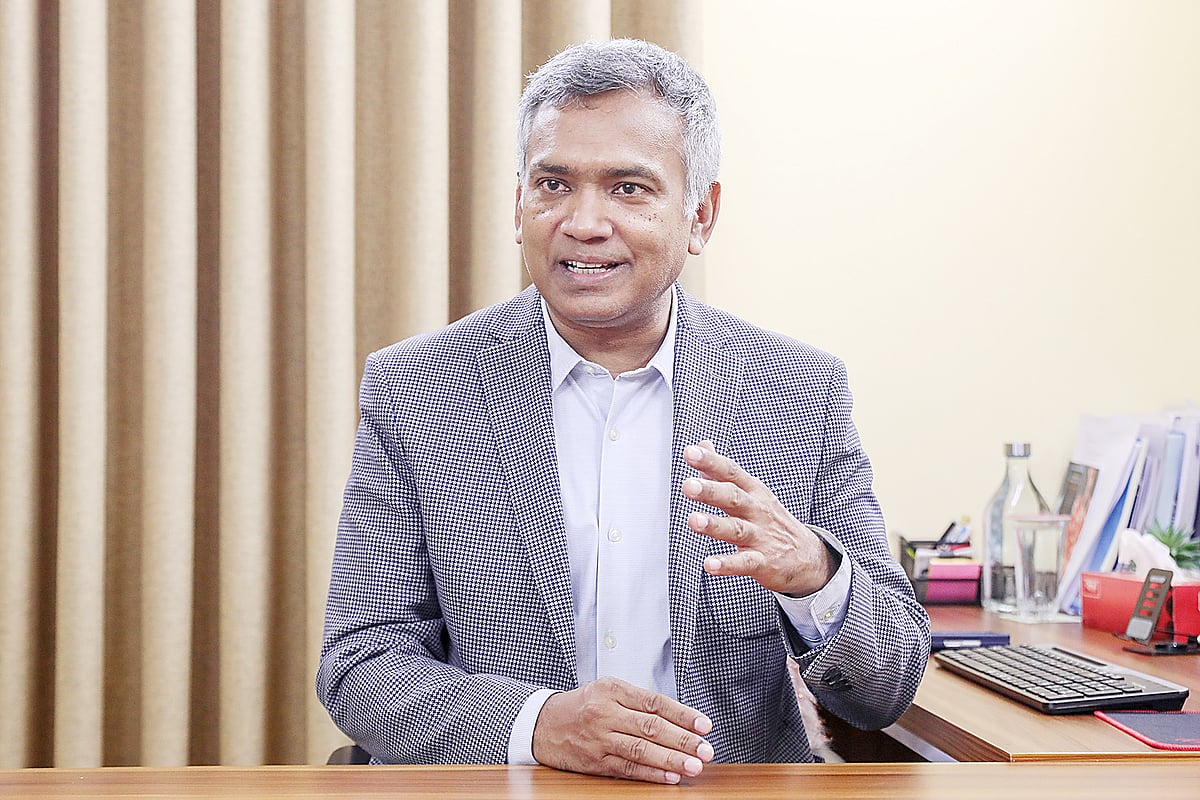
Exclusive Interview: Mohammad Abdur Razzaque
Extreme inequality and jobless growth bound to create instability
Dr. Mohammad Abdur Razzaque is the chairman of Research and Policy Integration for Development (RAPID). He has recently joined the board of directors of BRAC Bank as an independent director. Prothom Alo had a conversation with him regarding Bangladesh's economic situation, development, and public policy. The interview was conducted by Sohul Ahmed.
How stable is the country's economy seven months after the government came to power?
Mohammad Abdur Razzaque: There has been some improvement in certain areas of the economy, but the foundation of stability is still weak. The foreign currency reserves have increased, the exchange rate has remained relatively stable, and remittances are helping to manage the external sector pressures. Thus, some risks have decreased, but the structural weaknesses of the economy persist.
People's purchasing power and savings have decreased due to long-term inflation. The investment situation remains weak. ADB has reduced its GDP growth forecast for the fiscal year 2026-27 from 4.5 per cent to 4 per cent.
Statistics on overall savings are also concerning. According to BBS data, domestic savings have decreased from about 25. 8 per cent of GDP to 21. 4 per cent between the fiscal years 2022-23 to 2025-26, and national savings have fallen from nearly 30 per cent to 26.9 per cent.
There is also pressure in the government's income and expenditure calculations. Since revenue collection does not cover the necessary expenses, dependence on bank loans is required. There is a plan to take about Tk 300 billion in net loans from October to December. If liquidity remains adequate in banks and private sector credit demand is weak, its immediate impact may be limited. However, if this dependence becomes prolonged, interest expenses will increase, opportunities for spending on essential public services will decrease, and if private investment starts to return, pressure may build on its financing.
However, conflict in the Middle East, rising fuel prices, and uncertainties in international trade have increased import costs and production costs, making the work of restoring stability challenging. My assessment is that there has been some improvement, but visible results in controlling inflation, revenue collection, and banking reforms are now necessary to turn it into sustainable stability.
What kind of impact is the war situation and Trump's second-term trade policies having?
Abdur Razzaque: The rise in oil prices due to the Iran war and the subsequent uncertainty in the energy market have affected our efforts to control inflation. The fuel price adjustment will have a direct impact on general inflation.
The war and changes in US trade policy are putting pressure on Bangladesh's economy from two sides. On one hand, import and production costs are rising; on the other hand, uncertainty is being created in increasing export income. The continuous change in Trump's trade policy and its concerning trajectory have put Bangladesh at a severe risk. This rapidly changing policy is creating uncertainty globally and is extremely detrimental to business and export trade.
From post-COVID experience, we have seen that high inflation reduces people's purchasing power, which in turn reduces spending on clothing, affecting international trade in ready-made garments. The import picture of the two major markets is also concerning. In 2022, the European union imported 102 billion dollars' worth of ready-made garments, which rose to only 104 billion dollars by 2025. On the other hand, during the same period, US garment imports fell from 100 billion to 87 billion dollars. In other words, imports have almost stagnated in one market and contracted in the other. With nearly 85 per cent of Bangladesh's export products being reliant on ready-made garments, increasing export income in this situation has become very challenging.
While increasing remittances and export income is critical for macroeconomic stability, the combination of weak foreign demand and internal supply constraints is hindering these efforts. Additionally, there is a commitment to increase purchases of US goods in reciprocal trade agreements with the United States. Despite these external pressures, maintaining the country's production and export capabilities remains a challenge for the government.
How do you view the trade agreement with the United States?
Abdur Razzaque: Firstly, the process of the agreement was opaque. Generally, negotiations of this kind require confidentiality, so not all information can be made public. Still, there is a practice of including experts in the negotiation team so that they can participate in the bargaining process. The government did not take that initiative in this agreement.
Secondly, we are seeing an unequal bargaining process here. If an agreement with the United States conflicts with the rules of the World Trade Organisation (WTO), it was necessary to consult with experts, even on a limited scale, to understand their areas of concern. Unfortunately, that was not done; had it been, the quality and effectiveness of the bargaining could have been improved significantly.
It's true that there was pressure from the private sector to sign the agreement quickly due to fears of losing the US market. At such a time of geopolitical crisis, the private sector will always think of expanding market benefits, but determining the right strategy to protect the country's interests in the long term was the government's responsibility. The then-government could not appropriately understand the importance of this issue.
There has been news that overseas employment is declining; what impact could that have?
Abdur Razzaque: If overseas employment declines, the immediate impact on remittances might not be felt. Perhaps its impact will be understood two years later. However, how much impact will occur on remittances at this moment depends on whether expatriates' working hours or income are decreasing or whether there is a risk of them losing their jobs.
In the country, many families rely on remittances for daily expenses, education, health, and various local investments, which keep the rural and semi-urban economies active (multiplier effect). Due to high inflation, the national savings rate has already decreased by over 3 per cent; if remittance inflows decrease further in this situation, savings will be severely affected. This will pose a significant risk to overall investment and employment.
What is your view on the impact and prospects of implementing various social safety programmes like family cards and farmer cards in line with the government's electoral promises?
Abdur Razzaque: In the current situation, strengthening the social safety net in an economy like Bangladesh's is extremely necessary. According to the latest 2022 household survey in Bangladesh, the poverty rate was 18. 7 per cent. However, there is a clear indication of increasing poverty due to long-term high inflation and comparatively low wage growth. In such a reality, there is no alternative but to expand the social safety net sector.
Secondly, while the main aim of the National Social Safety Strategy over the last decade has been to reduce poverty and inequality, many genuinely poor, extremely poor, and vulnerable families remain outside these supports. According to the BBS household survey, about 48 per cent of the extreme poor in the country do not receive any social protection benefits.
Meanwhile, only 20 per cent of these benefits reach the genuinely poor; the remaining 80 per cent are beneficiaries who are above the poverty line.
There are several reasons behind this: failure to accurately identify poor populations (targeting error), irregularities-corruption, and political bias. Additionally, while trying to provide universal benefits (like old-age allowances or stipends), the prioritisation of genuinely poor people has been overlooked.
Since the 1990s, the main strategy for poverty alleviation in Bangladesh has been the 'trickle-down effect'. That is, if there is economic growth, its benefits will gradually reach the disadvantaged. However, due to the inability to create quality and sustainable employment, this has not been working effectively enough in the last 10-15 years. On the other hand, in microfinance, it is also seen that only 27 per cent of its recipients live below the poverty line.
In this situation, if family cards protect everyone who is poor or at risk of poverty, it can play a significant role in poverty alleviation. According to our research, if all families below the poverty line in 2022 are brought under the family card, the poverty rate will decrease by 7 percentage points from 18.7 per cent to 11 per cent.
This is a calculation of potential impact, not the result received after implementation. The main challenge of launching the family card is accurately identifying genuine poor individuals while preventing corruption. Introducing only poor and vulnerable families under this scheme would incur an additional cost of only 0. 6 per cent of GDP, which would not place much pressure on the economy; the real crisis will arise if the government fails to collect sufficient revenue.
The tax-to-GDP ratio in Bangladesh has been stagnant for a long time. Why is that?
Abdur Razzaque: A significant reason for the tax-to-GDP ratio not increasing is the weakness in tax administration and collection systems. Despite the economy's size increasing, we have been unable to expand the tax net proportionately. There are also significant gaps in VAT collection.
Our tax structure also requires changes. Heavy reliance on indirect taxes, including import duties, imposes a heavier tax burden on comparatively low-income people. Therefore, increasing direct taxes based on income and wealth should be prioritized.
The issue of trust among taxpayers is also crucial. Taxpayers want to see transparency in government spending and the creation of a corruption-free environment. However, when they see wastefulness or excessive escalation in mega project costs due to delays, it discourages taxpayers.
Imposing a tax on inherited wealth above a certain limit is necessary. Additionally, the tendency to conceal the actual market value of land and flats by showing lower values should be stopped.
A mass uprising centered on employment issues has erupted, and there is talk of jobless growth. Artificial intelligence poses new concerns there. How can this situation be managed?
Abdur Razzaque: The mass uprising in 2024 was also an outburst of long-accumulated inequality and discontent. A statistic can be seen. According to BBS's 2022 household survey data, the top 10 per cent of households in terms of income hold about 41 per cent of total household income. Wealth inequality is even more pronounced. We have shown that the most affluent 1 per cent of households control 47 per cent of the total wealth measured in the survey, while the top 10 per cent hold 76 per cent. If more detailed information were available on the wealth of ultra-rich families, the picture of inequality could become even more intense.
Such extreme inequality and 'jobless growth' are bound to create social unrest. Along with this, due to technological advancement and increased use of machinery, fewer workers are needed compared to before. We have seen this earlier in the garment industry. In the early 2010s, garment exports were around $12 billion, with estimated direct employment of 3. 5 million. Later on, although exports have approached $40 billion, employment has not increased proportionately.
Therefore, alongside increasing productivity through technology, overall employment will need significant expansion in production and markets. However, due to the increase in inequality and pressure on the real income of ordinary people, domestic market demand is not growing sufficiently. When most people's purchasing power is limited, relying solely on the domestic market for significant production and employment expansion becomes tough.
Therefore, real income for a vast population must be increased alongside leveraging international market demand. If four to five large export sectors like ready-made garments can be established, the production scope can expand significantly. Many sectors in the Bangladeshi economy still offer opportunities to increase production and service extents. By leveraging technological advancements to rapidly expand these sectors and new export markets, employment can also increase.
What might be the impact of graduating from LDC status on Bangladesh?
Abdur Razzaque: Bangladesh has applied to extend the LDC graduation timeline to November 2029 for three more years. If granted this additional time, duty-free access to the European union market will continue for three more years. However, the current state of global trade is kind of chaotic, and WTO rules have also weakened. Consequently, several new challenges are added as we gradually exit from the LDC status.
During the interim government period, a Smooth Transition Strategy (STS) was developed. Some institutional initiatives were taken, but more visible progress in actual reform is necessary. Therefore, if additional time is obtained, our first task will be to determine the most critical priorities from this strategy and focus more on their implementation.
Maintaining market access in the EU similar to current levels should be our top priority. However, due to stringent rules, the opportunity for 'GSP Plus' is not available, so priority should now be given to preparing for a free trade agreement with the EU.
Even if there is a free trade agreement with the EU, the 'double transformation' condition will generally require producing garments domestically with locally made fabric. This will put pressure on our backward linkage. Therefore, in agreement negotiations, we must strongly push for relaxing this condition to maintain benefits concerning imported fabric as well.
However, there are good chances of retaining duty-free and contractual benefits in markets like the UK, Japan, and South Korea. Moreover, preparations to join the Regional Comprehensive Economic Partnership should also be made.
However, it is particularly important to prioritise the Indian market. Because India is one of our key export destinations, in the absence of an alternative trade agreement after LDC graduation, there will be the pressure of additional tariffs on several items, including garments, which will reduce competitive capability. Therefore, advance discussions with India need to start now.
Export support strategy will also need to change. Special exemptions for direct subsidies to industrial exports will no longer be available after LDC graduation. In intellectual property, special preparations are needed in the pharmaceutical industry. The special exemption for patent-related aspects of pharmaceuticals enjoyed as an LDC will have to be forfeited after graduation. Additionally, due to unilateral tariffs and weaker dispute resolution in international trade, legal protection for countries like Bangladesh is diminishing. Therefore, when engaging in bilateral discussions with a powerful country concerning market benefits, we must cautiously scrutinise the conditions or obligations we accept.
Amidst the uncertainty of Trump's trade policy and global tensions, will Bangladesh's relationship with China bring any positive economic messages?
Abdur Razzaque: Increasing economic relations with China can create opportunities for Bangladesh, provided it increases productive investment, new exports, technology, and employment. If it only increases import or loan-dependent infrastructure, long-term benefits will not be realised.
China, India, Japan, the United States, and the EU—all have significant importance in different areas of Bangladesh's economy. Therefore, avoiding dependency on a single country and deriving complementary benefits from all should be our objective. Even in the midst of the rivalry among global powers, we must retain the ability to make decisions that keep our national interests intact.
In the era of intense geopolitical rivalry among the United States, China, and India, Bangladesh must exercise caution in managing bilateral relationships. Economic closeness with one country should not appear as a threat to another rival; Bangladesh must maintain this awareness and retain the freedom to make neutral decisions in its national interest by maintaining transparency. Therefore, Bangladesh needs a clear geopolitical risk management strategy.
Thank you.
Abdur Razzaque: Thank you as well.
#This article, originally published in Prothom Alo print and online editions, has been rewritten in English by Rabiul Islam