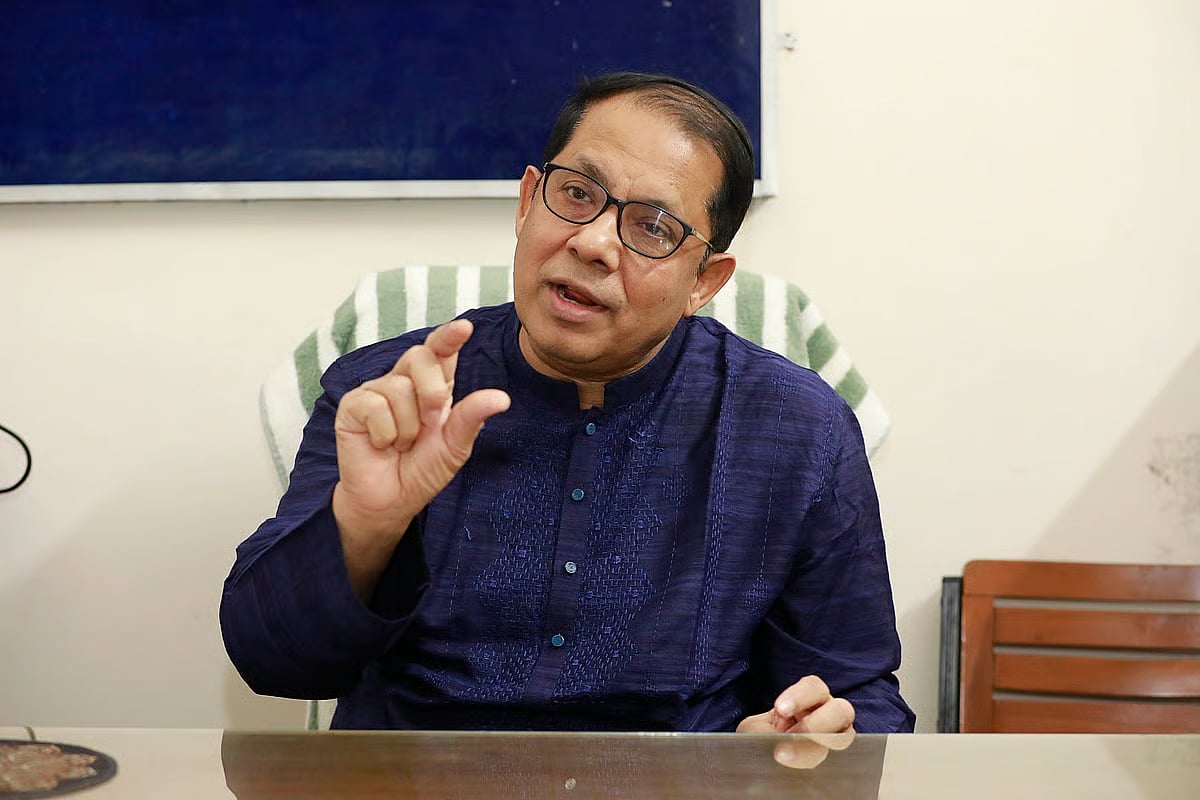
Exclusive Interview: Anwar Hossain Bhuiyan
Gas exploration cannot be halted for fear of failure
Anwar Hossain Bhuiyan is a professor at the Department of Geology at the University of Dhaka. He holds a PhD in Petroleum Geophysics from the Norwegian University of Science and Technology. In an interview with Prothom Alo's Monoj Dey, he spoke about the causes of Bangladesh’s ongoing energy crisis, ways to overcome it, development of old gas fields and the prospects for discovering new gas fields.
Production at factories is being halted because of gas shortages, households are unable to cook because their stoves have no gas, vehicles are queuing for hours at CNG stations, and load-shedding is occurring frequently. The energy crisis is affecting the entire economy and people’s daily lives. What has led to this situation?
Anwar Hossain Bhuiyan:The main reason for the current energy crisis is that our gas production has declined. At the same time, imports have also been disrupted to some extent because of the war situation in the Middle East. One of the two LNG terminals in Maheshkhali, Cox’s Bazar, has developed a technical problem. Taken together, these factors mean that we are unable to supply enough gas to meet demand.
The biggest question here is why our gas production has declined. One point needs to be made: given our limited resources and manpower capacity, it can be said that the situation could have become critical much earlier if we had not been able to maintain the continuity in gas production that had existed since 2000.
However, we failed to carry out extensive exploration adequately to maintain that production. In other words, we were unable to take the right decisions at the right time when it came to the long-term planning needed to ensure gas supplies from domestic sources.
At one point, it was said that Bangladesh was “floating on gas”. Some even talked about exporting gas through pipelines. Yet the current energy crisis stems largely from dependence on imported gas. Was there no alternative to this dependence on imports?
Anwar Hossain Bhuiyan: There certainly were alternatives. The biggest alternative was to step up domestic gas exploration and strengthen the production system.
However, I do not consider the claim that “Bangladesh is floating on gas” to be realistic. I do not think any geologist would make such a statement without data, scientific analysis and evidence-based modelling. Oil and gas exploration is fraught with numerous uncertainties. Exploration activities have to be carried out while dealing with those uncertainties.
The gas fields discovered in Bangladesh are the result of long-term exploration. Our country is not very large in area. However, there are still opportunities to discover new gas through effective, science-based exploration. A great deal of work has been done in this area, but there is still much more that can be done. There are challenges, but there are also prospects for the future.
We have seen gas production decline steadily since 2016–17. Are our gas reserves running out?
Anwar Hossain Bhuiyan: Gas reserves are not infinite, nor are they renewable. So, eventually, they will run out—that is an eternal truth.
So far, we have discovered around 29 trillion cubic feet (TCF) of gas in total. Various industries have developed in our country using this gas. Alongside small and medium-sized industries, gas use has increased in the readymade garment sector, agriculture and various other areas. As a result, demand for gas has continued to rise. But we have not been able to increase supply at the same rate. This is why, after a certain point, gas production gradually began to decline.
However, we should have carried out more gas exploration. Globally, a success rate of one discovery for every eight to 10 wells drilled is considered roughly normal. In Bangladesh, the success rate is around one in three. Therefore, there is absolutely no justification for halting gas exploration for fear of failure.
By analysing seismic data, other geophysical data and information from previously drilled wells in and around our existing gas fields and in prospective areas, around 250 to 300 prospective structures have been identified.
BAPEX, some organisations under Petrobangla, multinational companies, several universities and other institutions were involved in this work. In addition, foreign consulting firms have come in at different times and analysed the data in several phases. Based on these analyses, the prospective gas fields have been ranked at various times.
How much gas could these prospective areas contain, and how long could it meet Bangladesh’s needs?
Anwar Hossain Bhuiyan: I had the opportunity to work with officials from BAPEX, Petrobangla and Sylhet Gas Fields. With their assistance, I conducted an assessment showing that around 15 TCF of gas could potentially be found in prospective areas surrounding fields where gas has already been discovered.
Suppose we drill 30 wells in the first five to seven years. If at least one-third of them are successful, we could find around five TCF of gas. If another 30 wells can be drilled over the following five years, preliminary estimates suggest that at least another five TCF could potentially be found.
In other words, if we find five TCF in the first phase and another five TCF in the next phase—ten TCF in total—our reserves, combined with the roughly eight TCF currently in hand, could reach around 18 TCF. If we can ensure an average supply of one TCF of gas a year and meet the remaining shortfall through imports, these reserves could ensure supply until 2043.
Even if drilling 30 wells yields at least five TCF of gas, its value would be around Tk five trillion (500,000 crore). By contrast, the cost of drilling 30 wells would be around Tk 75 billion (7,500 crore). Including other expenses, the total would come to Tk 100 billion (10,000 crore). In other words, the investment would be Tk 100 billion, against a potential gas value of around Tk five trillion.
It can never be considered smart management to use all our domestic gas and import not a single molecule of gas. At the same time, leaving our gas underground and becoming entirely dependent on imports is not smart management either.
We need to manage our resources in a way that ensures our domestic gas reserves remain available for a long time. That is where our bargaining power, or bargaining position, lies. You cannot negotiate with anyone when you have nothing to bargain with.We must ensure the right balance between domestic and imported gas in our energy mix.
If our gas reserves can meet our needs until 2043, other alternative energy sources will have further time to develop. Hydrocarbon reserves are gradually declining worldwide. That is why everyone is working on alternative energy sources. Research and development are under way on hydrogen energy, green energy and blue energy as well.
Given the current energy crisis, is there a possibility of any quick solutions?
Anwar Hossain Bhuiyan: I would say we should first focus on the existing gas fields. There are 29 gas fields in the country. If we consider 20 of them to be operational, there is still potential within these fields.
Due to natural geological constraints, it is not possible to extract all the gas in a field by drilling just one or a few wells. As a result, there may be some areas beyond those from which we have extracted gas where reserves remain untapped. These are known as undrained compartments.
These undrained compartments can be identified by reprocessing, reinterpreting and reevaluating data from existing gas fields. New wells can then be drilled there quickly. Since gas has already been found in another part of the same field, the likelihood of finding gas in these areas is relatively high. Another major advantage is that there would be no need to build new infrastructure. Existing infrastructure could be used, allowing gas to be supplied directly to the national grid. This could be a quick and effective way to increase gas production.
Oil and gas exploration began in Bangladesh in 1955 and became a reality with discoveries in 1961. As a result, many of our wells are quite old. Many of these wells have deteriorated. Production can be increased by repairing them through workovers.
However, everyone should remember that whether it is BAPEX or a foreign company, all parties involved in exploration have to work amid considerable uncertainty.
Bangladesh is a small country, and our gas fields are also relatively small. So exploration failures should not be viewed as a major setback. Rather, failing to find gas in a well means we have gained new information. That information is extremely valuable. It can be used to make future exploration more precise and reduce uncertainty.
Another possibility is to drill into the deeper sections of gas fields that are currently in production. Because of our technological limitations, we have so far drilled only to certain depths and extracted gas from the upper layers. But the layers deeper below offer not only uncertainty but also a much greater possibility of finding gas.
Bangladesh has already taken initiatives for deep drilling in several gas fields. I believe these fields could yield some very encouraging results.
In short, by identifying undrained compartments and drilling new wells, repairing existing wells through workovers to increase production, and drilling into deeper layers of existing gas fields, we can increase production from the fields we already have.
How likely are we to discover new gas fields?
Anwar Hossain Bhuiyan: There is potential in under-explored or unexplored areas between existing gas fields. As gas fields are found around structures such as Titas, Bakhrabad and Bibiyana, the potential in the intervening areas is not zero.
Another important prospective area is the hinge zone. This transitional zone, stretching from Kolkata through Pabna and Mymensingh to Sylhet, has seen relatively little exploration. The recent discovery of gas in Jamalpur indicates the potential of this region. Further exploration will be needed to determine whether the gas in Jamalpur can be commercially extracted.
Then there is the extensive area of the Sylhet Trough or Surma Basin, as well as the Hatiya Trough and its surrounding areas. Cumilla, Brahmanbaria and Sylhet are the country’s main hydrocarbon hubs. Meanwhile, the presence of hydrocarbons in the Hatiya Trough region has been established through gas discoveries at Shahbazpur, Bhola North, Sundarpur, Feni, and offshore at Sangu and Kutubdia. However, these areas have not been studied or researched sufficiently. With detailed studies and exploration, this could become the country’s second major hydrocarbon hub.
However, extensive exploration and drilling will be required in these prospective areas. It is natural that many of these wells will turn out to be dry holes. Therefore, exploration should be pursued as part of a long-term plan rather than being viewed as a loss.
Gas has been discovered in Tripura, India. How much potential is there for gas in the Chittagong Hill Tracts? What are the challenges of exploration there?
Anwar Hossain Bhuiyan: The geological structure of the Chittagong Hill Tracts is highly complex. As a result, oil and gas exploration in this region is relatively challenging. India’s Tripura state has a similar geological structure nearby. Tripura covers around 10,000 square kilometres, while Chattogram and the Chittagong Hill Tracts together cover around 18,000 square kilometres. Tripura has around 14 structures, while we have 28.
More than 150 exploration wells have been drilled in Tripura. So far, around 2.7 trillion cubic feet (TCF) of proven gas reserves have been identified there, and according to their estimates, there is potential for at least 14 TCF of gas. Importantly, they did not stop exploration despite the failures they encountered.
There are many similarities between the geological structures of Tripura and the Chittagong Hill Tracts. If they were able to begin exploration later and achieve success, the possibility of finding gas in our Chittagong Hill Tracts cannot be ruled out either.
The maritime boundary disputes with India and Myanmar were settled a decade ago. How much gas could potentially be found in our vast maritime area? Why has there been no effective initiative to explore for gas offshore?
Anwar Hossain Bhuiyan: I would explain this challenge from the perspective of a rather harsh reality. Major multinational companies conduct exploration in the maritime areas of Brazil, Angola, Mexico and the Middle East. Large reserves are often found in a single gas field in these areas.
Companies that invest billions of dollars in Bangladesh’s maritime area would naturally expect substantial returns. So how do you attract them? By demonstrating success, of course. This creates a kind of ‘chicken-and-egg’ problem. Should we explore first and demonstrate success, and then attract foreign companies? Or should they come first, and then we explore?
If we can demonstrate success, they will come. But if they do not come, we currently lack the capacity to undertake large-scale exploration and demonstrate that success ourselves.
Although there has yet to be any major success in oil and gas exploration in Bangladesh’s deep sea, there are reasons to remain hopeful. In particular, gas discoveries in Myanmar, along with certain geological similarities with Bangladesh’s offshore area, point to potential. In some parts of our maritime area, sedimentary rocks extend to depths of 17 to 19 kilometres. There is potential for oil and gas to have formed, accumulated and become trapped in these deep layers. Moreover, the deeper offshore region contains the world’s largest deep-sea fan—the Bengal Fan.
However, the challenges will remain until success is achieved. To generate interest among international companies and encourage investment, we must do the necessary work ourselves—particularly by properly analysing existing seismic data, identifying prospects and ensuring investment-friendly policies.
There have long been calls to build national capacity in gas exploration and production. BAPEX has achieved greater success in gas exploration with limited resources. How can BAPEX’s capacity be strengthened?
Anwar Hossain Bhuiyan: Two factors are important in explaining why BAPEX’s capabilities have not reached international standards. First, talented engineers and geologists who join BAPEX gain experience and develop expertise at an international level. But when they see that a friend with the same skills is working for a foreign company for much higher pay and benefits, they become frustrated.
As a result, many leave the country in search of better opportunities. This is a form of ‘brain drain’. Therefore, at the national level, we should consider providing BAPEX’s skilled personnel with special benefits to retain them.
Second, strengthening capacity requires investment in new technologies and modern software, rigs and drilling technology, as well as the ability to acquire two-dimensional and three-dimensional seismic data. In other words, capacity must be built through a combination of skilled personnel, software and hardware.
One might now ask, we are already doing, or trying to do, these things. So why is it still not enough? The reality is that investment is inadequate. We are spending billions of taka on energy imports. The subsidies we had to provide for buying gas from the spot market during the Covid-19 pandemic may have been more than ten times what was invested in gas exploration and capacity building over the past decade. It is not possible to build substantial capacity with such limited investment.
Therefore, if we are to make a long-term plan, we cannot consider only how much we are investing at present. We must consider both what will happen if we do not invest and what the potential returns could be if we succeed.
We must also move away from the mindset that a dry hole or an unsuccessful exploration attempt in one location means everything is over. Failure is inevitable in exploration. The information gained from that failure can also be extremely valuable for subsequent exploration. Therefore, failing to find gas in a well should not be viewed simply as a loss, but also as an opportunity to gain new information for future exploration.