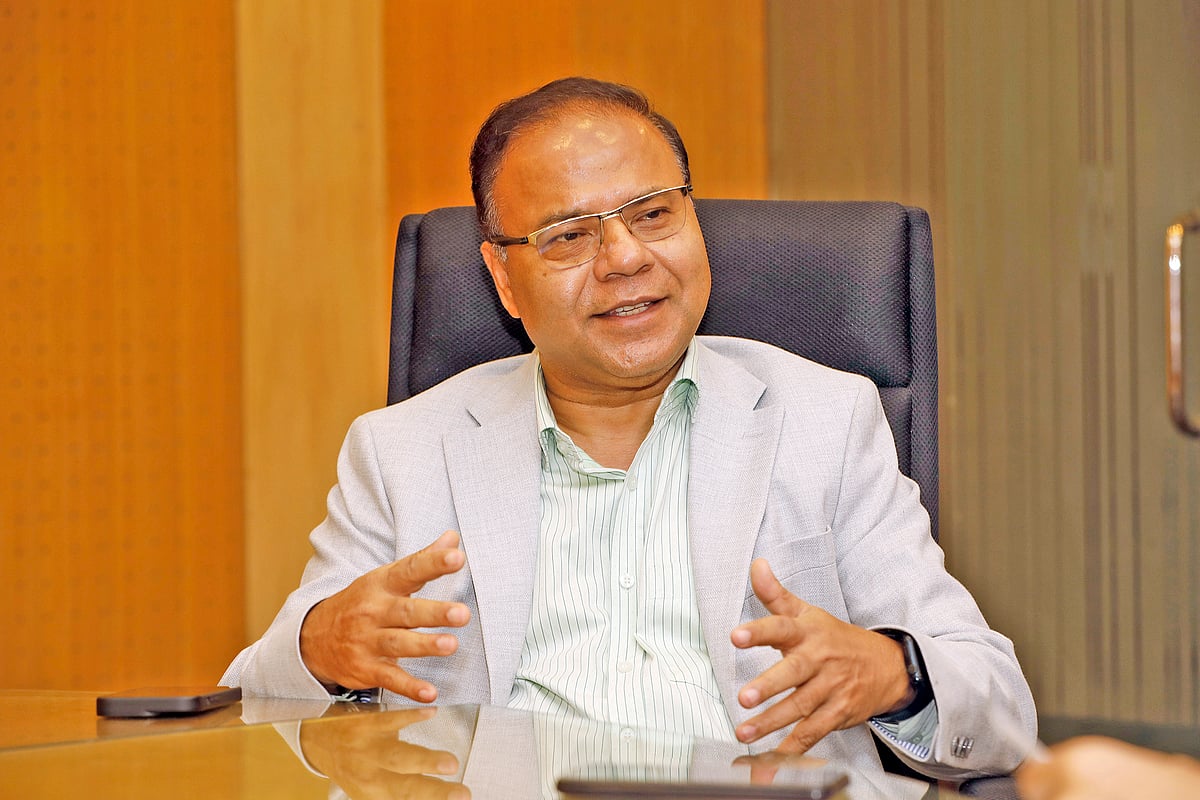
Exclusive Interview: Mohammed Abu Eusuf
Reforms must be carried out in our own interests, not under pressure
Mohammed Abu Eusuf is an economist and professor in the Development Studies Department at the University of Dhaka. He is serving as the Executive Director of Research and Policy Integration for Development (RAPID). He spoke with Prothom Alo about the development and poverty situation in Bangladesh, ways for economic recovery, and reforms in the banking and revenue sectors. Monoj Dey took the interview.
The World Bank's recently published report indicates that 62 million people are in such a vulnerable state that a single economic shock could push them below the poverty line. What is the fundamental flaw in our development narrative?
Mohammed Abu Eusuf: When we talk about the development of any country, two things are of utmost importance—political stability and economic stability. Bangladesh has finally been taken over by a democratic government after a long time. We hope this will bring about political stability in the country. Now, the most critical need is to ensure economic stability.
After 5 August 2024, during the interim government period, uncertainty arose among domestic and foreign investors and businessmen due to political changes and various crises. They lacked confidence regarding the direction of the nation's economy and the investment environment. Previously, the COVID pandemic, followed by several wars and international crises, also impacted the economy. Immediately after the new government took over, various global crises, including the Iran-US war, arose. As Bangladesh is an importing country, these situations affected our economy.
Continued high inflation in Bangladesh has reduced the real purchasing power of low and limited-income people. Besides the poor and extremely poor populations, families who are ''vulnerable non-poor'' just above the poverty line are also at risk. Economic shocks or disasters may push them back below the poverty line. To tackle this situation, alongside controlling inflation, it is essential to increase wages and real income.
It is also crucial to make development inclusive. Government borrowing should not crowd out funding in the private sector. Ensuring youth employment, skill development, and an investment-friendly environment will transform political changes into sustainable economic and social progress.
Following the World Bank, the IMF''s reports also indicate that poverty will increase in the country, and GDP growth will slow down. How likely do you see the economy recovering in the next couple of years?
Mohammad Abu Eusuf: There is considerable potential for our economy to recover. The government mentioned ten priorities in the budget speech. They spoke about honest and capable leadership and accountable institutions and mentioned employment, investment, and single-window services. Now, effective steps need to be taken on these matters.
It is true that we cannot control global realities like wars and pandemics. But we have to adequately address those aspects that are within our control. Projects that are supposed to be completed in three years should indeed be completed in three years. If time and cost are increased, the extra burden ultimately falls on everyone.
If you had to specify, what should be our steps for economic recovery?
Mohammad Abu Eusuf: For economic recovery, we need a big push or a major boost. I want to explain this using the three ''C''s.
Firstly, comprehensiveness or an overall perspective. If we think about the banking sector or revenue sector in isolation, desired results will not be achieved. Because one sector is interconnected with another, we need to develop an integrated and coordinated system. For instance, in revenue collection, an automated system needs to be carried out from start to finish. For example, if we cannot connect the holding number information of the City Corporation with the relevant database to increase revenue collection, the desired outcome will not be achieved.
Secondly, coordination. There needs to be effective coordination between various government agencies. Often, WASA's work does not coordinate with the work of the power department, resulting in repeated digging in the same area, increased costs, and inconvenience for people. The initiative to bring investment-related agencies under an integrated framework is a positive step.
Thirdly, compliance. In today's world, a strong saying prevails, ''No compliance, no business.'' In the matter of compliance, there is no room for laxity in areas where we say zero tolerance. Be it environmental, social, or economic compliance, it must be ensured.
To bring about economic recovery, the three ''C''s must be ensured together. If we can ensure good governance and strengthen institutions, the path to economic recovery will become smooth. Our main issue is that while there are rules, they are not implemented. Let me give an example. The Public Money and Budget Management Act of 2009 requires the presentation of budget progress to Parliament every three months.
However, without proper implementation, it's impossible to understand where the economy is headed or what progress is being made in budget implementation.
After assuming responsibility, the current government has formulated a five-year reform strategy. It has set targets for GDP growth rate, public and private investment, and national savings. Now the question is, are we following this strategy? How can that be determined? For this, an integrated dashboard can be created, where progress based on KPIs can be measured. It needs to be considered a national priority. If progress is made according to the target in any area, it should be indicated in green, and if not, it should be shown in red. This will make it easy to identify problem areas and hold the relevant people accountable.
Banking sector reform is critical to restoring confidence in the economy. What is the way forward for reforming this sector?
Mohammad Abu Eusuf: Currently, there are 61-62 banks, which is more than in many countries. Many banks have been approved based on political considerations, which now needs to be managed by the government and the people. Recently, the governor of Bangladesh Bank had a meeting with economists and private sector representatives. There, the governor said that no bank directors would be appointed based on political considerations. This is a positive initiative, but ensuring its implementation will be the main challenge.
The bank's money belongs to depositors and customers. Restoring the confidence of depositors, businesses, and taxpayers in the banking sector is crucial to moving the economy away from its current state. Supervision of government banks is done by the Financial Institutions Division of the Ministry of Finance, while private banks are supervised by Bangladesh Bank. Discussions are also underway on whether this dual administrative system can be removed and supervision responsibilities coordinated. Such reforms are necessary to bring discipline to the banking sector. Reforms must be made in our interest, not under pressure from the IMF or the World Bank.
To bring discipline back to the banking sector, tough decisions need to be taken. If necessary, and if the situation demands it, the government must take a firm stance to close one or two banks, ensuring the protection of depositors' interests. In this case, the ''carrot and stick'' policy must be followed. Reward for good work, punishment for irregularities. Those borrowers who repay their loan installments regularly should be incentivised. Those who face difficulties in repayment due to global situations or unavoidable reasons should be assisted. However, no concession can be given to willful defaulters to save the banking sector. Granting special concessions or opportunities for evading responsibility to them will be an injustice to regular payers.
The issue of loan recovery being hindered due to long-pending cases and stays in financial loan courts must also be addressed. A special tribunal can be formed to finish trials of willful defaulters' cases within six months. Exemplary punishment will serve as a warning to others. There is no alternative to reform to restore discipline in the banking sector. A strong political will is needed irrespective of party affiliation.
Prothom Alo: Inflation has been high for over four years in the country. Why aren't the conventional tools to control inflation in Bangladesh effective?
Mohammad Abu Eusuf: There are three areas in controlling inflation. Firstly, monetary policy. The central bank has tried to control inflation by increasing the policy rate.
Secondly, revenue policy. The government reduces tariffs or provides subsidies on many imported goods. However, if its benefits are not reflected in the market, the purpose of the initiative is not fulfilled. For example, even though the government set the price of LPG gas, it is being sold at a higher price in the market. This means there is a weakness in market supervision. The government loses revenue, but the public does not receive benefits.
Thirdly, market management. In a report in Prothom Alo, it was mentioned that Malta is being imported at Tk 87, but sold in the market for Tk 500. Including duties and other expenses, its price should be a maximum of Tk 250 to Tk 300. However, due to repeated handovers and extortion, the price increases abnormally.
Two to three days of market operation is not enough to establish discipline. A continuous monitoring system must be developed throughout the year. Local administration, local government, and market committees must be involved to ensure accountability. Extortion must be stopped. The supply chain from producer to consumer must be kept normal so that intermediaries cannot make excessive profits.
One thing to remember is that ordinary people do not use 200-300 types of products. Their daily demand is focused mainly on certain essential food and essential products. If production and potential shortages of essential products like rice, oil, potatoes, and onions are determined and monitored throughout the year, it is possible to control inflation.
If India or Sri Lanka can keep inflation between 3 to 5 per cent, why can't we? Effective application, continuous monitoring, and accountability can also control inflation in Bangladesh.
Income and wealth disparity in Bangladesh is continually increasing. In 2022, based on the Gini coefficient, Bangladesh stands at the extreme of an unequal country. Where does the situation stand four years later?
Mohammad Abu Eusuf: The first thing is that the household income and expenditure survey needs to be done regularly. Now, standing in 2026, we are talking about 2022 data. Updated information is needed for effective policy formulation.
According to government figures, poverty stood at 18. 7 per cent in 2022. However, the recent World Bank estimate suggests it has risen above 22 per cent. Meanwhile, the Gini coefficient is increasing. This means that despite reducing poverty, income inequality is continuously increasing. The top 10 per cent of people have 41 per cent of total income. In terms of wealth, a large amount of wealth is concentrated in the top 1 per cent.
To reduce income inequality, we need to bring changes to our tax structure. In an economy worth 500 billion dollars, only 4. 2 to 4. 3 million tax returns are filed yearly. A large portion of this is again from government and private sector employees. In many instances, zero-return statements are being filed. Therefore, it is crucial to expand the tax base without imposing a new burden on regular taxpayers.
For example, if only ownership information related to flats and plots in major cities like Dhaka and Chittagong can be interconnected with the National Board of Revenue's (NBR) database, it is possible to significantly increase the number of taxpayers. Additionally, transparency in transactions and tax evasion can be reduced by implementing cashless transactions and Bangla QR codes in rural areas. Alongside this, an automated system must be in place from start to finish in NBR activities. If the loopholes in VAT collection can be sealed, revenue collection could increase two to three-fold.
Our economy is still heavily reliant on indirect taxes like VAT and import duties. This dependence must be reduced, and the scope of direct taxes expanded. At least one crore capable taxpayers should be targeted to bring within the tax net. This will increase the tax-to-GDP ratio and strengthen the revenue base.
Additionally, tax waiver opportunities should be rationalised. Revenue targets should also be realistic and evidence-based. It's not just about expanding the tax net but also restoring taxpayers' confidence. They need to be assured that tax money is being properly utilised and that quality in healthcare, education, and other government services is improving in return. If fairness, transparency, and accountability in the tax system are ensured, people's interest in paying taxes will also increase.
Recently, the salaries and allowances of government employees have been significantly increased. Questions have arisen about the source of its funding.
Mohammad Abu Eusuf: A new pay scale is being implemented 11 years after the 2015 national pay structure. During this time, inflation has increased, so salary adjustments have become necessary to maintain government employees' purchasing power. I consider the initiative to implement this pay scale in phases a strategic move, as implementing it all at once would create financial pressure on the government. The budget speech has also made provisions for funding this. This pay scale was overdue for government officials and staff. However, to meet this expenditure, the government must not rely on bank loans. Instead, revenue collection needs to increase.
In the future, instead of repeatedly forming pay commissions, salary adjustments should be made annually based on inflation. Particularly, the entry-level salaries of new government employees should also be adjusted based on inflation. If an effective system is established, regular salary adjustments are possible. This will eliminate the need for such significant increases in allowances in one go. The economic burden will not fall all at once.
Thank you.
Mohammad Abu Eusuf: Thank you, too