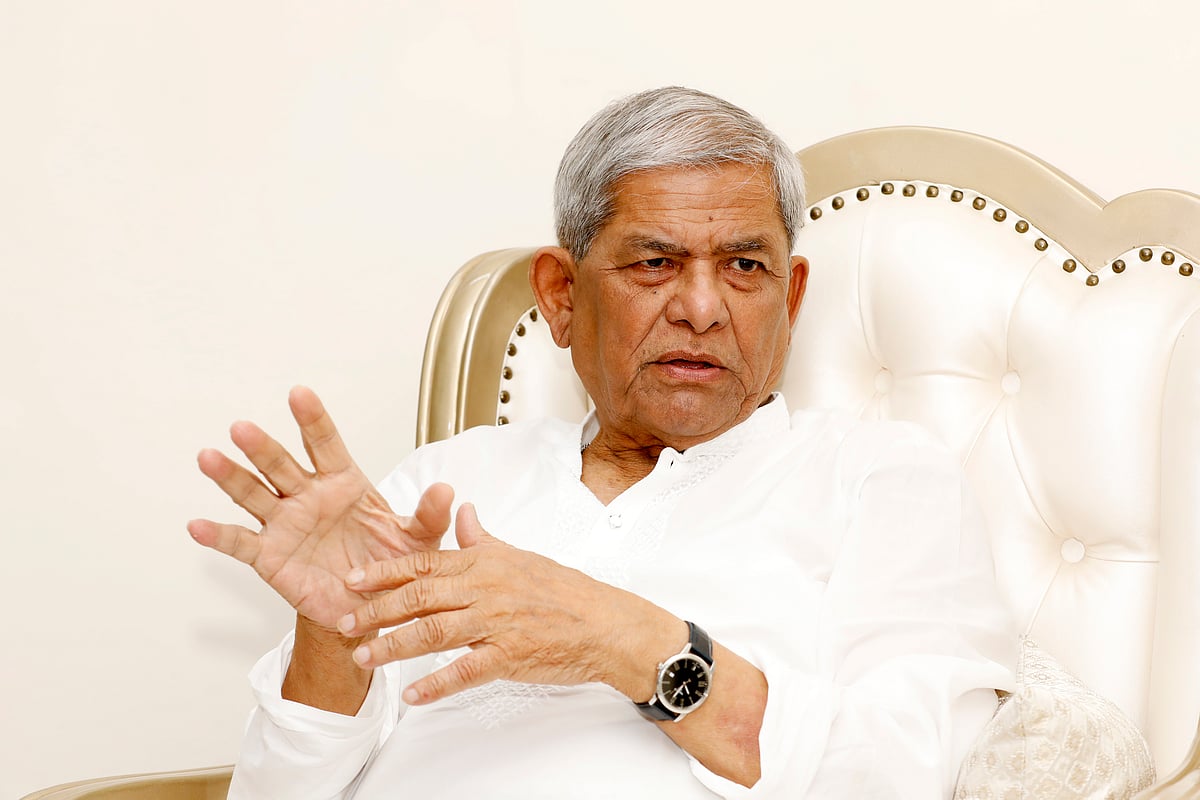
Exclusive Interview: Mirza Fakhrul Islam
Sheikh Hasina's departure seemed miraculous
On 5 August 2024, the fascist Awami League government was ousted from power following 36 days of intense student-led mass protests. The second anniversary of the mass uprising will be observed next Wednesday. Ahead of the occasion, Prothom Alo interviewed BNP Secretary General and Local Government Minister Mirza Fakhrul Islam Alamgir. In the interview, he reflected on a range of significant issues surrounding that period. The interview was conducted by Prothom Alo Special Correspondent Selim Zahid.
Prothom Alo: Where were you on the morning of 5 August 2024? Had you received any indication that the downfall of Sheikh Hasina's government was imminent that day?
Mirza Fakhrul: I was at home. We had been in communication with the students for a while, and it was ongoing. I don’t remember the exact time, but it was probably around 11 o'clock when our General Akbar (Retired Major General Fazle Elahi Akbar) called me to say that the Chief (Army Chief) would call me, and I should take the call. Then, around 12pm, the Chief called and said he wanted to talk with us. The Prime Minister wanted to resign, and he wanted to discuss that matter with us—what would happen afterward.
I asked who else he was inviting, and he said he had invited most of the political parties. I then said there was no way I could go out now as no vehicles were moving, and the streets were full of people. He said he would send a car for us. He sent a car for me and Abas (Mirza Abbas) as well. During that time, I was in touch with our chairman Tarique Rahman in London to discuss what we should talk about, how far we could or couldn't go. After finalising things through discussion with him, we went. After arriving, we discussed with the other political parties. The topic of a national government came up.
Prothom Alo: You said you spoke with the Army Chief around 12 o'clock; who was the intermediary, and were you informed about the meeting's agenda and participants in advance?
Mirza Fakhrul: No. At that time, people were heading towards the Ganabhaban, and the situation was on the verge of an explosion. You couldn’t set an agenda from nowhere. It was conveyed to the Army Chief that the Prime Minister would resign. Now, what should we (the political parties) do? We discussed what could be done in this situation.
Prothom Alo: What did you see when you arrived at the Army Headquarters?
Mirza Fakhrul: At the Army Headquarters, we saw the chiefs of the three armed forces present, and the National Party had arrived before us. GM Quader, Anisul Islam Mahmud, and Mujibul Haque Chunnu were there. Then Jamaat came, with Shafiqur Rahman, and as far as I remember, Azad (Hamidur Rahman Azad) was there too.
No. At that time, people were heading towards the Ganabhaban, and the situation was on the verge of an explosion. You couldn’t set an agenda from nowhere. It was conveyed to the Army Chief that the Prime Minister would resign. Now, what should we (the political parties) do? We discussed what could be done in this situation.
Prothom Alo: What was the agenda of the discussions?
Mirza Fakhrul: The discussion was about the Prime Minister resigning and what we could do next.
Prothom Alo: Who played a role in decision-making at that time?
Mirza Fakhrul: Manna (Mahmudur Rahman Manna) and Saki (Junaid Saki) were there. Then representatives from Islamic parties were coming. Maulana Mamunul Haque was there. At that time, no student leaders were present; later, we heard that they wouldn’t come here. We had to approach them instead. At that point, the issue of a National Government came up. But we already decided after consulting our party leader that we would talk about an Interim Government. We wouldn’t be part of a National Government.
Prothom Alo: You mean the discussion at the Army Headquarters included the topic of a national government? Who raised the discussion?
Mirza Fakhrul: I can't remember exactly. It might have been Manna or someone like him who brought it up. We decided then and there that we wouldn’t go for a National Government; we wanted an Interim Government. They should discuss the formation of an Interim Government.
Prothom Alo: Shortly thereafter, the Army Chief addressed the nation about an Interim Government.
Mirza Fakhrul: Yes, he mentioned it after talking with us. He also suggested that we join in the conversation, but we declined, saying it wasn’t appropriate for us to go there at that moment.
Prothom Alo: How did you perceive the role of the army that day—were they making decisions, or were they creating an environment for political parties to reach a decision?
Mirza Fakhrul: I saw the army’s role as very positive, especially the Army Chief, who was very active. He was communicating with everyone and bringing them together. He wanted the issue to be resolved through political means. News came to him that the Prime Minister, Sheikh Hasina, had left the country. He went inside to make some phone calls and returned to say that the Prime Minister had left.
You understand, it was a very exciting moment. Hasina leaving felt like a miraculous event to us. We had been fighting for this for 17 years, and such a huge, tough movement cannot really be described—the emotion of that moment.
Prothom Alo: What was your reaction at that moment?
Mirza Fakhrul: You understand, it was a very exciting moment. Hasina leaving felt like a miraculous event to us. We had been fighting for this for 17 years, and such a huge, tough movement cannot really be described—the emotion of that moment. I was also in contact with our chairman at intervals. After that, we were all taken to Bangabhaban. We started in the afternoon, but it was evening by the time we arrived, taking almost three hours to get there. The streets were filled with people, and everyone was incredibly joyous. Men, women, and children were everywhere, some with kids on their shoulders.
When we were about to leave the cantonment gate, we saw that there was no way to drive out. The road was completely blocked by people. Right there, on top of some drums, first Manna stood, then I, and then Jamaat-e-Islami's Shafiqur Rahman stood. We requested everyone to maintain peace and discipline, as we need to run the country. We were on our way to Bangabhaban. By the time we reached Bangabhaban, it was almost evening. The student leaders had not yet arrived. A few had reached, but I don’t remember their names exactly. Leaders from different political parties, the chiefs of the three armed forces, and officials from DGFI and NSI were there. Asif Nazrul was negotiating; in fact, he was bridging the conversations that were taking place. He was also at the Army Headquarters and was playing a leading role. (At Bangabhaban) Once we arrived there, discussions were taking place. Right at the start, I said that before any discussions, Begum Khaleda Zia must be released. Then the Army Chief said, yes, that indeed should be done.
Prothom Alo: Was this in the presence of the President? What was his reaction?
Mirza Fakhrul: The President said if everyone agreed, it should be done. He didn’t oppose anything. Then came the question of who will lead the government. During the discussion, Yunus Sahib’s (Professor Muhammad Yunus) name came up.
Prothom Alo: Who brought up this name?
Mirza Fakhrul: The students suggested it.
Prothom Alo: So, it wasn’t from any political party.
Mirza Fakhrul: No, his (Yunus’s) name didn’t come from any political party.
We discussed with the student leaders. We were having discussions with the student leaders every day. We spoke every night, and during the day too. Sometimes, they would come to my house at night. Mahfuz (Mahfuz Alam) came to my house on 3 August.
Prothom Alo: The "March to Dhaka" programme during the July uprising was a significant turning point. It was moved one day ahead from 6 August to 5 August. Did you play any role in that decision? If so, how and at what level were you involved?
Mirza Fakhrul: We discussed with the student leaders. We were having discussions with the student leaders every day. We spoke every night, and during the day too. Sometimes, they would come to my house at night. Mahfuz (Mahfuz Alam) came to my house on 3 August.
Prothom Alo: Can you elaborate on this part?
Mirza Fakhrul: I don't remember exactly.
Prothom Alo: Tell us as much as you can remember.
Mirza Fakhrul: As I said, they came to my house at night. We discussed what could be done, the possible decisions to be made. Then they were moved away by changing vehicles at night. At that time, Nazmul (Chhatra Dal leader Nazmul Hasan) was negotiating on our behalf, and Ehsan (Ehsan Mahmud) was also involved in these communications. Ashraf Uddin Nizan (currently the Whip of the National Parliament) was executing tasks on our behalf during that time.
Prothom Alo: Besides Mahfuz, who else from the student body came to meet you?
Mirza Fakhrul: Nahid Islam came once too. As far as I remember, Patwary (Nasiruddin Patwary) came once. This was two or three days before the 5th. Again, they were there on the 6th-7th as well. At some point, most probably on 7 August, the whole team came. They brought a list of people who could serve as advisors for the interim government. They had already finalised that Professor Yunus would be the chief advisor. They gave us that list.
Prothom Alo: Did you have any preferences or objections?
Mirza Fakhrul: Of course, I couldn't make a quick decision about the list they brought. I had to discuss it with my party's top leaders. We sat together and spoke to the chairman (Tarique Rahman) via video conference about the students' proposal. I was there, along with, I believe, the current Law Minister Asaduzzaman, who is now Deputy Speaker Kaiser Kamal; they were there as well. Nazrul Islam Khan was present too.
Prothom Alo: Did BNP propose or suggest any specific names from the list provided by the students?
Mirza Fakhrul: We also prepared our own list based on their list.
Prothom Alo: Can you recall any names from the list?
Mirza Fakhrul: I don’t want to mention names as it might create confusion.
I had discussions on this matter and sent a message that if the programme was delayed, it could be obstructed and fail. Therefore, I suggested doing it the next day, meaning on the 5th.
Prothom Alo: In an interview, you mentioned whether anyone from your side played a role in moving the students' "March to Dhaka" programme forward by one day.
Mirza Fakhrul: I had discussions on this matter and sent a message that if the programme was delayed, it could be obstructed and fail. Therefore, I suggested doing it the next day, meaning on the 5th.
Prothom Alo: It has been reported in various ways that your party was in contact with the students in the days leading up to 5 August. During this 36-day movement, did you have communication amid government oppression and intelligence surveillance?
Mirza Fakhrul: We had a line of communication with them. I spoke with Nahid. Initially, we consciously avoided taking the lead in the movement for strategic reasons. Even Nahid mentioned. . . for strategic reasons, we put all our efforts behind them. We also went out on what was probably 3 August, where there was a lot of shooting from helicopters. We weren’t allowed to stand in front of the press club. Mirza Abbas and I, among others, were beaten during that time.
Prothom Alo: Was there any coordination with the students in formulating the programme?
Mirza Fakhrul: They developed the programme in their way. We supported them; there was communication. They had to stay hidden, moved from one house to another. Most of our party members were in jail. I was the only one outside. You might remember that I used to go to the party office for press conferences and then return home.
Prothom Alo: The students proposed that Professor Yunus would lead the interim government. What was discussed within BNP on the night of 5 August regarding who would lead the interim government? Was there any consideration for another name?
Mirza Fakhrul: We had no objection to the students' proposal.
Prothom Alo: Once it was finalised that Professor Yunus would lead the interim government, did he speak with Tarique Rahman?
Mirza Fakhrul: I can’t say for sure. At that time, Tarique Rahman was in London, and Professor Yunus was in France. Whether they spoke, I don’t know. We had one conversation with him. When he landed at the airport, he invited a few people for discussions, including Wahiduddin Mahmud and Salehuddin Ahmed, who went to meet him.
Prothom Alo: As far as we observed, after Abu Sayed's death around 16-17 July, Tarique Rahman was very active on social media.
Mirza Fakhrul: Here, as you may know, there was a ban on broadcasting statements. But not a single day passed without his input in the movement. He maintained direct contact with our student wing, youth wing, and volunteers. He was one of the main architects, deciding on movements in different areas and whom to work with. There were several rounds of virtual meetings with the student leaders, including Nahid, before the 5th.
Prothom Alo: How much was BNP involved in forming the advisory council of the interim government or creating an outline for governing the country?
Mirza Fakhrul: There were discussions with the student leaders, which also reached the Army Chief. Only after the Army Chief agreed, everyone came together to form it. The Army Chief played a significant role in forming the interim government.
Prothom Alo: Did they (army headquarters) have any preference?
Mirza Fakhrul: No, I can't say that; but every matter was discussed with them.
The matter of student killings had stirred such emotions among people, students, youth, and women, that no one had the power to resist it. It struck like a terrifying wave, like a tsunami.
Standing two years after the mass uprising, what do you consider to be its greatest achievement? Do you see any shortcomings in it?
Mirza Fakhrul Islam: What came forward in the people's uprising was the participation of people. The main issue was 'against fascism.' The 'no' against Hasina meant she had to go; this was one of the major issues of the mass uprising. The matter of student killings had stirred such emotions among people, students, youth, and women, that no one had the power to resist it. It struck like a terrifying wave, like a tsunami.
Personally, I believe the first issue is change. Change requires an environment for a democratic system, to protect rights. Number two is that after long fascism, institutions were destroyed, people found no resolution anywhere, no justice or fairness. These matters came forth to people. That was the desire of people, and discussions were in accordance with that desire. For 15 months, the reform commission sat. There were long discussions with us regarding the July announcement. Sitting together with us, the student leaders, and Jamaat, the July declaration was ultimately made.
Then came the July National Charter. This discussion continued for 15 months. Finally, we never agreed to a proportional representation system in the upper house, and we also have a note of dissent. We agreed to the referendum matter at that moment because. . . a decision had to be made. They were showing an attitude of wanting to leave. Therefore, for the greater interest of the nation, we mentioned a referendum. I don't speak of elections. But where did the deception occur? The deception was in the four questions of the referendum. That turned the whole issue around to be like that. In the July Charter, it is stated in each that those who form the government will work according to their manifesto. That was agreed. Now, saying otherwise won't work. You agreed that you would do it your way. We have already formed committees in parliament. They are being repeatedly requested to come and talk here. If we want to change anything more through discussions, we will change. But they are not doing that. What's the problem here? Jamaat-e-Islami is playing a very negative role regarding this constitutional amendment. They are making it an issue for political gain and are conducting a movement for it. There is no response in the movement.
Prothom Alo: Before and after 5th August, there is a perception of your communication with the students; but how was the communication with other parties besides the students, especially with Jamaat? The leaders of the party were also in hiding and were banned before 5th August.
Mirza Fakhrul: Before 5th August, Jamaat (leaders) would not come out. There was communication even then. How we have done it for 15 years, secretly.
Prothom Alo: So, there was communication and discussion between Jamaat and BNP regarding the July movement.
Mirza Fakhrul: Regular discussions took place. We had a team. These teams would discuss. This matter of discussion has always been ongoing with us. Even before the 5th, we had discussions.
We worked by bypassing intelligence surveillance, changing cars, going to different places, just like the Communist Party. I have gone so many times myself. I, along with Nazrul Islam Khan bhai. And among them would be Dr. Shafiqur Rahman sometimes. If he were in jail, there would be Hamidur Rahman Azad, Parwar (Golam Parwar) was very less; Abdul Halim, however, would be more involved. He was the main one, he could stay outside. Thus, there was constant communication between BNP and like-minded parties, including Jamaat, regarding the July movement.
Prothom Alo: How did you do it under intense intelligence surveillance?
Mirza Fakhrul: We worked by bypassing intelligence surveillance, changing cars, going to different places, just like the Communist Party. I have gone so many times myself. I, along with Nazrul Islam Khan bhai. And among them would be Dr. Shafiqur Rahman sometimes. If he were in jail, there would be Hamidur Rahman Azad, Parwar (Golam Parwar) was very less; Abdul Halim, however, would be more involved. He was the main one, he could stay outside. Thus, there was constant communication between BNP and like-minded parties, including Jamaat, regarding the July movement.
Prothom Alo: The fall of fascism in the July mass uprising was a big achievement. What do you see as its inadequacies?
Mirza Fakhrul: Fulfillment won't come so quickly. Why don't you notice something of the past 15 years? All institutions are destroyed. Think about education. The vice-chancellor (VC) roams around with money to become one. We weren't even in government yet, during the interim government, VCs were being appointed in various places. Wahiduddin Mahmud was then the education advisor. Everyone thought that if they were my friends, maybe it would work if they said something. People came to me to become VCs, bringing money. Believe me, at that moment I thought, what will happen to this nation?
Tarique Rahman is working day and night. He holds meetings till 9 o'clock at night, takes the car himself, works out how to beautify Dhaka city. But what are others doing? I don't need to say, you find out yourself. Ministers are trying, what are the government officials doing? How sincerely are they working?
Pothom Alo: Just last Thursday you said, nothing has changed.
Mirza Fakhrul Islam: Saying these things puts me in trouble, brother. Tarique is working day and night. He holds meetings till 9 o'clock at night, takes the car himself, works out how to beautify Dhaka city. But what are others doing? I don't need to say, you find out yourself. Ministers are trying, what are the government officials doing? How sincerely are they working?
Prothom Alo: What was the biggest success and failure of the interim government of approximately one and a half years?
Mirza Fakhrul: What I think is, their success was—they at least managed to form the commissions. Forming commissions was very important. They managed to create a guideline for changes. There was a terrifying situation then—on one side India was propagating that communal killings were happening here; facing it, challenging it. They managed to create a good image internationally too. There’s no doubt about that. Yes, it's not possible for an interim government to do everything. Where are our crises? Prices of goods. The interim government tried. If production doesn’t increase, how will you solve it?
Prothom Alo: But at that time, you heavily criticised Professor Yunus's government.
Mirza Fakhrul: Yes, we criticised. I'm also saying, supporting the interim government led by Professor Yunus was entirely right. Yunus was the only acceptable person then.
Prothom Alo: There was a distance created between BNP and the student leaders of the movement over the credit of the mass uprising. In your opinion, where and why did this tension begin?
Mirza Fakhrul: I don't see any scope of that, and it shouldn't happen. I don't think there is such a thing. Yes, one thing happens that we also worked, our people died, we went to jail. So naturally. . . I have done so much, for so long, and the credit is going to others. . . such a mentality might exist; but I don't believe that. Normally what I know, as an old person, is if the youth, the students hadn't taken to the streets, the movement wouldn't have succeeded. When they did, it succeeded. As long as Dhaka University doesn’t take to the streets, no movement in Bangladesh succeeds. This is proven history.
Prothom Alo: What about the conflicts and clashes happening with the NCP now?
Mirza Fakhrul: These are isolated incidents. Locally, centrally we don't have that problem.
Prothom Alo: Why does it happen more in Sylhet?
Mirza Fakhrul: The people of Sylhet are a bit more active. Whenever their leader is insulted, they can't tolerate it. Frankly speaking. They (NCP) insult using vile-obscene language. This is Patwary, a young boy. Tell me. He came to my office for the first time and told me that we have to do this, do that, make a second republic, abandon the constitution and make a new constitution. I said, you seem to be talking like a fascist.
Prothom Alo: A section of the students who were on the streets in 2024 is now saying, the aspirations of the people's uprising haven’t been fulfilled. Which part of their statement do you find justified?
Mirza Fakhrul: A country like Bangladesh, with 200 million people, with an area of 154,000 square kilometers. You have to depend a lot on foreign aid. There are only two sectors where you earn. 40 million educated people are unemployed. We have made these people pass BA, pass MA due to wrong policies. But we couldn’t take technical education. It was the wrong policy of the past government. They don't have jobs. They are a problem.
Prothom Alo: Recently, there has been an apparent attempt to create the perception that things were better before.
Mirza Fakhrul: That is completely incorrect. Like now, your schools have started classes. Education sector is being shifted to a system of transfer. Your primary school teachers are transferred to the districts. Cheating has completely stopped.
These are positive aspects. I wouldn’t say anarchy in the health sector is all gone, but it has decreased a lot. Judiciary is much better than before. No BNP MP or minister ever phones a judge in the judiciary. So how will you say, nothing has happened. We have moved far ahead. This perception you are talking about that we were better off before, completely wrong perception. Those spreading it are doing so purposefully.
Prothom Alo: Recently, there has been an apparent attempt to create the perception that things were better before.
Mirza Fakhrul: That is completely incorrect. Like now, your schools have started classes. Education sector is being shifted to a system of transfer. Your primary school teachers are transferred to the districts. Cheating has completely stopped.
These are positive aspects. I wouldn’t say anarchy in the health sector is all gone, but it has decreased a lot. Judiciary is much better than before. No BNP MP or minister ever phones a judge in the judiciary. So how will you say, nothing has happened. We have moved far ahead. This perception you are talking about that we were better off before, completely wrong perception. Those spreading it are doing so purposefully.
Prothom Alo: One of the aspirations of the mass uprising was state reform, accountability, and a new political settlement. BNP is now in power. How do you evaluate the first months of the government in light of these aspirations?
Mirza Fakhrul: Our first six months went in organising everything. The chairman consolidated party leadership. Second is enhancing administrative consolidation, making the administration development-oriented. He is doing it by holding frequent meetings, and we are doing it. The social safety works he has done had a very good impact in villages and rural areas.
This time the budget is very positive. Prices of goods aren’t expected to rise. Prices are being raised due to a lack of supply, production is less. Second, businessmen haven’t yet been able to reach the place where they play a good role. You are an import-based economy. Your ships don’t move (due to the Middle East war). The sea is closed. So what will you do
Prothom Alo: Criticisms are heard like the old political settlement is returning in a new guise. There are also allegations of party influence in recruitment, transfer, contracting, and local administration. How will the government and the party respond to these allegations?
Mirza Fakhrul: What we saw after coming to power, were the public procurement rules. These were made by the Awami League and they were made to benefit only their people, creating an oligarchy. We have started changing these. From now on, the contracting matter will change significantly.
Prothom Alo: You yourself have questioned why nothing is changing, so what is it?
Mirza Fakhrul: That will take some time. It won’t happen overnight. The people given jobs during the 17 years of fascism weren’t employed on merit. You looked if they were with the Awami League, looked at the group. Those people are still there, in every sector. They are slow. They don’t want to work. And they have become accustomed to corruption. It will take time to bring them out of those habits.
Prothom Alo: You have said to focus on merit in education and administration; but recently it was seen that chairmen or heads in 11-12 government institutions were appointed on a party basis. There is criticism about it.
Mirza Fakhrul: Those recruited aren't unqualified. For example, Danny (ATM Abdul Bari, central secretary for religious affairs of BNP), he was a good student at a university, was a student leader. Almost all are student leaders. There are students from Dhaka University, from Rajshahi University, most are like that. They all possess qualifications. Why not qualified? And you are talking about field qualifications. Field qualifications will be with the MD, with the GM. He is the chairman. He will preside over a meeting; nothing more. When the chairman goes to a meeting, there have to be people there to ensure that the fascists do not return. I call it, anti-fascism. I am in government, won't I have my people?
Prothom Alo: How much of the opportunity for political change created through the people's uprising remains intact?
Mirza Fakhrul: There is considerable opportunity for change and it remains quite intact. If we can function in parliament, it will be settled.
Most of the reforms are being implemented. Except for a couple of places, we have taken measures. We have already formed a parliamentary committee for constitutional amendments. We want the opposition to come and solve the problems there. Even if the opposition doesn’t nominate anyone to the committee, we have to carry out the changes. We are committed to our 31 points and the July Charter and manifesto. We have to do that.
Prothom Alo: If the reforms aren’t implemented quickly, can the opportunity be lost?
Mirza Fakhrul: Most of the reforms are being implemented. Except for a couple of places, we have taken measures. We have already formed a parliamentary committee for constitutional amendments. We want the opposition to come and solve the problems there. Even if the opposition doesn’t nominate anyone to the committee, we have to carry out the changes. We are committed to our 31 points and the July Charter and manifesto. We have to do that.
Prothom Alo: What is BNP's principled position on the political future of the Awami League? How does BNP view judgments of the party’s leadership, organisational activities, and political rights of its supporters?
Mirza Fakhrul: I have nothing personal to say about this. The Awami League has ruined itself, killed itself. As a political party, the Awami League doesn’t actually exist now. The Awami League couldn’t retain its political entity. A party whose leader flees the country along with the team and leaves all ordinary workers helpless here. Now tell me, how will such a party survive?
Prothom Alo: What kind of Bangladesh do you want to see by the third year of the people's uprising?
Mirza Fakhrul: I have always wanted to see it as a liberal democratic country. I wanted to see it as a country of economic prosperity. I want to see it as a country of justice and fairness in every sector.
Prothom Alo: What do you consider the three most important tasks for the government and BNP in the coming year?
Mirza Fakhrul: First is taking measures to activate the economy, which has already been taken; and making the administration positive for moving the economy forward. Bureaucracy, administration will do its job properly, do that; and the third is ensuring that people aren't misled by politics based on religion. Preventing extremism or division of people based on religion.
Prothom Alo: Previously in an interview with Prothom Alo, you expressed concern over the rise of right-wingers in the country. How do you see it now?
Mirza Fakhrul: I still can’t dismiss it. It's still there. You see, during the World Cup when Brazil is playing, at that time someone writes the Kalima on white cloth. Who are they? This rise is alarming to me. Then bombs are being found in different places, this is alarming too. I think there is a conspiracy to present Bangladesh as an unstable country again. There is an attempt to create a plot against the government.
Prothom Alo: On one hand, you are saying the signs of the right-wing or extremist rise are alarming, on the other hand, saying there’s an attempt to plot against the government.
Mirza Fakhrul: That incitement is given by the Awami League. Awami League is involved in it, and extremism is also involved.
I have to always think every moment. If there is reconciliation for changing this situation if all political parties agree that we will give our programme to the people, if people take the programme they will take it. We won’t fight over it, won’t take to the streets, won’t victimise. If this happens, reconciliation will occur.
Prothom Alo: Many talk about reconciliation in such cases. Do you think it’s possible?
Mirza Fakhrul: I believe that without reconciliation you cannot take Bangladesh forward. It’s my personal belief. Will you stay in politics here and fight all the time, kill each other, victimize? When this comes to power, that will be in the case, when that comes, this will be in the case.
We do politics, do we remain in uncertainty every day? Now before doing every work, it seems, do I have to go to jail again? So that it doesn’t happen again, I have to always think every moment. If there is reconciliation for changing this situation if all political parties agree that we will give our programme to the people, if people take the programme they will take it. We won’t fight over it, won’t take to the streets, won’t victimise. If this happens, reconciliation will occur.
Prothom Alo: Is the government considering anything along those lines?
Mirza Fakhrul: It's already included in our manifesto.
Prothom Alo: Thank you
Mirza Fakhrul: Thank you too
*This interview, originally published in Prothom Alo print and online editions, has been rewritten in English by Rabiul Islam