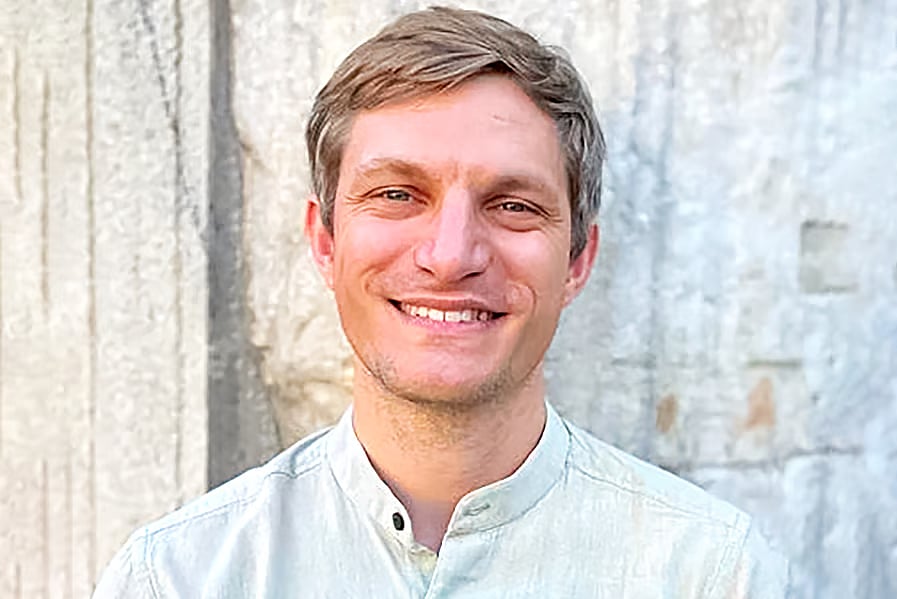
It's not possible to shut down all brick kilns, but the most harmful ones must be closed first: Martin Mattsson
The ‘Brick Kiln Tracker’ has been developed using satellite data, machine learning and air-quality modelling to help control pollution from brick kilns in Bangladesh. It can identify how harmful individual brick kilns are to human health. The research was led by Martin Mattsson, Assistant Professor in the Department of Economics at the National University of Singapore. Interview by Partha Shankar Saha.
What motivated you to undertake this research and develop the 'Brick Kiln Tracker’ for Bangladesh? Why do you think brick kiln pollution deserves particular attention in the country’s air pollution crisis?
Martin Mattsson : Bangladesh loses more life expectancy to air pollution than any other country: 5.5 years for the average person (Air Quality Life Index, 2025). Brick kilns are one of the largest sources, particularly in winter, when they operate and the weather traps pollution over the cities. Estimates of the kilns’ share of Dhaka’s fine-particle pollution range from about a tenth, which is my team’s estimate for the winter season, to more than half.
Kiln pollution also deserves attention because it is avoidable: Bangladesh does not need as many fired bricks as it is currently using. Hollow concrete blocks are made from cement, sand and stone chips and harden without being fired, so making them produces no kiln smoke. Concrete blocks are widely used both around the world and in Bangladesh, and switching most construction to using concrete blocks is feasible within just a few years if we start today.
The Tracker uses satellite imagery, machine learning and air-quality modelling. Could you explain how these technologies work together to identify individual brick kilns, classify their technologies and estimate their pollution levels? How accurate and reliable are these estimates?
Martin Mattsson : There are three steps. First, a neural network scans high-resolution satellite images for kilns. We combine its results with earlier kiln maps, and a person then checks every kiln in the imagery, recording its technology (zigzag or fixed-chimney) and whether it operated that season, from signs such as smoke and drying bricks. We then trained another machine learning algorithm to tell the difference between an active and closed kiln from lower-resolution imagery that is updated more frequently. Using this lower-resolution imagery, we update the map with information about which kilns are active every season. So the current tracker is based on which kilns were active in the 2025/26 brick kiln season.
Second, we estimate each kiln’s emissions from how much coal kilns of its type burn, based on our survey of kiln managers, and from field measurements in South Asia of the pollution released per unit of coal. An air quality model then traces where the pollution travels during the brick season. Third, we combine the resulting pollution with population maps and standard estimates of how fine-particle exposure raises mortality to calculate a health harm score for each individual kiln.
The health estimates are modelled, not measured. The largest uncertainty is how much a kiln emits: few studies have measured kiln emissions, and their results differ substantially. The total number of deaths caused by kilns is therefore uncertain. The ranking of kilns is more reliable, because the same assumptions apply to every kiln and the differences between kilns come from location and technology, which we observe well. One limitation is that we assume all kilns of one technology emit the same amount, so a badly run kiln, or one burning dirtier fuel, may do more harm than the tracker shows.
What are the most important findings from your research? How many brick kilns have been identified across Bangladesh, and are there particular regions or districts where the concentration of kilns is especially high?
Martin Mattsson : We have mapped more than 9,000 kilns that have operated at some point since 2010. In the 2025/26 season about 6,000 were active, and more than four in five of these were zigzag kilns. The number of active kilns peaked in 2019 and has fallen by more than a fifth since, with fixed-chimney kilns falling fastest.
The most important finding is that the harm is concentrated: 14 per cent of kilns cause a quarter of the health damage from all kilns, and a third of kilns cause half. Kilns close to and upwind of a large city do the most harm per kiln, because more people breathe their smoke. People in the areas covered by the pilot of our new public tracker, iterbhata.com, can look up each kiln near them and how harmful it is. While we evaluate the pilot, I would rather not single out districts or upazilas outside it.
The current siting rules are a poor guide to this harm. Kilns near schools, hospitals, wetlands or forests are on average about as harmful as other kilns.
Your research estimates the potential health impacts of pollution from individual brick kilns. What are the major health risks associated with this pollution? Can you quantify the potential health burden, particularly in terms of respiratory and cardiovascular diseases and premature deaths?
Martin Mattsson : Kiln smoke contains fine particles (PM2.5) and gases such as sulphur dioxide that form more fine particles in the air. Long-term exposure to fine particles raises the risk of heart disease, stroke, chronic lung disease, lung cancer and lower respiratory infections such as pneumonia.
Our model estimates premature deaths; it does not estimate the larger number of people who fall ill. I prefer not to give a single figure for total deaths, because it depends heavily on assumptions about emissions and the plausible range is wide. Some recent evidence suggests that particles from burning coal are more harmful than the average particle, so our estimates may, if anything, be too low. We are more confident about comparisons: which kilns do the most harm, and how the total has changed. By that measure, the harm from kilns has fallen by about 30% since 2019 as kilns closed or switched to zigzag technology.
How significant is the difference in pollution between zigzag kilns and traditional fixed-chimney kilns? Does adopting zigzag technology necessarily mean that a kiln is environmentally safe, or are there other factors that need to be considered?
Martin Mattsson : The difference is substantial. Per brick, a fixed-chimney kiln emits about twice as much fine-particle pollution as a zigzag kiln, and more than four times as much sulphur dioxide, which forms more fine particles in the air. Fixed-chimney kilns have been banned since 2013, yet about one in six active kilns still uses the technology.
But a zigzag kiln is not safe. It still burns coal and still pollutes. Location matters as much as technology: about four in five of the most harmful kilns in the country are zigzag kilns, because a zigzag kiln upwind of a large city exposes far more people than a fixed-chimney kiln in a sparsely populated area. How well a kiln is run also matters. Converting every fixed-chimney kiln still operating to zigzag would cut the health harm from kilns by less than a tenth. Teaching zigzag kiln owners to operate their kilns more efficiently may reduce their emissions by another 20 per cent. Closing the most harmful fifth of kilns, whatever their technology, would cut the health harm by about a third.
Prothom Alo: Bangladesh has laws and regulations governing brick kilns, but illegal and highly polluting kilns continue to operate. How can this publicly accessible Tracker help government agencies enforce environmental regulations? Could it become an effective tool for holding kiln owners and authorities accountable?
Martin Mattsson : There are two versions of the tracker. Department of Environment officials log in to a version that is designed for government use. The second version is public: iterbhata.com. We are launching it first as a pilot covering about a third of all upazilas, where anyone can see each kiln on a map with its technology and estimated health harm. If the pilot is successful, we plan to expand the public tracker to all of Bangladesh.
On accountability: because the ranking is objective, the Department’s headquarters or the Ministry can check whether each district office is acting against the most harmful kilns. The public tracker lets residents, journalists and local representatives see which kilns near them do the most harm and nudge the authorities to act.
Prothom Alo: Based on your research, what are the three most important actions Bangladesh should take to reduce pollution from brick kilns? Should the country focus on stricter enforcement, cleaner kiln technologies, alternative building materials, or a combination of these approaches?
Martin Mattsson : A combination. First, direct enforcement at the kilns that do the most harm. Since almost every kiln breaks the law, the question is where to start. The tracker gives officials a list of the most harmful kilns, and the officials’ version now covers the whole country. Second, make enforcement against those kilns stick. A small fine rarely stops a kiln. Closures should last, and seasonal satellite updates can show whether a closed kiln has started operating again.
Third, encourage construction companies and public infrastructure projects to use alternatives to traditional fired bricks. Bricks are still the country’s main construction material, so closing all kilns is not realistic in the near term, which is why priorities matter. Over time, alternatives such as hollow concrete blocks should replace fired bricks, and the government can speed this up by meeting its own target of using blocks in public construction.
Furthermore, the government could ban kilns from operating during the worst air pollution season of November, December, and January. That would substantially reduce the health harms that kilns cause.