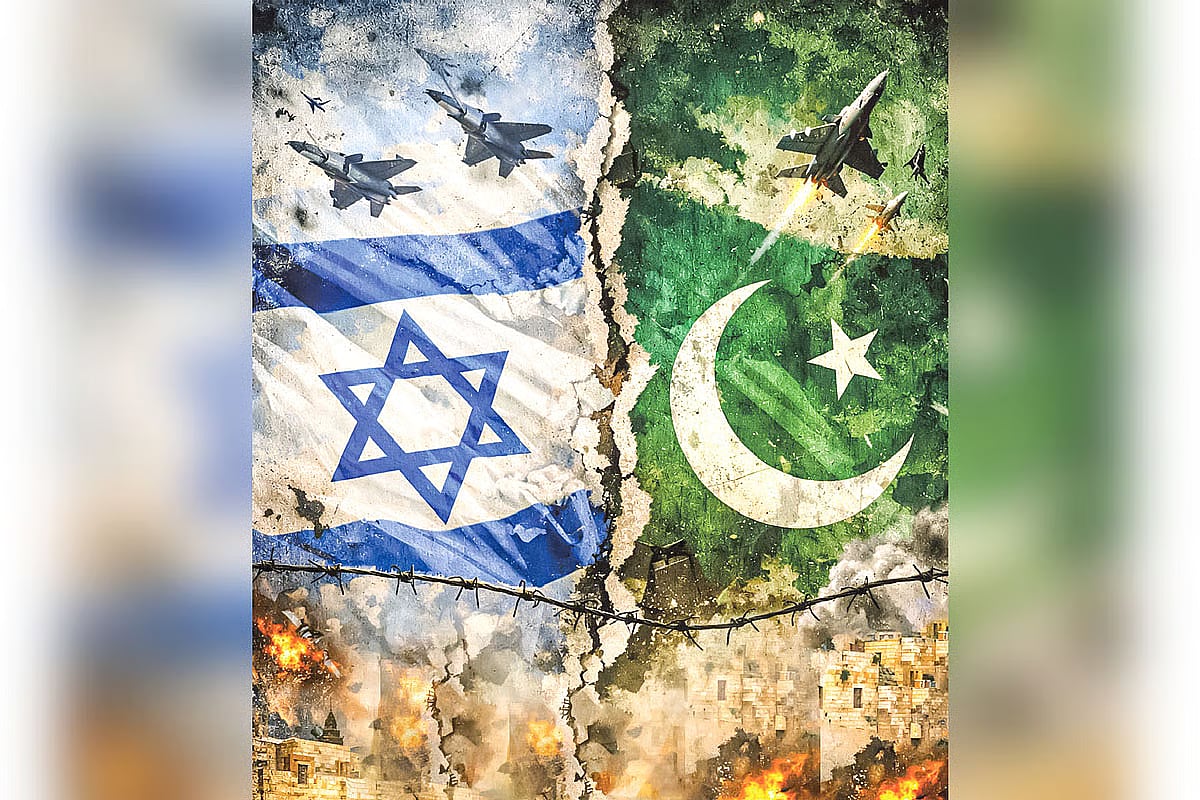
Iran’s capacity to wage war is diminishing in the face of the joint aggression of Israel and the United States. Even so, its citizens may continue to fight to defend the country’s sovereignty. What shape that struggle will take in the coming days is difficult to predict. Meanwhile, under the pretext of suppressing Hezbollah, which supports Iran, Israel is currently wreaking devastation in Lebanon. Amid this, a question has emerged: after Iraq, Syria, Libya, Iran and now Lebanon, will the aggressive axis of the United States and Israel target another country? In particular, how realistic are the rumours surrounding Pakistan?
The question may sound unusual. But in the face of the near-total ineffectiveness of international organisations such as the United Nations and the Organisation of Islamic Cooperation (OIC), even raising such questions has become a harsh reality—especially when certain signs appear to support them.
Modi in Israel before the Iran operation
Three days before the joint attack on Iran by Washington and Tel Aviv, Indian Prime Minister Narendra Modi visited Israel. Soon after he returned, the war began; at the same time, new speculation and anxiety emerged internationally regarding Pakistan. The concern is that if nuclear capability made Muslim-majority Iran a target of Zionist hostility, Pakistan could face the same anger. Especially as ties between India and Israel deepen steadily, a distant warning seems to loom for Islamabad.
At a time when Israel and its prime minister Benjamin Netanyahu are widely condemned around the world for the brutality of the Gaza killings, India’s prime minister walked the red carpet in that country. The visit was not only a disregard for global opinion but also an effort to strengthen practical cooperation against Pakistan. Ahead of Modi’s visit, Netanyahu made it clear that Tel Aviv wanted to build a new axis including India, Greece and Cyprus. He said like against ‘Shia axis,’ they will strike against the ‘Sunni axis’ as well.”
Although he did not name any country directly, the statement has created anxiety in South Asia. For some time, Turkey and Saudi Arabia have been exploring a military partnership involving Pakistan. According to Netanyahu’s interpretation, that could represent a “Sunni axis”.
Has Pakistan become a ‘target’?
Even policymakers in Pakistan have at times suggested that the country could become a target of Israel. Pakistan’s defence minister, Khawaja Muhammad Asif, said on the social media platform X on 3 March that Zionists have a plan to turn Pakistan into a compliant state. After succeeding in Iran, he suggested, Israel might try to implement that plan with the help of India and Afghanistan. Referring to the roughly 900-kilometre border between Pakistan and Iran, Asif said that if Zionist control were established in Iran and a puppet government installed there, its effects would inevitably reach Pakistan’s borders. He also highlighted the important role of nuclear weapons in ensuring Pakistan’s security.
In Pakistan, about 25 people have reportedly died so far during protests opposing the Israeli and US attacks on Iran. The defence minister’s statement has drawn considerable attention within the country’s civil society and internationally as well. Naturally, the question arises: how realistic are these fears?
How much of a threat is Pakistan to Israel?
At least nine countries in the world possess nuclear weapons, including the United States and Israel itself. So what is the problem if Iran or Pakistan possesses the same technology? The question is logical, but there is no longer any international organisation with enough backbone to demand or provide an answer. In practice, the United States and its allies now determine which country may possess what kinds of weapons and to what extent. In this equation of preference and power, Israel’s influence often appears even stronger than that of the United States. It does not want any Muslim-majority country to possess nuclear technology.
Israel has its own explanations for this stance. In essence, it does not want any Muslim-majority country capable of opposing the establishment of a “Greater Israel” in Arab lands. It also argues that if one Muslim-majority country acquires such technology, it could spread to others sharing the same religion. India’s Rashtriya Swayamsevak Sangh–Bharatiya Janata Party ideological camp broadly agrees with this perspective. That is one reason why Narendra Modi has visited Israel twice as prime minister on such issues.
Given their historical rivalry with Pakistan, India’s current rulers also appear keen to bring Israel into that equation. From another perspective, Israel sees an opportunity in its partnership with New Delhi regarding nuclear and strategic questions. Thus a new area of concern is emerging for Pakistan—something Khawaja Asif has spoken about openly.
Asif’s fears also seem plausible in light of earlier reports. In 1981, international media revealed that Israel had offered to assist India in attacking Pakistan’s nuclear facilities—similar to the operation in which Israel destroyed an Iraqi reactor in what was known as Operation Opera (often also referred to as Operation Babylon). In 2008, Catherine Scott Clark and Adrian Levy wrote a book about those discussions and initiatives between Israel and India.
‘Greater Israel’ vs ‘Muslim NATO’
Pakistan and Israel are more than 3,000 kilometres apart and are not neighbours. Even if Zionists aim to create a larger state—an idea widely discussed today—Pakistan would not be directly affected. The concept of “Greater Israel” could encompass not only Palestinian land but also parts of Syria, Iraq, Lebanon and Jordan. Israel’s leadership has already established varying degrees of political and military control in some areas of those territories. Jewish settlements have not yet been built across all those lands, but those states are no longer in a position to prevent Israeli military activity in their airspace.
Pakistan has not stood as a barrier to Israel’s repeated violations of sovereignty in Syria, Iraq or Lebanon. It does not have the capacity to do so. Nevertheless, Tel Aviv may be concerned that the “Greater Israel” project could eventually push Muslim-majority Arab states toward collective self-defence. In such a situation, Pakistan’s military strength could pose a challenge to Israel. Recent signs of a possible military partnership among Pakistan, Turkey and Saudi Arabia are particularly worrying for Israel. The military agreement signed between Pakistan and Saudi Arabia last September is viewed in Israel as part of that potential alliance.
Israeli strategists speculate that such a “Sunni bloc” could place pressure on them in the future. At a recent international conference of American Jewish leaders in Israel, former prime minister Naftali Bennett reportedly described the possible trilateral alliance as a “threat to our existence”. Some Israeli newspapers have even labelled it an “Islamic NATO”.
How dangerous is the India–Israel partnership?
India and Pakistan have already fought four major wars. Each sees the other as a permanent enemy, and both have built large nuclear arsenals. The politics of both countries are sustained partly by the constant rivalry and the destructive potential of these weapons. Against this backdrop, New Delhi and Tel Aviv appear to see an opportunity for a mutually beneficial strategic partnership. After the fall of the Assad government in Syria and the weakening of Iran, Israel currently faces no immediate regional security threat. Yet eliminating nuclear capabilities in Muslim-majority states could provide it additional reassurance.
India, on the other hand, having failed to decisively defeat Pakistan even after several wars, sees in Israel a militarily experienced partner that might strengthen its position against its neighbour.
During his visit to Israel, Modi reportedly said in the Israeli parliament: “You are the father, we are the mother.” This may symbolise a new ideological convergence between Hindutva and Zionism—one that legitimises occupation in Arab lands while hinting at similar geopolitical ambitions in South Asia. The remark suggests an effort to extend Middle Eastern religious-nationalist aggression into this region as well. Bangladesh may even feel some of its repercussions. But undoubtedly Islamabad would be the immediate next focus of this self-proclaimed “father-mother” alliance.
If Pakistan could be turned into a failed state, New Delhi’s leadership in South Asia would become unchallenged. After Pakistan, Israel’s final strategic concern might be Turkey. The emerging ideological alignment between Modi and Netanyahu also serves as a distant warning for Saudi Arabia. Gulf economies—including the United Arab Emirates—host large numbers of Indian workers, whose presence Israel increasingly views as a geopolitical asset in its partnership with India.
Israeli military technology in India
Israel has rarely expressed concern about nuclear weapons in other nuclear-armed countries except Pakistan. Nuclear capabilities of the United States, France or Russia are never interpreted in religious terms; no one calls them “Christian bombs”. The same has been true of India’s arsenal. But Pakistan’s nuclear capability is often labelled the “Islamic bomb”.
Since Pakistan acquired nuclear technology, India’s current leadership has placed strong emphasis on obtaining advanced military technologies from Israel. This could raise military imbalance in South Asia, similar to what has happened in the Middle East. During Modi’s latest visit, one key topic reportedly discussed was expanding AI-based warfare capabilities. The visit may open the door for Israel to transfer technologies to India that it had previously been reluctant to share—including its well-known air defence systems Iron Dome and Iron Beam.
The Indian government calls its new military technology initiative “Mission Sudarshan Chakra”, which will involve not only defensive systems but also next-generation offensive missile technology. Only six months after launching the initiative, Modi travelled to Tel Aviv. Reports suggest the two countries may move toward joint development and production of such weapons—potentially surpassing earlier joint projects such as drone programmes involving Israel’s Elbit Systems and India’s Adani Group.
An investigation by Al Jazeera (26 June 2024) found that Indian manufacturers—such as Premier Explosives Limited—supplied rockets and explosives to Tel Aviv during the Gaza offensive.
The diplomatic understandings behind these Israel–India joint initiatives resemble earlier arrangements Israel has long maintained with United States and Germany. Consequently, Western military technologies and long-standing alliances are also intertwined with the Israel–India partnership. Naturally, this presents a multi-dimensional challenge for Islamabad. An additional concern for Pakistan is that the country’s main nuclear arsenal is located in Balochistan—a region currently facing a serious insurgency.
*Altaf Parvez is a researcher on the history of South Asia.
** The views expressed are the author’s own.