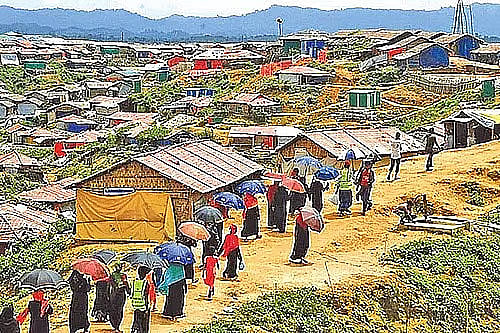
Bangladesh's demand for Rohingya repatriation is not new in diplomatic agenda. It has been a key goal of Bangladesh's policy on the crisis for decades. In 1978 and 1991-92, there were two instances of large-scale displacement from Myanmar, which were followed by return programmes between Bangladesh and Myanmar. Dhaka has made voluntary return a top foreign policy priority after more than 700,000 Rohingya refugees arrived in Bangladesh in response to violence in Rakhine State, Myanmar, in August 2017. However, nothing much has happened since 2017 in terms of a large, voluntary repatriation.
The challenge is not only to plan a physical return across the border, but to ensure the conditions are in place for a voluntary, safe, dignified and sustainable return. UNHCR has repeatedly called for refugees to be able to return freely and voluntarily.
The challenge is more apparent when it's understood that the history of displacement has been a complex process. Rohingya have been discriminated and excluded in Myanmar for decades. The 1982 Citizenship Law introduced a concept of citizenship that effectively denied citizenship to most Rohingya and denied secure citizenship. Repeated displacement was caused by restrictions on movement, education and employment, as well as by recurrent violence and persecution by state and non-state actors, against victims.
The main issue is that physical infrastructure is not sufficient for repatriation. Rohingya refugees should be given protection from persecution and violence, genuine rights, freedom of movement, and a viable solution to the refugees' citizenship status. Economic recovery is possible by development, but not by infrastructure. This separation is especially relevant during the current conflict in Rakhine, where political and security issues are ambiguous, raising the risks of return.
Limited movement, limited education, and limited access to public services, in addition to repeated violence and persecution by both state and nonstate actors, all played a part in causing repeated displacement. The displacement of 2017 was much greater than the previous big refugee influx of 1978 and 1991-92. For Rohingya refugees in Bangladesh, then, there is no easy return to Myanmar as it's just a border crossing. Whether conditions have indeed improved for them is the question.
On 23 November 2017, Bangladesh and Myanmar inked a deal on the repatriation of the Rohingya. This was not followed by significant progress, however, as issues of verification, citizenship, security, freedom of movement and conditions of return remained largely unresolved. In 2018 and 2019, refugees did not find the conditions favourable, and the repatriation of the refugees was not successful. The bilateral agreement's effectiveness was demonstrated to be insufficient to create refugees' confidence in the safety of their return. The "Let's Go Home" mobilisation of the Rohingya leader Mohib Ullah also revealed the possibility of an aspiration to return coupled with also demands for security, rights and recognition.
The situation has become more complex since the military takeover in Myanmar in February 2021 and the increased violence in the country. Since the renewed conflict between the Myanmar military and Arakan Army, the security situation in Rakhine has deteriorated even further. This has made the repatriation issue more complex. Territorial control and governance in Rakhine are increasingly contested and the problem cannot be approached in isolation of the relationship between the two central governments of Bangladesh and Myanmar. Any return process should take into account the real security and political situation of the areas to which Rohingya will return.
But Bangladesh continued to engage in diplomatic activities. The fifth meeting of the Myanmar-Bangladesh Joint Working Group was held in June 2022, and ongoing dialogue on verification/repatriation. In 2023, Bangladesh and Myanmar moved forward with a pilot repatriation programme involving 1,140 Rohingya. Of these, 711 had been cleared for return, while the remaining 429 were subject to further verification.
Refugees had raised many concerns about security, citizenship, freedom of movement and the possibility of repatriation to their countries of origin. The experience showed that a list of returnees or reception arrangements is not enough, rather refugees must be given sufficient information and confidence to make a truly voluntary decision to return.
It is in this respect that China's part is significant. China was more active with its diplomacy following the 2017 crisis. In November 2017, the Chinese Foreign Minister Wang Yi proposed three steps: "First, peace and stability; second, bilateral consultation on repatriation; and third, development and poverty reduction in Rakhine State. This important proposal was because it was not just a logistical exercise, but linked to the broader themes of stability and development.
The unique position of China is that it has significant political, economic and strategic ties with both Bangladesh and Myanmar. China has been enjoying long-standing cooperation with Myanmar as well as Bangladesh has been having extensive cooperation in the fields of economic and infrastructure development with China.
Chinese investment in Myanmar is spread across many fields, such as connectivity and infrastructure developments, which are connected with the China – Myanmar Economic Corridor and Kyaukphyu. These ties open up diplomatic access for Beijing to Myanmar which Bangladesh doesn't have. But accessing doesn't equate to unlimited leverage. China has influence over Myanmar through the economic and political ties with the country but Beijing does not have a right to impose its solution on Myanmar or any armed groups in Rakhine.
The Rohingya crisis has no easy solution. Previous agreements have shown that diplomatic commitments alone cannot overcome the security and political conditions underlying displacement. Sustainable return ultimately depends on whether Rohingya refugees can reasonably expect to live with security, rights and dignity in Myanmar.
China's involvement started to become more institutionalised in the form of trilateral diplomacy. Bangladesh, Myanmar and China signed a tripartite mechanism in 2019 to help the repatriation process and conduct on-the-ground assessments. China restated its commitment to return and willingness to help communications between Bangladesh and Myanmar. However, with all these diplomatic gestures not much in the way of large-scale voluntary repatriation has happened. China's contribution should be measured in terms of practical action aimed at promoting conditions for repatriation, not just in terms of verbal assurances.
The main issue is that physical infrastructure is not sufficient for repatriation. Rohingya refugees should be given protection from persecution and violence, genuine rights, freedom of movement, and a viable solution to the refugees' citizenship status. Economic recovery is possible by development, but not by infrastructure. This separation is especially relevant during the current conflict in Rakhine, where political and security issues are ambiguous, raising the risks of return.
Hence, for Bangladesh, China's engagement must be viewed as part of a wider diplomatic policy and not as a substitute for diplomacy with other nations. Dhaka must keep in touch with Beijing and continue to cooperate with UN, ASEAN, humanitarian groups and other foreign agencies. Bangladesh should leverage the political and economic relationship with Myanmar for the creation of conditions that facilitate the voluntary, safe, dignified and sustainable return. China can help to facilitate dialogue and help to implement confidence-building measures and development to benefit affected communities; development assistance cannot replace rights, citizenship and security.
The Rohingya crisis has no easy solution. Previous agreements have shown that diplomatic commitments alone cannot overcome the security and political conditions underlying displacement. Sustainable return ultimately depends on whether Rohingya refugees can reasonably expect to live with security, rights and dignity in Myanmar.
China has an important role to play, not in resolving the Rohingya crisis alone, but through its combination of political, economic and strategic ties with Myanmar. If Beijing can translate these relationships into sustained efforts that improve the conditions for return, its contribution could become genuinely meaningful. Bangladesh should encourage such engagement while continuing to pursue broader regional and international diplomacy. The ultimate goal should not simply be to move refugees across a border, but to create conditions in which returning home is genuinely safe, voluntary, dignified and sustainable.
#Jannatul Ferdous is Associate Professor, Department of Public Administration, Comilla University
E-mail: Jannat.lata@yahoo.com