Opinion
July Declaration: What are we supposed to do with it?
The irony is that the political parties that had been most vocal about the July Declaration have expressed disappointment after its release, while those that had shown little enthusiasm about it until now have welcomed it without reservation.
BNP standing committee member Salahuddin Ahmed, in an immediate reaction, said, “Today (5 August) the Chief Adviser made two important announcements. One is the July Declaration, and the other is the declaration of elections through his address to the nation. We welcome both.”
The Declaration has also been welcomed by Nagorik Oikya, Ganosamhati Andolon, and the Biplobi Workers Party.
On the other hand, Jamaat-e-Islami’s Nayeb-e-Ameer Dr. Syed Abdullah Mohammad Taher expressed disappointment, saying the Declaration does not reflect the aspirations and expectations of the July uprising.
Speaking at a press briefing, member secretary of the National Citizen Party, Akhtar Hossain, said that some important issues were missing from the July Declaration. he said, “The Declaration speaks of anti-colonial struggles, but it fails to mention 1947 which is one of the key reference points in the anti-colonial struggle of the people of this land. We believe that the achievement of a sovereign state for Bangladesh, or for this territory, is the result of a confluence of 1947, 1971 and our 2024 movement. Including all of these could have enriched the Declaration further.”
While the role of the 1971 Liberation War in the creation of a sovereign state is undeniable, it is unclear how 1947 contributed to that process. The events of 1971 came about precisely by rejecting the two-nation theory of 1947. Moreover, in 1947, it was not the Bengali Muslim middle class but the Bengali Hindu middle class that had pushed for the division of Bengal (see 'Bengal Divided' by Joya Chatterji).
In a statement, the Amir of Khelafat Majlis, Maulana Mamunul Haque, said, “The July Declaration read out by the Chief Adviser, the way the declaration was staged, and the announcement of the election date following consultation with only one party, all prove that the views, sacrifices and organisational role of Islamic groups have been disregarded.”
He also expressed resentment that the Declaration makes no mention of the 1947 Azadi, alongside the 2013 Shapla Chattar massacre and the Pilkhana tragedy.
The Gono Odhikar Parishad remarked, “The July Declaration has been built upon a false historical foundation.”
Gono Forum also criticised the Declaration, but from a different perspective. They said that it requires no deep research to understand the political character of those who lament the “Azadi” of 1947, sitting in independent Bangladesh. Those haunted by the legacies of the past will, inevitably, do such things. But what is puzzling is how young people, who are firmly committed to building an egalitarian Bangladesh, have become enamored with the idea of freedom in 1947.
Given the political nature of the Declaration, it is perhaps not surprising that political leaders interpret it through the lens of party interest and electoral calculations. But journalist David Bergman’s observations surely stand above such partisanship
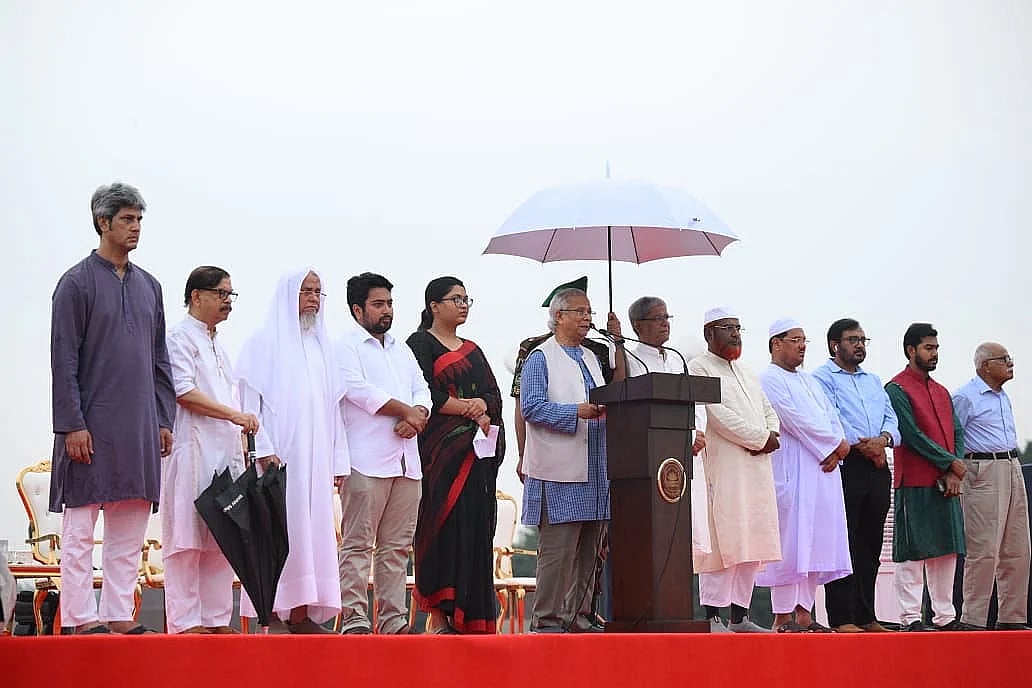
It may be noted that on 5 August, the anniversary of the July popular uprising, Chief Adviser Muhammad Yunus read out a 28-point Declaration and officially declared state and constitutional recognition of the uprising.
Political leaders may of course bring their partisan or personal perspectives to the interpretation of the Declaration. But the hard truths of history cannot be denied or disregarded.
In this context, one may look into the reaction of British journalist David Bergman, renowned for 'The War Crimes Files', the documentary that first brought the issue of 1971 war criminals to light in the 1980s. In his Facebook Post, David Bergman wrote: " Much of the history - as well as description of the Awami League - set out in this declaration is highly biased and partial, and seems to just represent the views of those who hate the Awami League, not just for what the party has done whilst in government, but for what the party is to them, that is to say a political adversary. That is to say, much of it reads like a political tract written by long standing adversaries and critics of the Awami League."
His concern is that the narrative presented in the Declaration could prove even more problematic than the politically biased version of the 1971 war promoted by the Awami League.
According to David Bergman, the Declaration portrays the Awami League’s rule from 1972 to 1975 solely through the lens of one-party governance under BAKSAL, overlooking the initiatives the party undertook in the post-war nation-building process.
The Declaration states that under the leadership of Sheikh Hasina, her government turned Bangladesh into a fascist state, dominated by an extremely anti-people, authoritarian, corrupt, and rights-violating force. There is little room to dispute that
The Declaration states that on 26 March 1971, independence was declared and the state of Bangladesh was established through a bloody Liberation War aimed at national emancipation. However, it does not mention who led that war.
It also claims that the post-independence Awami League government failed to fulfill the aspirations of the Liberation War due to the way the 1972 Constitution was formulated, its structural weaknesses, and its misuse. But there is no evidence that any government in the past 53 years has fulfilled those aspirations or that any has upheld power through genuinely fair elections.
The Declaration refers to the establishment of one-party rule by the Awami League and to the Sipahi-Janata (soldier-people) uprising of 7 November 1975. However, Bergman criticises the omission of the assassinations of the architect of independence, Sheikh Mujibur Rahman, on 15 August 1975, and of the four national leaders on 3 November that same year.
The Declaration acknowledges the nine-year-long struggle against military dictatorship in the 1980s, culminating in the 1990 mass uprising, but skips over the imposition of martial law by Khandaker Mushtaque Ahmad.
The Declaration claims that the 1/11 emergency regime paved the way for Sheikh Hasina’s absolute power, dominance, and eventual fascism in Bangladesh. But the absence of any mention of the 2008 elections appears to be an attempt to obscure the truth. The Declaration does refer to three farcical elections of 2014, 2018, and 2024.
The Declaration states that under the leadership of Sheikh Hasina, her government turned Bangladesh into a fascist state, dominated by an extremely anti-people, authoritarian, corrupt, and rights-violating force. There is little room to dispute that. Nor is there much scope to question the government's real intentions regarding the rule of law, human rights, corruption, exploitation, inequality, moral values and the establishment of a democratic system.
We firmly state that the Awami League did not honour the people’s verdict in the 2008 election. It is also true that the party sought to make its hold on power permanent through three farcical elections. However, while the Declaration accuses Sheikh Hasina of coming to power through a conspiracy, it also places in the dock those who played a crucial role in the 2008 elections, some of whom now hold key positions in the current government.
Given the political nature of the Declaration, it is perhaps not surprising that political leaders interpret it through the lens of party interest and electoral calculations. But journalist David Bergman’s observations surely stand above such partisanship.
Those who now question his interpretation of history should revisit the articles he wrote during the Awami League government’s war crimes trials. At the time, this journalist closely followed the trial proceedings, critiqued them with supporting evidence, and did so in the interest of justice.
As a result, he was declared persona non grata in Bangladesh for a long time during the Awami League regime. I believe his current analysis of the July Charter is also part of that same pursuit of truth.
* Sohrab Hassan is joint editor of Prothom Alo, and poet