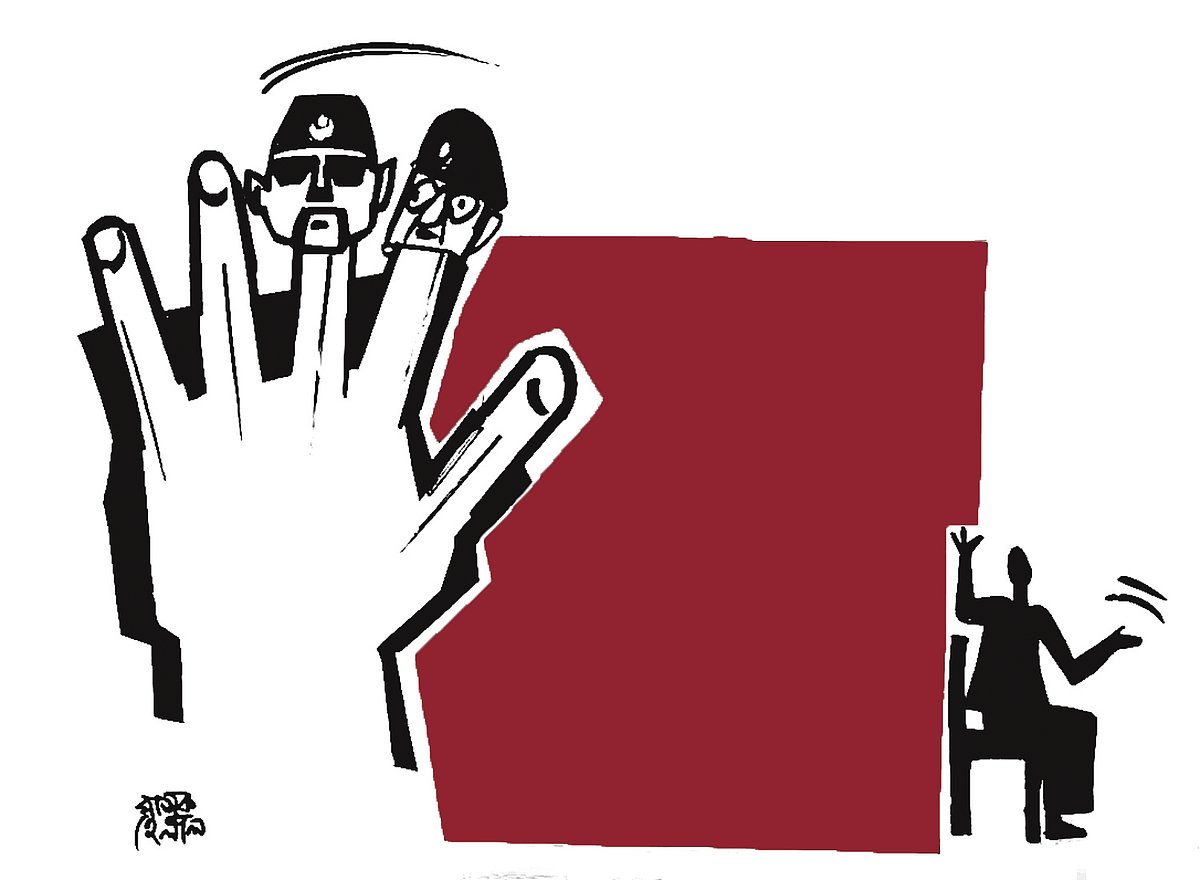
During the tenure of the Awami League government, the Rapid Action Battalion (RAB) has been heavily criticised due to its involvement in enforced disappearances, extrajudicial killings, torture in secret detention centres, and other serious human rights violations. Consequently, there is widespread public support for the dissolution of RAB. The commission investigating disappearances also recommended dissolving RAB in its final report, "Unfolding the Truth: A Structural Diagnosis of Enforced Disappearances in Bangladesh," stating that RAB was central to the disappearances, torture, and extrajudicial killings described in their report.
It is notable that during the Awami League's tenure, the United States imposed sanctions on this force in 2021. After the mass uprising in 2024, the report by the United Nations Office of the High Commissioner for Human Rights, which conducted independent investigations into human rights violations and abuses related to the mass uprising, also recommended the dissolution of RAB.
In this context, the passing of the Special Response Battalion (SRB) Act, 2026, concerning the dissolution of RAB in parliament on 10 September was expected to be a hopeful development. Unfortunately, this is not the case. Although the act contains provisions for dissolving RAB, it essentially retains the fundamental structure, powers, and functions of the force, merely changing its name. A new elite force named the Special Response Battalion (SRB) is being formed to replace RAB.
Under the act, the SRB assumes RAB’s powers, functions, existing assets, institutional structure, regulations and orders, personnel, funds, bank deposits, properties, liabilities, contracts, registers, and documents. Until new regulations are formulated, RAB’s existing 2005 regulations regarding disciplinary measures and court proceedings will also apply to the SRB. It will operate as a specialised unit of the police force. Notably, its members may include police officers, members of other law enforcement agencies, designated members of the armed forces, or government employees. They will join through direct recruitment or deputation.
The SRB will have its own flag, emblem, and attire. It will be led by a Director General of additional Inspector General of Police rank or higher. The force will wield extensive legal powers, including investigating criminal offences and conducting searches, arrests, and seizures. It will have its own detention facilities and interrogation arrangements. The act provides for the formation of a complaints redressal committee to resolve complaints. This committee will address not only general public complaints but also internal complaints from SRB members.
The aforementioned UN report, alongside recommending RAB’s dissolution, suggested that in exceptional circumstances and for limited durations, with parliamentary approval, members of the armed forces should only be deployed for internal security under the civilian law enforcement authorities, ensuring full transparency about their duties and use of force to the public.
The report also recommended that the functions of the Border Guard Bangladesh (BGB) and the Directorate General of Forces Intelligence (DGFI) be strictly limited to border security and military intelligence operations, respectively. The rationale behind this is clear—deploying armed forces personnel in forces like RAB or the newly proposed SRB for internal security, law enforcement, and crime prevention poses a significant risk of severe human rights violations.
The SRB Act is inconsistent with these recommendations. As mentioned earlier, like in RAB, the SRB can include members of the armed forces. With similar personnel taken from the police and other law enforcement agencies and having its legal, institutional, and jurisdictional structures unchanged, apart from a new name and perhaps new uniforms, it essentially remains a force similar to RAB.
The RAB operated within a legal framework of impunity, and the SRB will operate within the same framework—this is undoubtedly concerning. No law operates in isolation but works within a system comprising a comprehensive legal framework. Unfortunately, the system may again fail to prevent the same actions and crimes that gave rise to demands for RAB’s dissolution.
In this regard, notably, the National Human Rights Commission Act, 2026, and the Prevention and Remedy of Enforced Disappearance Act, 2026, have been passed in parliament amid opposition walkouts and protests from human rights activists and past victims. Consequently, on one hand, a path has been created for establishing a completely powerless National Human Rights Commission, and on the other hand, an inadequate law has been enacted to prevent disappearances. Analyzing the new laws reveals that the new Human Rights Commission will not be an independent institution.
The government will control the appointment of its members and may appoint government-aligned individuals instead of neutral and qualified human rights activists. Even after appointments, the government will control its operations in various ways, including staffing and budget control. The most important point for our current discussion is that the Human Rights Commission will not have the authority to conduct independent investigations into human rights violations by security and law enforcement agencies, including the SRB.
Similarly, the newly passed disappearance-related law strips the Human Rights Commission of the power to investigate cases of disappearances, a power previously granted in an ordinance that was later repealed. Instead, the current law states that if a state agency is accused of involvement in a disappearance, another state agency or an inter-agency investigation team, excluding the accused agency, will investigate the complaint.
This could create three major problems. First, if one state agency investigates another, the likelihood of the investigation being independent is low. Second, in many cases, it may not initially be possible to determine which agency was involved in the disappearance. Consequently, identifying another agency for investigation may not be possible. Third, since the law assigns the investigation responsibility of one agency to another, every agency might claim, out of embarrassment, that they are unsuitable for conducting the investigation. This would create uncertainty and could waste valuable time.
Clearly, the legal and circumstantial frameworks under which the SRB will operate remain inadequate in preventing severe human rights violations that gave rise to demands for RAB’s dissolution. The government tells us they have good intentions, so there is no reason for people to be concerned about the law. But if good intentions were enough, no country would build its law enforcement institutions centered on human rights protection, nor create accountability institutions to control state power.
Considering the horrific human costs of disappearances, torture, extrajudicial killings, and other abuses, it is quite natural for the country's people to hope that lessons will be learned from these violations and that the three laws discussed in this article will be appropriately amended.
#Sharif Bhuiyan is a former visiting fellow at the University of Cambridge and a senior lawyer at the Bangladesh Supreme Court. He was also a member of the Constitutional Reform Commission.
*The views expressed here are the author's own.
#This article, originally published in Prothom Alo print and online editions, has been rewritten in English by Rabiul Islam.