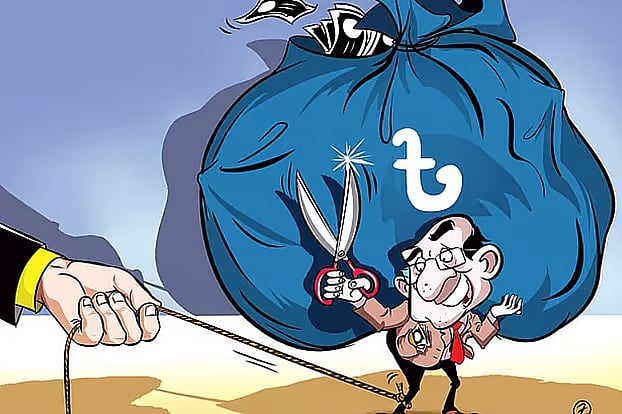
It seems we cannot break free from the culture of default loans. Default loans are increasing, or even if reduced temporarily by some means (rescheduling or restructuring), they rise again under the pretext of some crisis or another.
We've repeatedly heard that this excessive amount of defaulted loans has created multidimensional risks in the banking sector. Defaulted loans are consuming good assets, increasing bad assets, and overall, raising the level of loan risk for banks. High default loans signify weaknesses in loan management and reveal a lack of capability on the part of borrowers to repay their debts.
Through the deterioration of these indicators, the overall weakness of the economic condition is starkly highlighted. A recent report by the central bank also made comments on the upward trend of defaulted loans concerning the banking sector and the overall economic situation.
The report states that to maintain financial sector stability and the well-being of the banking sector, the upward trend of defaulted loans must be effectively controlled. At the same time, it's necessary to recover from the status of accumulated defaulted loans to reduce the excessively increased defaulted loans. The current rate of defaulted loans in the banking sector is identified as concerning.
There are complaints that the amount of collateral against defaulted loans is very low. Consequently, despite legal initiatives, the majority of defaulted loans have turned into bad or unrecoverable loans. A 100 per cent provision must be kept against such loans. In the financial crunch, many banks cannot maintain the required provision, which is gradually decreasing the quality of assets in banks.
The report indicates that the rate of defaulted loans in the banking sector as of December 2024 was 19.90 per cent. By the end of September last year, it had increased to 36.30 per cent, and by the same year's December, it had decreased again to 31.20 per cent. We know that the open opportunity to renew defaulted loans at special discounts has somewhat reduced the amount.
We now know with certainty that during the past Awami League government, unprecedented looting occurred in several Shariah-based and state-owned banks. As a result, defaulted loans have increased more in these banks, reflecting a lack of good governance and weak loan management. On the other hand, foreign banks have a very low level of defaulted loans, which also results in lower loan risk for them.
The amount of default due to looting during the past Awami League government increased to its highest, reaching Tk 6,450 billion by last September. It decreased slightly to Tk 5,570 billion by last December. In three months, defaulted loans decreased by Tk 880 billion. Some more policies have been relaxed to renew defaulted loans. Now, if ongoing capital loans become defaulted, they can also be renewed. Hence, it is expected that defaulted loans will decrease a bit more in the March quarter.
A designated provision rate is required against defaulted loans. To maintain this, a substantial part of the profit is being held back. If defaulted loans were lower, a large part of the profit could be redistributed as loans. That is no longer feasible while tackling the risk of defaulted loans.
The created defaulted loans are someone's deposits. Consequently, an interest or profit must be paid to depositors at the determined rate against their deposits. This also leads to the outflow of interest or profit money from the bank. On the other hand, the bank's profit is reduced, adversely affecting the share prices of these banks in the capital market.
The report shows that compared to December 2024, the rate of defaulted loans in the business and trade sector increased the most by last December. Defaulted loans in this sector were 23.40 per cent in December 2024 and increased to 42.5 per cent by last December. The default loan rate is highest in this sector. Among these, the most default happens under the pretext of opening letters of credit (LCs) for importing goods but instead smuggling money abroad without bringing the goods into the country. Additionally, banks' money has not been repaid even after selling imported goods.
Next are the agriculture, fisheries, and forestry sectors. Defaulted loans in these sectors were 11.30 per cent in December 2024 and increased to 28.20 per cent by last December.
There are complaints that the amount of collateral against defaulted loans is very low. Consequently, despite legal initiatives, the majority of defaulted loans have turned into bad or unrecoverable loans. A 100 per cent provision must be kept against such loans. In the financial crunch, many banks cannot maintain the required provision, which is gradually decreasing the quality of assets in banks.
Banks fail to meet international standards, and some banks' LCs are not accepted or confirmed by international banks. This increases the cost of cross-border or international transactions for customers, raising doubts about the overall economic management.
The solution to this situation lies in improving customer risk management in commercial banks, reducing unwarranted interference in management authorities, and ensuring political good governance through a strong central bank.
#Mamun Rashid is economic analyst and banker.
*This article, originally published in Prothom Alo online edition, has been rewritten in English by Rabiul Islam