Opinion
One year since mass uprising: Hasina’s fall must not be the sole achievement
The downfall of an autocratic or authoritarian is rarely smooth or peaceful. They must be overthrown — through revolution, mass uprising, or coup. Borrowing from political sociologists like Charles Tilly and Frantz Fanon, one could say: since states are born through violence and conflict, violence tends to persist in state politics as a continuation of that process. This is particularly true for countries that have emerged from colonial rule or through armed liberation struggles — where violence remains as a legacy. In such states, when an autocracy takes hold, the path to removing it is often violent as well.
It was already certain that Hasina would eventually fall. What was uncertain was when and how it would happen. Naturally, there was also the fear that her ouster could be bloody.
The BNP and other opposition political forces had tried to fight against this regime for 10–11 years. Blood was shed then too. Through enforced disappearances, killings, and various forms of repression, Hasina crushed those efforts.
The BNP’s long campaign to topple the government failed because the downfall of a dictatorship or a mass uprising cannot be achieved solely through the efforts of party leaders and activists — it requires public participation.
Although people wanted Hasina gone, the BNP could not make them partners in their movement. Had they succeeded, the BNP would have been the party to lead the uprising.
The anniversary of the mass uprising is not a particularly hopeful moment, especially if we take into account the disunity and conflicts among the political forces of the uprising, along with the interim government’s lack of capacity, absence of necessary initiative, indecision, and, in many cases, indifference.
2.
The public was searching for a way out of authoritarian rule, but they did not feel confident rallying behind the BNP. In 2018, when students took to the streets demanding safe roads, ordinary citizens stood beside them. The spontaneity and intensity of that non-political movement struck fear into the government, making them worry about its own downfall.
They took no risks — alongside the police, they deployed its cadres of the Chhatra League and Jubo League to crush the protests. The school and college students who suffered violence — along with their parents and supporters — eventually returned home, but they were waiting. Six years later, it was again students who created that opening.
In the apolitical, quota-reform movement, students stood face-to-face with the authoritarian with unparalleled courage. This time, people began rallying behind them. The public had been waiting for precisely such a force to join the movement to oust Hasina. Opposition political parties also entered the field. This time, the people were no longer willing to go home without an outcome.
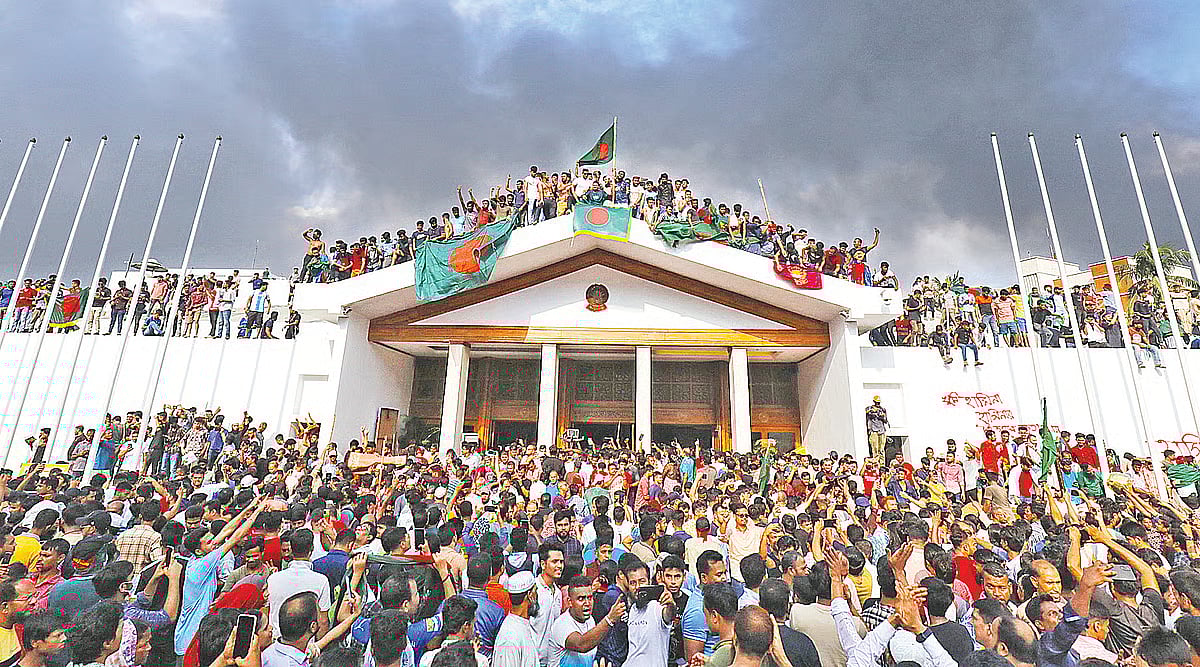
The mass uprising of 5 August was not a revolution under the leadership of any organised political party or guided by any ideology. Its primary objective was the removal of Sheikh Hasina and the end of authoritarian rule. That goal was achieved.
3.
Considering the political uncertainty after 5 August, as well as the infighting and conflicting interests among the forces that supported the uprising, I had already posed a question in the headline of a column published in Prothom Alo on 15 January this year: “Will we have to remain satisfied with just Hasina’s fall?” On the first anniversary of the mass uprising, the answer to that question is perhaps becoming clearer. Since there was no revolution on 5 August, the student leaders, allied political parties, other forces, and the general public involved in the uprising had no vision beyond ousting Hasina. The confusion over government formation and the events that followed 5 August prove this.
Still, since 5 August, many of us have begun talking about the “aspirations of the mass uprising.” But the question is: what are these aspirations, and who has defined them?
Under Sheikh Hasina’s authoritarian rule, the very concept of elections disappeared from Bangladesh; restoring free and fair elections thus became one of the uprising’s central aspirations.
But beyond that, several other demands have emerged as “aspirations of the mass uprising” — many of them taken from graffiti on the walls before and after 5 August.
Over the past 15 years, as we watched institutions being systematically destroyed, a deep-seated desire grew within us to repair them. We also developed the aspiration to ensure that the experiences we endured during this period are never repeated — that no one can ever again establish authoritarian rule in any form. We thought that through reforms, we could fulfil these aspirations.
4.
Now, as the reform process is underway, we are seeing that political parties cannot reach a consensus on how a democratic transition should take place. Parties have different ideologies and there could be disagreements. But what we are observing is that, rather than ideology, it is the calculation of gaining power that has become the central issue. Discussions on reforms are also revolving around these concerns.
As previously noted, violence has become entrenched in our political culture, something we have inherited as part of our state-building process. It is now an integral feature of our politics. At the same time, long periods of authoritarian rule inevitably strengthens reactionary and extremist politics, albeit secretly. We are now witnessing signs of that in the aftermath of Hasina’s fall.
The reform process remains stuck in attempts either to take power or to prevent others from gaining it. There has been no public debate on the reform proposals put forward by the commissions on labour, women, the media, local government, and health.
We see no sign of any internal reform initiatives or even aspirations for reform within the political parties themselves either, although they are going to assume responsibility for running the country in the near future. The older and major political parties, long before actually gaining power or becoming part of the government, have already started scrambling to place their people in various institutions and assert control, engaging in practices such as extortion and patronage.
Old political parties are determined to operate as before, but what about the new ones? Students who led the mass uprising have formed parties, and many more are emerging (148 political parties have reportedly applied for registration). Do we see any fresh direction or promising signs among them? Unfortunately, it’s the same old pattern of extortion, and hiring people to attend rallies.
The anniversary of the mass uprising was celebrated yesterday. If we look at the outcomes of recent uprisings around the world, we see that a mass uprising does not necessarily lead to meaningful reform or successful democratic transition. We too are perhaps walking down that same path. It seems we are being compelled to move forward through a kind of compromise between the fascist regime—which we wish to regard as the 'past'—and the 'present' that followed a mass uprising. This, perhaps, is the reality of our times.
5.
The anniversary of the mass uprising is not a particularly hopeful moment, especially if we take into account the disunity and conflicts among the political forces of the uprising, along with the interim government’s lack of capacity, absence of necessary initiative, indecision, and, in many cases, indifference.
Even so, the prolonged discussions at the National Consensus Commission and whatever limited consensus has emerged among the political parties must be seen as gains of the mass uprising, beyond simply the fall of Hasina. These gains could be carried forward by a free, fair, widely accepted, and inclusive election.
As previously noted, violence has become entrenched in our political culture, something we have inherited as part of our state-building process. It is now an integral feature of our politics. At the same time, long periods of authoritarian rule inevitably strengthens reactionary and extremist politics, albeit secretly. We are now witnessing signs of that in the aftermath of Hasina’s fall.
Thanks to Hasina’s autocracy, the influence of far-right politics has become increasingly apparent in our political landscape. Without placing too much hope in lofty outcomes, perhaps the most urgent task now is to guard against these twin dangers. Electoral politics is the only viable way to check the rise of reactionary forces.
To counter both the legacy of violent politics and the threat of far-right ascendance, the most immediate and effective step could be to resume electoral politics as soon as possible.
Yesterday, Chief Adviser Professor Yunus announced a specific timeline for elections, scheduled for the first half of February, before Ramadan. As we mark the anniversary of the mass uprising, for the time being our demand is this: let its gains extend beyond the fall of Hasina, and pave the way for credible elections.
* AKM Zakaria is the Deputy Editor at Prothom Alo. He can be reached at akmzakaria@gmail.com
* The opinions are of the writer’s own