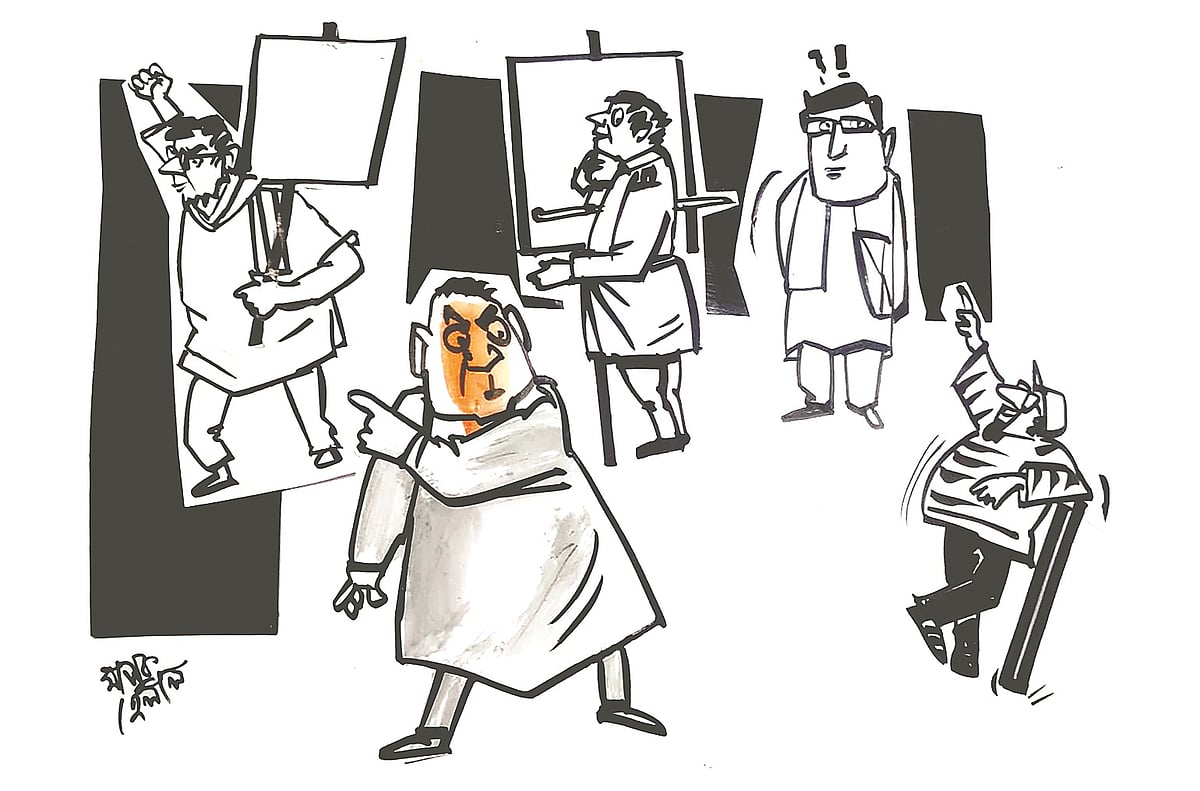
Pouring over ancient manuscript, Abdul Karim Sahityabisharad described the coronation ceremony of the 17th-century king of Rosang. From his account of the royal court, we see that the newly crowned king pledged before all that he would look after his subjects like his own children, never deceive them, govern lawfully, and empower the weak.
Even in the 21st century, we see similar scenes. Heads of government and their ministers take oaths, declaring that they will treat everyone impartially, uphold the constitution, and bring marginalised groups into the mainstream. We watch these ceremonies on television and listen to their fine words.
And what happens after that? The moment the oath is taken, preparations to break it begin. With utter disregard for the constitution, they race to do whatever they please. What we then witness is the punishment of the righteous and the protection of the corrupt. Handpicked criminals are placed in local government positions, made members and councilors. What they say in words, they do the exact opposite in action. The history of governance and politics in our country is a history of continuous betrayal. To borrow a line from Sunil Gangopadhyay’s poem, it can be said that--Fifty-four years have passed, no one kept their word.
Once upon a time, this land was the Islamic Republic of Pakistan. At a rally in Paltan Maidan, Maulana Bhashani said that the demands of the people here were modest and can easily be met. All they wanted was two meals a day of rice and lentils. Pakistan failed to ensure even that.
Then the country gained independence. It turned out that only the government became free—the people did not. When the government grows stronger, the people grow weaker. That is what happened here. There is government, there are parties. Where there are parties, there are factions. And there is the army of bureaucrats, who have only grown stronger. Citizens, on the other hand, have grown steadily weaker.
We often say our military is a symbol of sovereignty, our parliament is sovereign, our government is sovereign. The only thing not sovereign is the people. By the late 20th century, the concept of sovereignty had shifted in the civilized world. In those countries, governments of the people were established. The stronger the civil society becomes, the state becomes smaller in size, but greater in responsibility. In our country, government keeps growing in size, while the power of citizens shrinks.
The government and its followers even coined a mocking term for civil society—‘shushil shomaj.’ Officials often sneer, saying that this civil society won’t get anything done. Yet in the Western countries where they send their own children to study, no one dares to mock civil society. Because there, it is the citizens who run the state. Governments must serve citizens’ interests. Here, it is the opposite: the government owns the citizens, wields absolute authority. The people are treated like subjects, while those paid with their tax money act like their masters.
We often hear that “the hand of the state is long.” By “state,” we mean its various branches—secretariats, courts, security forces. With citizens’ tax money, the government keeps spies, whose job is to tail citizens like hounds—where they go, what they say, what they do.
Imagine that you hire guards or servants to protect your home and keep it clean, but then those very guards and servants lord over you. This system of governance began in the days of the East India Company. We have kept it alive. And yet, hypocritically, we proudly declare that we are free. Who is this “we”?
Among the rulers of this land, there are several syndicates—some family-based, others oligarchic. They have different logos and identities. One leaves, another arrives. Do they go easily? Never. Their removal costs much sweat and blood. And once ousted, the defeated side chants the same theory that there was a conspiracy against them. Their claim is always the same—everything was going fine, the country was advancing steadily, the tide of development was rising, people were happier than ever. Suddenly, some group conspired saying let’s topple them. They staged protests, foreigners spun webs of conspiracy, and the gullible public fell into their trap. The government changed. These syndicates keep parrots who repeat such lines endlessly.
Meanwhile, those who newly seize power soon unsheathe their sharp claws and teeth, surpassing even their predecessors in authoritarianism. Then the ousted rulers lament: “See, things were better when we were in charge.” Like a game of passing the pillow, this cycle has continued for 54 years.
In our political lexicon, power means the ‘chair.’ The lust for that chair is insatiable. Once in power, all sense of responsibility disappears. That power means responsibility—this truth never sinks in. Fifty-five years ago, one of our leaders said in a speech: “Even after winning the 1954 election, we could not sit in the chair.” This insatiable desire for the chair runs in their very bones and brains. With every new election, they concoct fresh tricks. They say: if we come to power this time, we’ll do this, we’ll do that. We’ll turn the country into gold. And then what happens? In 1970, a bhori (11.66g) of gold cost Tk 120. Today it is nearly 200,000. Sixteen eggs once cost Tk one; today one egg costs Tk 16.
For some time now, election fever has been in the air. Preparations are underway. Soon, everyone will jump into the fray. New manifestos will be drafted, the nation drowned in promises. But ask them this: how, when, with how much money, and with whom will you fulfill these promises? Where is your roadmap?
Meanwhile, we hear competing theories and discourses: some call for democracy, some for revolution, some for caliphate. None accept the other’s vision. Each runs their own little shop, hawking their panacea saying I have the cure for all ills. Take mine, and all your problems will vanish.
Can they be trusted? To this day, no one has kept their word.
* Mohiuddin Ahmad, writer and researcher.
* The views expressed are the author’s own.