Badiul Alam Majumdar’s column
Local govt elections: Why non-partisan local elections are essential
One of the central objectives of the mass uprising that brought down the Sheikh Hasina government was to establish a democratic system of governance, the foremost prerequisite of which is government based on the consent of the people.
Such consent is expressed through elections—not only to the Jatiya Sangsad (national parliament) but also through the election of representatives at every level. To this end, our Constitution provides for both parliamentary elections and elections to local government bodies. The 13th parliamentary election has already been held, in February.
Since the national election, we have repeatedly heard assurances from the government that local government elections will be held soon. The election commission (EC) has also repeatedly said that it is preparing for them. It is understood that elections at all levels of local government will begin with union parishad elections towards the end of this year.
However, the government has already appointed political figures as administrators of city corporations and district councils (Zilla Parishads). It has now begun appointing administrators to union parishads as well.
It should be noted that these appointments are a clear violation of 31-point reform agenda of the ruling Bangladesh Nationalist Party (BNP). The 31 points pledge that administrators will be appointed only when an elected representative is removed due to death or by court order. The appointments also run contrary to a ruling of our Supreme Court.
In the landmark Kudrat-E-Elahi Panir vs Bangladesh case in 1992, arising from a challenge to the abolition of upazila parishads, the Supreme Court, led by Justice Shahabuddin, expressed strong disapproval of the appointment of administrators to local government bodies and directed that elections to all local institutions be held within six months.
Historically, local government elections in Bangladesh were held on a non-partisan basis. However, in 2015, following a meeting between our then local government minister Syed Ashraful Islam and West Bengal’s panchayat minister Anisur Rahman, a decision was taken to introduce party symbols in our local elections.
The appointment of administrators is therefore likely to weaken the government’s urgency to hold elections. There may also be unspoken opposition to local government elections from the administrators themselves, as well as from members of parliament (MPs) who have gradually been given greater powers—outside the constitutional framework—over local development, such as inspection authority over upazila parishads and the power to oversee local development projects, including allocations of Tk 500 million for local development.
Abdul Moyeen Khan has recently taken charge as the new local government minister. After assuming office, he pledged to hold elections at every level of local government in accordance with the Constitution so that genuine representatives can be elected.
I hope he will arrange the elections quickly. At the same time, he should ensure that all laws and regulations are followed. In particular, the law enacted during the previous interim government and passed at the first session of the 13th parliament, which prohibits the use of party symbols in local government elections, must be fully implemented.
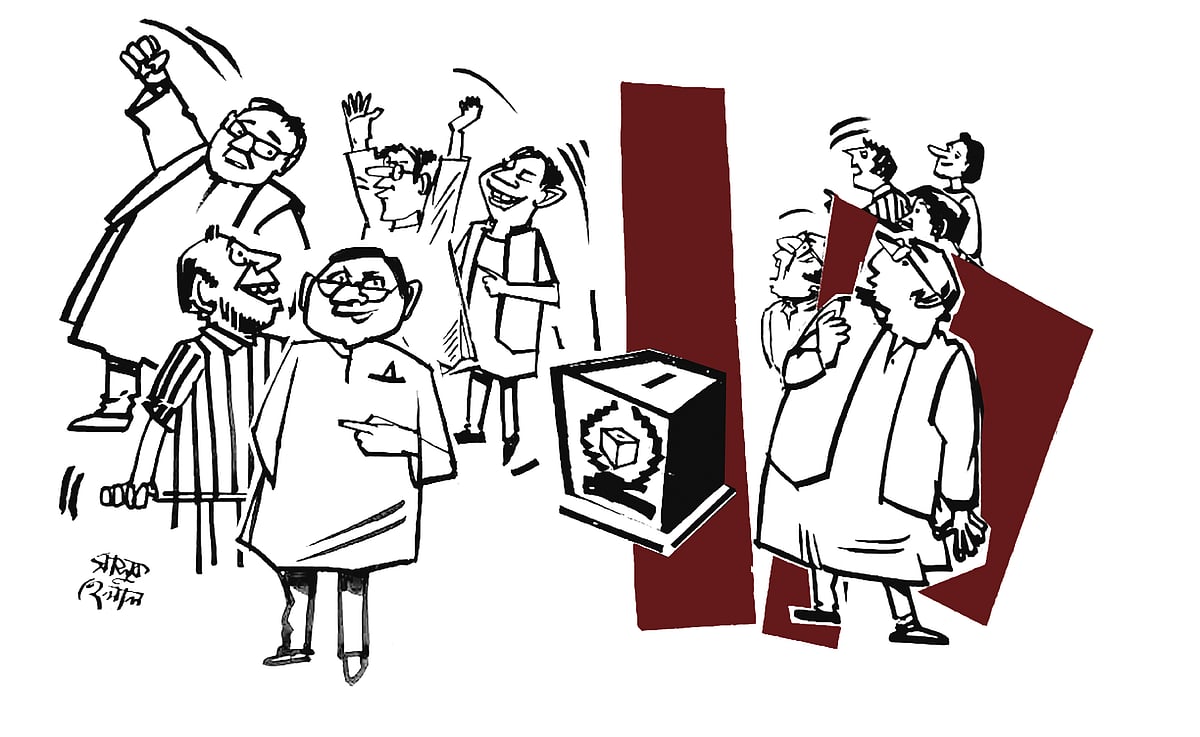
Unfortunately, even after parliament passed legislation banning the use of party symbols, our politicians appear reluctant to understand its significance. The purpose of removing party symbols is to make local government elections completely non-partisan, with no political party affiliation or involvement.
Historically, local government elections in Bangladesh were held on a non-partisan basis. However, in 2015, following a meeting between our then local government minister Syed Ashraful Islam and West Bengal’s panchayat minister Anisur Rahman, a decision was taken to introduce party symbols in our local elections. Although the present writer described the decision as self-destructive at the time, those in power completely ignored the warning.
We have already experienced firsthand the severe negative consequences of holding local elections on the basis of party symbols. The number of candidates in those elections fell sharply. In the past, many locally popular independent figures would contest and win local government elections.
But once party symbols were introduced, prominent independent figures in society, other than those nominated by political parties, became reluctant to contest.
Based on data collected by Citizens for Good Governance (SHUJAN), we showed that the use of party symbols led to a dramatic decline in the quality of elected local government representatives.
Another reason for this decline was the so-called “nomination trade” and the influence of muscle power, which meant that the most qualified candidates were rarely nominated.
Moreover, because the electoral system effectively went into exile during the previous government’s tenure, those who secured nominations from the ruling party were virtually guaranteed victory. As a result, securing a party nomination at any cost became the overriding priority, deeply corrupting our electoral system.
In indirect elections to district councils, where the electorate is limited, vote-buying and vote-selling became rampant, further undermining the local government system. In areas where ruling-party rebel candidates contested, intra-party violence also reached alarming levels.
Looking at elections in West Bengal, we can see that what takes place there in the name of elections is effectively a kind of “war,” while partisan local elections have created deep divisions in society, severely hampering socioeconomic progress.
Unfortunately, even after parliament passed legislation banning the use of party symbols, our politicians appear reluctant to understand its significance. The purpose of removing party symbols is to make local government elections completely non-partisan, with no political party affiliation or involvement.
Yet Jamaat-e-Islami and the National Citizen Party (NCP) have already begun announcing their party candidates for city corporation elections. The BNP, too, appears determined to field single candidates in local elections.
It is clear that politicians are not only reluctant to understand the significance of removing party symbols from local elections; they are also ignoring its potential negative consequences. The purpose of eliminating party symbols is to make elections non-partisan so that the most honest and capable candidates can emerge from among a larger field of contenders.
Once qualified people are elected, it will be easier for the government in power to implement its programmes. Conflicts and violence between party-nominated and rebel candidates—which reached alarming levels during the previous government—can be prevented. Non-partisan elections can also help prevent further social division, which has already reached a dangerous level.
With the aim of creating a strong and effective local government system through free and fair elections, I would also like to draw the local government minister’s attention to another important issue.
Our local government laws are archaic and backward-looking. They are also inconsistent with one another. For example, while union parishad and upazila parishad representatives are directly elected, district council elections are held indirectly by a limited electorate, following a model resembling the old “Basic Democracies” system.
To address these weaknesses in local government legislation, the Local Government Strengthening and Dynamisation Committee, formed in 2007 under the leadership of Shawkat Ali, proposed a modern and integrated legal framework. The present writer was a member of that committee.
The Sheikh Hasina government, however, subsequently ignored almost all of its recommendations. During the previous interim government, another commission was formed under the leadership of the late Tofail Ahmed. It further refined the legal framework proposed by the earlier committee.
Based on the recommendations of these two commissions, we now have a historic opportunity to modernise our legal framework for local government, paving the way for a more effective system of local governance. I hope our new local government minister will seize this opportunity before the local government elections are held.
* Badiul Alam Majumdar is the Chief Executive of SHUJAN.
* The views expressed are those of the author.