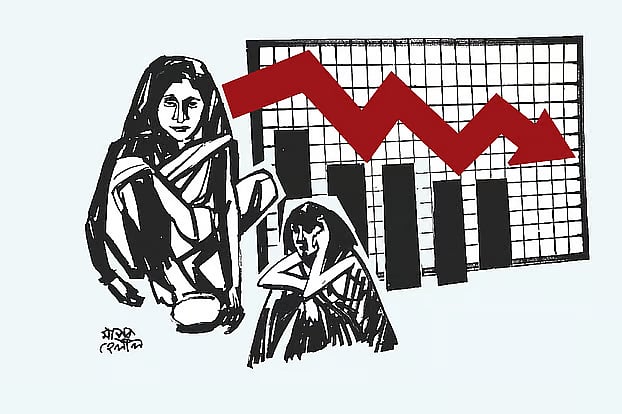
The success in poverty reduction in Bangladesh was once one of the strongest examples in development discussions. For many years, a positive relationship was observed between growth, exports, remittances, and improvements in social indicators with poverty reduction.
However, recent trends show a clear disruption in this continuity. According to the World Bank, the poverty rate in the country has increased for four consecutive years. During this period, approximately 8 million people have fallen below the poverty line. Additionally, around 61. 25 million people are in such a vulnerable position.
The economy has grown, but the question of how widely the benefits of that growth have reached people in terms of income, employment and security can no longer be ignored. Over the past few years, high inflation has been one of the major blows to low- and middle-income people. In particular, food inflation has quickly eroded the real income of poor families.
Higher-income families can cope with inflation by reducing some savings or changing spending patterns. Poor families cannot. For them, rising prices mean less food, less nutrition, delaying medical treatment, cutting back on children's education expenses, or relying on debt. Thus, inflation is not just a macroeconomic problem, but it also directly relates to poverty and inequality.
The weaknesses in the labour market have deepened this pressure. Most employment in Bangladesh is still in the informal sector, where job security is low, wages are low, and social insurance is almost non-existent. Even though nominal wages have increased slightly, they have not kept pace with inflation for a long time. As a result, real income has decreased. On the other hand, due to weak private investment, new and quality jobs have not been created sufficiently. Families are thus caught under the pressure of high prices on the one hand and limited income opportunities on the other.
Here, questions about the quality of growth arise. If growth increases production but not employment, its capacity to reduce poverty becomes limited. This disconnect has become more evident in Bangladesh in recent years. A large segment of educated youth is not getting good jobs.
Progress in women's employment has stalled. Small and medium enterprises are struggling under the pressure of loans, energy, markets, and uncertain demand. As a result, families that have risen slightly above poverty are not able to stay in a stable and safe position permanently.
The risk posed to 61. 25 million people is a bigger warning sign. Being above the poverty line and economic security are not the same thing. Illness, job loss, floods, crop failure, new spikes in food prices, or increases in rent and education expenses can completely change a family's position. If this vast population is kept invisible in policy decisions, previous achievements in poverty reduction will not be sustainable.
Yet, Bangladesh's social protection system is still not aligned with this reality. It largely depends on allowances and fragmented programmes. There is some assistance after becoming poor, but the structure to protect people from falling into poverty is weak. There is no unemployment insurance, insufficient financial protection against health expenses, and limited social insurance for informal workers. As a result, families have to bear the risk instead of the state.
Here, the problem is not just a lack of funds. A major issue is institutional weakness. There are errors in selecting beneficiaries, genuine poor are left out, and influential or non-priority people get benefits. Political influence at the local level, weak information systems, limited oversight, and lack of effective grievance redress reduce programme outcomes. Even if the social protection budget is large, its effectiveness does not always increase proportionately.
A tougher question is the political economy. For many years, Bangladesh's economic policy has been run within a framework where organised and influential groups can extract special privileges from policies, but the bargaining power of ordinary people is limited.
In the banking sector, large debt defaulters repeatedly get waivers. Some sectors get tax exemptions or protection. On the other hand, if a worker loses a job or a small business loses capital, there is no comparatively strong protection for them. This means the distribution of risk is uneven. The state often bears the cost of failures of powerful groups, but the failures of ordinary people remain personal. This framework gradually shifts resources and opportunities towards powerful groups, while weaker families become more insecure.
Market weaknesses are another reason for rising poverty. Questions about the effectiveness of competition in various tiers of food products, transportation, imports, energy, and wholesale trade have persisted for a long time. Even if prices decrease in the international market, the benefits often do not fully reach consumers, but when prices rise, the additional costs are quickly passed downward. This price disparity reflects the power dynamics in the market.
Government responses are often short-term. Market operations, fines, or administrative directives may come into discussion for a while, but they do not solve structural problems. What is needed is an effective role for the competition commission, transparency of market information, monitoring of the import and supply chains, and regulation sufficiently independent of political and business influence.
The tax system also features similar inequities. Excessive reliance on indirect taxes places a comparatively higher burden on low- and middle-income people. In contrast, potential revenue from high income, wealth, capital gains, and various privileged groups is not fully realised. Tax evasion, exemptions, and special privileges reduce revenue capacity. This has a direct impact on health, education, social protection, and urban services.
Therefore, questions of policy prioritisation are also crucial. Large infrastructure projects are politically visible. A bridge, highway, or mega-project easily becomes a symbol of development. However, the income security of a worker, the health protection of a family, or the opportunity for quality education for a child is not visible. Political incentives often prioritise expenditures that can be shown immediately, while sectors that build long-term security for people lag behind.
So now, merely expanding poverty programmes will not suffice. The first task is to see inflation control as a comprehensive economic governance question. Food supply, market competition, import policy, energy prices, transportation costs, and monetary policy need to be looked at together.
Secondly, social protection needs to move beyond allowance limits towards social insurance, unemployment risk, health expenses, and countering income loss. Thirdly, private investment and productive employment need to be brought back to the central strategy for poverty reduction.
In conclusion, the descent of 8 million people into poverty and the vulnerability of 61. 25 million people is not a minor policy deviation. It is a serious warning for our development strategy. If growth does not secure people''s income, improve job quality, and protect families from economic shocks, then the social foundation of that growth will remain weak. Development success becomes meaningful only when people not only rise above the poverty line but also achieve the capability to stay there.
#Selim Raihan is a Professor of Economics at the University of Dhaka and Executive Director at SANEM
selim. raihan@gmail. com
*The opinions expressed here are the author's own.
#The article, originally published in Prothom Alo print and online editions, has been rewritten in English by Rabiul Islam