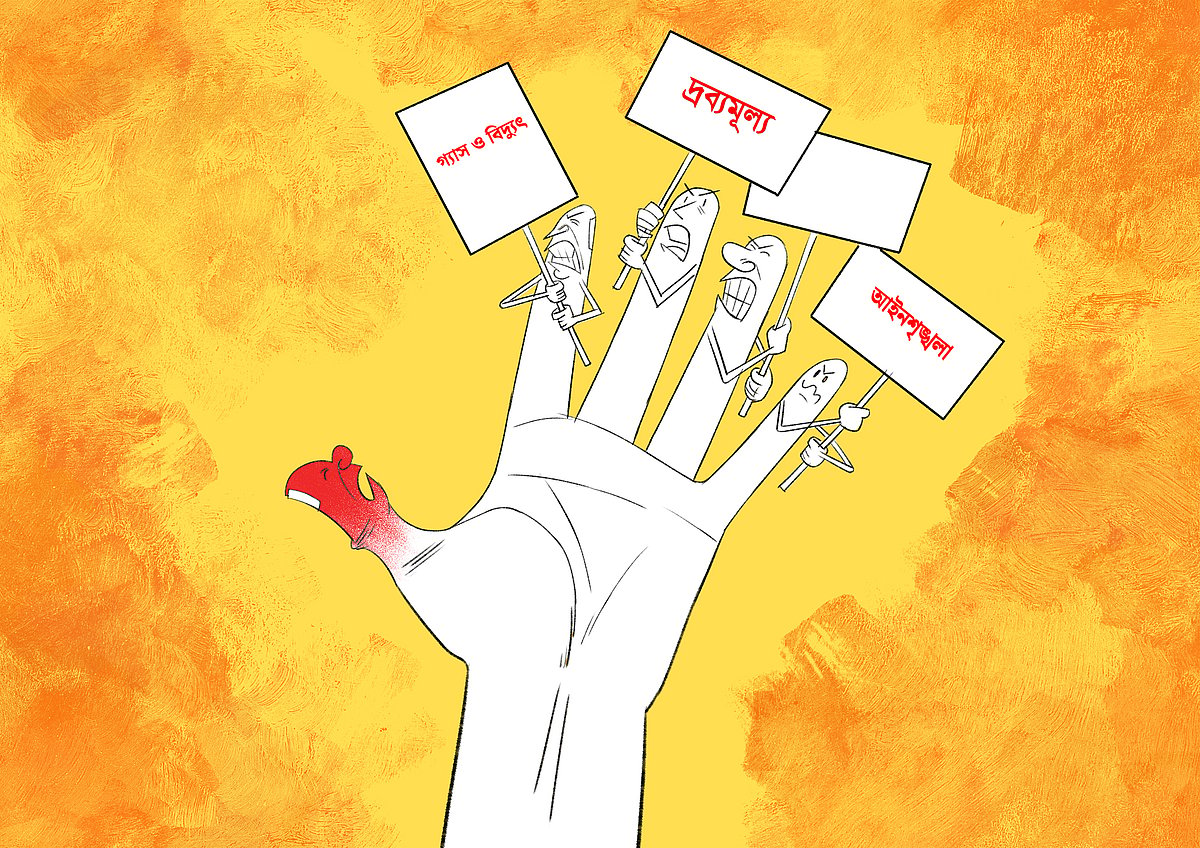
A government does not become weak only when its parliamentary majority decreases, the opposition gets stronger, or a significant movement starts on the streets. The weakness of a government can begin much earlier—in the market, police stations, hospitals, roads, banks, government offices, the job market, and in the monthly balance sheets of ordinary people's families. In the language of political science, a government's power is not measured solely by its capacity to exert force; rather, its real strength is understood by how efficiently it can enforce laws, provide services, manage the economy, control crime, and maintain the trust of its citizens.
In a densely populated, youthful, and rapidly changing country like Bangladesh, this matter is even more important. Here, people feel the presence of the government every day. Whether electricity is available, whether medical treatment is accessible in hospitals, whether it is safe to move on roads, whether commodity prices are within reach, whether tasks at passport or land offices can be done without bribery—these are all measures of government effectiveness to the ordinary public.
The World Bank, in a recent assessment of Bangladesh, has also identified the importance of enhancing the capacities of public institutions, revenue collection, public procurement, information systems, audit, and public investment management to increase economic growth and citizen confidence.
One related issue is employment. Every year, hundreds of thousands of young people finish their education and enter the labour market. Failing to create productive employment for them is not only an economic failure; in the long term, it becomes a political problem. For an unemployed university graduate, GDP growth, large infrastructure, or development statistics carry little meaning if they cannot see their own future.
In April 2026, the World Bank specifically mentioned slow economic growth, persistent inflation, weak private investment, banking sector pressures, and the need for job creation in Bangladesh. The same report stated that the wages of low-income people have not kept pace with rising prices, resulting in a decrease in their real purchasing power. This leads to feelings of inflation and decreased income.
While on paper a person’s income might remain the same, if it now takes Tk 13,000 to 14,000 to buy what used to cost Tk 10,000, then their real income has decreased. Weaknesses in monetary policy, market management, supply systems, and government economic coordination directly affect kitchen tables. Political speeches cannot easily explain away inflation because people do not see the rate of inflation; they see the price of rice, eggs, rent, schooling costs, and medical bills.
Traffic congestion is also an undervalued political indicator of government capability. If a person in Dhaka or another large city loses three hours on the road every day, they are not only losing time; the state loses productivity, families lose time, fuel is wasted, and people’s stress levels increase. Building flyovers is not city planning. If there is no long-term planning regarding where people will live, where jobs will be created, how public transport will operate, who the sidewalks are for, and how much private vehicles will be regulated, then traffic congestion reveals a lack of foresight on the government's part.
A government becomes weaker when decisions are made, but not implemented. In Bangladesh, a lack of policies, committees, task forces, and projects are rarely seen; the problem often lies in the distance between decision and outcome. An investigation committee may be formed after an incident, but the results aren't known; orders for market regulation may be issued, but prices do not fall; illegal encroachments may be announced for removal, only to return after a few days—such incidents lead citizens to realise that the connection between government words and outcomes is weak.
Another major problem is the culture of shifting responsibility. One ministry blames another, central government blames local government, regulatory agencies blame businesses, and businesses blame the international market. But to citizens, there is only one government. There is no point in explaining to the public the organisational boundaries of the agriculture ministry, the commerce ministry, importers, and the district administration when onion prices rise in the market. They want to see results.
A simple rule of modern governance should be: internal coordination is the state's problem, not the citizens'. Another sign of weakness is policy uncertainty. If businesses do not know what the tax policy will be in six months, if investors are doubtful about the durability of rules, if bank depositors are worried about the financial health of banks, then the economy slowly transforms into one that avoids risk. Money may move from investment to land, dollars, gold, or abroad. The World Bank’s recent assessment highlighted Bangladesh's high non-performing loans and weak financial condition as major risks in the banking sector.
Next is the failure of state communication. It is unrealistic to expect the government to solve every problem immediately. However, if the government needs time, it must communicate the reasoning to the citizens. Suppose three years are needed for banking sector reform. The government needs to say: what will happen in the first six months, where it will reach in a year, and what indicators will show citizens that the reforms are working. Statements like 'it will take time,' 'we are working on it,' or 'the previous government caused the problem' are not accepted by people for long.
The government’s language to the nation should be honest and specific: the problem is this; we found it in this state; we are doing these five things to solve it; in six months you will see this result, in a year, this; if we fail, we will be held accountable.
A strong government, therefore, is not one with fewer critics. A strong government is one that citizens consider effective. In Bangladesh, to strengthen the government, not many slogans are needed. Only a few tough tasks are required.
Firstly, impartial application of the law must be ensured; party, identity, wealth, or power should not protect a criminal. Secondly, each major government promise must be transformed into time-bound real results and regularly progress must be openly shown to the public. Thirdly, besides GDP, jobs, real income, inflation, and investment must also be the focus of economic policy. Fourthly, police, judiciary, banks, revenue, local government, and public service institutions should be developed as professional bodies, not instruments of political advantage. Fifthly, a political culture of admitting faults must be cultivated.
Because a government’s greatest strength is not fear, but trust. When people believe that laws will be enforced, job opportunities will be created, medical treatment will be accessible in hospitals, money deposited in banks will be safe, movement on roads will be easy, and even the powerful will be punished for wrongdoing, then the state becomes strong. And when everyday experiences teach people the opposite, then a government’s weakness need not be announced in political speeches. People understand it on their own.
#AKM Ahsan Ullah is Professor, International, Security, and Migration, University of Brunei Darussalam, Brunei
akmahsanullah@gmail. com
#This article, originally published in Prothom Alo print and online editions, has been rewritten in English by Rabiul Islam