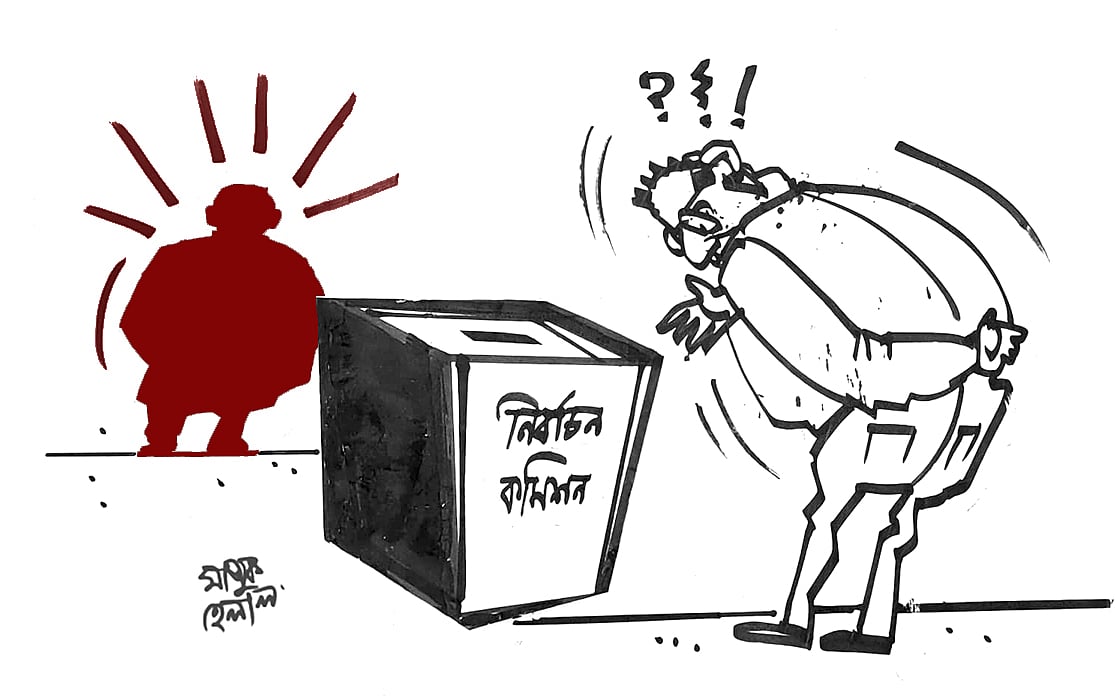
The 13th national parliamentary election will be held in February next year. Political parties have been preparing for the election for a long time. Discussions are ongoing about which party will nominate whom in which constituency. The BNP and Jamaat-e-Islami have almost finalised their candidate lists. Everyone hopes for a fair election, where citizens can vote freely, and the election period remains peaceful. Previous election commissions had a questionable reputation, and there is hope that the new election commission will restore citizens’ lost trust in the electoral process.
The election commission is independent. But is it truly independent? If it is, the commission should have the capacity to make decisions freely. We have seen before that even if the commission is given independence on paper, questions arise about whether the officials are loyal to the commission or to the government. The commission consists of six members, including a chief, all of whom were government employees — some in the secretariat, some in the judiciary, and some in the military. The question is, given their background in government bureaucracy, how much independent judgment can they exercise after leaving the hierarchical structure of government service?
While serving in various government roles, they always followed written rules. There was no way to bypass procedures. To make an urgent decision, there was often an excuse: “It’s not in the rules.” To change a rule, a new law must be passed by parliament, and then gazetted. By that time, the need may have passed, or it may be too late.
One issue has recently drawn attention. Election symbols have been used for a hundred years. Illiterate voters cannot read the names on the ballot. To recognize a candidate, they must recognise their symbol, making symbols extremely important. Although we often boast that we have made progress on social indicators and literacy rates have risen, the reality is different. A majority of the population is still illiterate, and many can only sign their names from memory. Yet, we have announced literacy rates based on these figures, and our leaders have received numerous awards and certificates from abroad, bringing a prize home every time they travel. This is a major deception.
For parties and individuals, election symbols are extremely important. The more familiar and relatable a symbol is to daily life, the higher its demand. This is why symbols like the moon, star, sun, boat, plough, sheaf of paddy, and balance scale are so highly sought after.
Once a party is allotted a symbol, it generally retains priority over that symbol in subsequent elections. If a symbol is not allocated according to the party’s preference, it may not be acceptable to the party. For example, in the 1973 election, JASAD initially requested the boat symbol, but the election commission did not grant it. The boat symbol went to the Awami League, with the commission arguing that since the Awami League had previously used the symbol in elections, it was theirs by right. JASAD challenged this decision in the High Court but lost, and later received the torch symbol.
In the 1986 election, Jamaat-e-Islami contested for the first time in independent Bangladesh with a party symbol. Their symbol was the balance scale. Initially, the election commission refused to allocate this symbol, arguing that since the balance scale was the Supreme Court logo, it should not be given to any political party. Jamaat leaders met with the commission and argued that they had used this symbol in the 1970 election, and it had become their identity. The commission accepted their request and retained the balance scale for Jamaat.
A new party named NCP has now emerged in the political landscape of the country. It is less than a year old, formed by the coordinators of the July 2024 movement. The party requested the Shapla symbol for the election. Another party, Nagorik Oikko, had also requested Shapla, but the Commission did not allot it to either party. Nagorik Oikya received the kettle symbol and was generally satisfied, choosing not to dispute the decision with the commission.
However, NCP is desperate to get the Shapla symbol. They have even threatened protests, saying they will not participate in the election without it. The election commission argues that since Shapla is not on the official list, it cannot be allocated according to regulations. This seems like a weak excuse. If the symbol is not on the list, can’t the list be amended? It is not a law etched in stone. Choosing which symbol a party contests with should be the party’s prerogative, and the commission cannot impose one by force.
Yet the commission says that if NCP does not accept another symbol, it will allocate one to them via notification. It appears that the commission is trying to enforce its authority. At the last moment, the EC added the ‘Shapla Kali’ symbol to the list. But Shapla and Shapla Kali are not the same, and the EC has stubbornly stuck to its rigid position.
The commission seems to have forgotten its role. The election commission is the referee of elections. Just as in a game, the referee cannot decide which team wears what jersey. If two teams have the same colour, the captains negotiate among themselves to reach a compromise. During the Pakistan era, for example, the Mohammedan Sporting Club and the Wanderers Club had the same white-and-black jerseys. On match days, they would wear different colours on their own.
Another decision of the commission has created complexities. Recently, an amendment was introduced to Section 20 of the Representation of the People Order (RPO) stating that if a registered political party joins an alliance, it must contest using its own symbol. Previously, parties had the freedom to choose either their own symbol or the alliance’s symbol.
The BNP disagrees with this amendment. It has called for keeping the symbol regulations unchanged. The party argues that registered political parties in alliances should retain the freedom to use their own symbol or any other symbol of the alliance.
The question is, this rule did not exist before. In the 1954 election, the United Front’s symbol was the boat. The alliance included the Krishak Sramik Party, Awami Muslim League, and Nezame Islam Party. Because one party was banned, candidates of the Communist Party negotiated behind the scenes and used the boat symbol. In independent Bangladesh, parties have been contesting in alliances since 1986.
There are examples of alliance members contesting with their own party symbols, such as Jamaat-e-Islami and Jatiya Party, and also examples where candidates of smaller parties contested under the symbol of the main alliance party, such as JASAD, CPB, NAP-Muzaffar, Workers’ Party, BNP, JAPA, LDP, and Islami Andolan. Choosing which symbol an alliance member contests with should be their decision, so it is unclear why the commission is creating a conflict here.
People who have spent their lives in government service often become rigid in thinking, like water trapped in a closed reservoir. Yet we see that the election commission often becomes a retirement refuge for such individuals. Instead of blindly following rules, they are expected to be proactive. The question remains: is the election commission acting on its own volition, or following someone else’s direction?
#Mohiuddin Ahmad is writer and researcher
#Opinion expressed is the author’s own