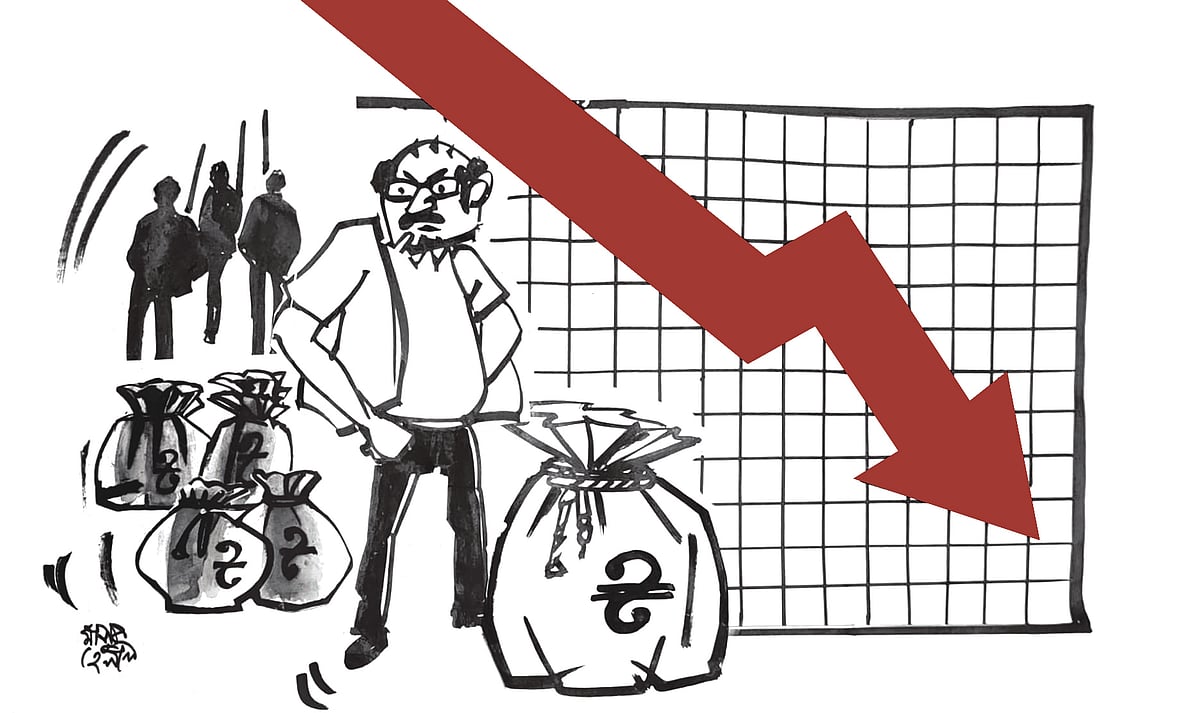
Nobel laureate economist Milton Friedman has a theory about economic recessions and recovery—the Guitar String Theory of Recessions. It can be explained like this: imagine a guitar string. If you pull the string down and then release it, it quickly returns to its original position.
Friedman said the economy behaves similarly to this guitar string. When a recession hits, the economy is “pulled down”: production falls, income declines, and employment drops. But once the causes of the recession disappear—demand rises, interest rates fall, and policy support is provided—the economy quickly bounces back. In other words, the deeper the recession, the faster the recovery should be.
This theory was first questioned after the deep global recession of 2008–09. The recovery then was not rapid; it was slow, weak, and uneven. Economists argued that the economy does not always behave like a guitar string because sometimes a recession is so severe that the string “snaps”—structural damage occurs, and recovery becomes slow or incomplete.
Bangladesh’s economy has effectively been in a recession since 2020. The first cause was the COVID-19 pandemic, followed by Russia’s invasion of Ukraine. These events affected nearly all economies worldwide. Most countries have since emerged from recession, but Bangladesh has struggled. In fact, structural damage was caused by the previous Awami League government, which destabilised the macroeconomy.
Transaction balances have also improved. The main contributor to the increase in reserves has been remittance inflows, followed by export earnings. At the same time, imports have been controlled, and due to the investment slowdown, demand for dollars was lower, making it easier to increase reserves. The government’s proactive approach also played a key role. However, the problem is that this macroeconomic stability has not revived economic activity. So the question arises: what has the economy actually gained, and what have the people of the country received, in exchange for the $32 billion reserves?
Since 1990, even though governments have changed regularly, the economy has never been so unstable. Corruption, money laundering, high inflation, continued money printing by the central bank, high non-performing loans, severe currency devaluation, favouritism toward specific groups, and rapid depletion of reserves—all were observed in the economy.
Now, the Awami League government is no longer in power, and an interim government is in charge. Yet, the guitar string has not fully returned to its original position. That said, it cannot be said that there has been no improvement. The rapid depletion of reserves has been halted. Foreign currency reserves have now surpassed $32 billion. This is closely linked to stabilising the dollar exchange rate, which has been made market-based.
Transaction balances have also improved. The main contributor to the increase in reserves has been remittance inflows, followed by export earnings. At the same time, imports have been controlled, and due to the investment slowdown, demand for dollars was lower, making it easier to increase reserves.
The government’s proactive approach also played a key role. However, the problem is that this macroeconomic stability has not revived economic activity. So the question arises: what has the economy actually gained, and what have the people of the country received, in exchange for the $32 billion reserves?
In the current fiscal year 2025–26, economic momentum remains sluggish, investment is in severe decline, and people’s incomes are not increasing. Export earnings have fallen for two consecutive months. Imports have risen slightly compared to before, putting additional pressure on the exchange rate. Bangladesh Bank has purchased $21.26 billion in the current fiscal year so far to keep the dollar rate stable.
While foreign currency reserves and overall macroeconomic indicators have been brought somewhat on track, the interim government has largely failed in the area of investment. This remains the core crisis of the economy. Growth in private sector credit is only 6.38 per cent.
Bangladesh’s economic growth depends heavily on the private sector; without increased investment there, new jobs are not created and incomes do not rise. Government data show that real incomes of people have actually declined. Inflation still exceeds wage increases. Moreover, over 50,000 workers have lost their jobs. During this period of high inflation, it is unclear how these unemployed workers are surviving with their families, and the government does not know either.
The government agency Bangladesh Bureau of Statistics (BBS) last conducted a national Household Income and Expenditure Survey in 2022, at which time the poverty rate was 18.7 per cent. No official survey has been conducted since. However, the private research organisation Power and Participation Research Centre (PPRC) has found that the current poverty rate is 27.93 per cent. In addition, 18 per cent of the population is at risk of falling into poverty at any time. In other words, poverty has not disappeared; rather, its harsh reality remains clearly visible across the country.
The study found that excessive uncertainty hinders economic recovery. Uncertainty arises from fear and doubt about policies and the future. When uncertainty increases, businesses postpone new investments, people delay major purchases, companies defer hiring new employees, and banks either raise interest rates or reduce lending due to higher perceived risks. In short, the greater the uncertainty and fear regarding policy, the lower the economic growth.
This raises a crucial question: is it really possible for an interim government to increase investment? Bangladesh has a history of being under caretaker governments. Historically, such governments do not favour any particular group, do not encourage corruption or extortion, and maintain law and order. But this time, that historical pattern has not been followed. In particular, the deterioration of law and order has undermined investors’ confidence.
Extortion has not stopped, and no measures have been taken against mob violence. In addition, there has been uncertainty and doubt about elections. These factors have created a climate of uncertainty and instability. We all know that uncertainty and instability are the greatest enemies of investment.
Twelve years ago, the renowned American economist Nicholas Bloom, a professor of economics at Stanford University, conducted research on the role of uncertainty in economic recovery. His collaborators included two IMF economists, Igan Cose (currently a Deputy Chief Economist at the World Bank) and Professor Marco Terrones.
The study found that excessive uncertainty hinders economic recovery. Uncertainty arises from fear and doubt about policies and the future. When uncertainty increases, businesses postpone new investments, people delay major purchases, companies defer hiring new employees, and banks either raise interest rates or reduce lending due to higher perceived risks. In short, the greater the uncertainty and fear regarding policy, the lower the economic growth.
Although the research was conducted 12 years ago, it is entirely relevant for today’s Bangladesh. Businesses are postponing new investments, banks are providing fewer loans, and hiring of new employees has declined. The result of all this is low economic growth.
So, what is the path to recovery? Clearly, uncertainty and instability must be reduced. Bangladesh has been in an economic crisis for nearly five years. Without recovery, people’s hardships will worsen, and social instability will increase. In this situation, a fair and credible election could significantly reduce the existing uncertainty and instability. After the election, those who take office and efficiently address issues such as corruption, infrastructure problems, weaknesses in the banking sector, and extortion, will be able to accelerate economic recovery.
Nicholas Bloom’s research also suggested several ways to measure uncertainty. One key method is to track how often the term “economic uncertainty” appears in the media. Following that approach, I have used the term “economic uncertainty” many times here. Now we will see when its use in the media stops. There are two ways this could happen: either all uncertainty is removed and the economy is stabilised, or authorities simply prohibit the term from being used. We will see which of these occurs.
#Shawkat Hossain is head of online, Prothom Alo
shawkat.massum@prothomalo.com
#The opinions expressed are the author’s own.