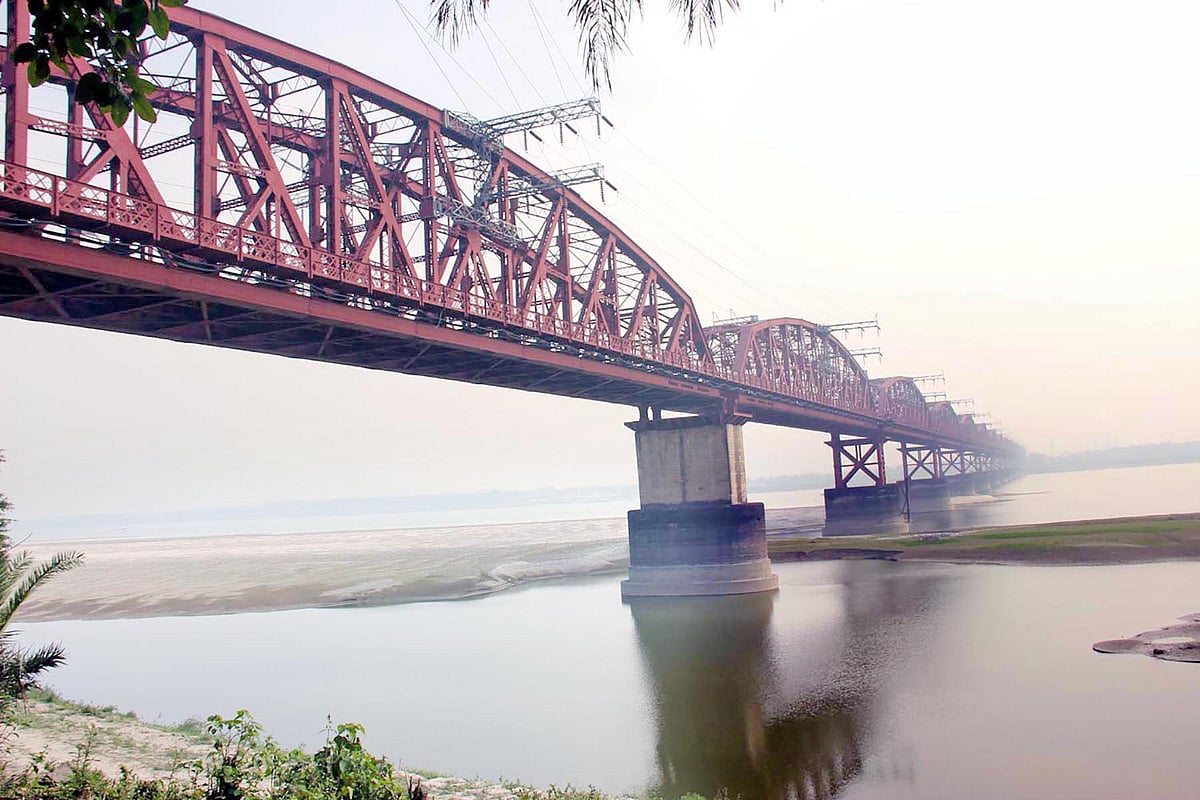
The Ganges treaty between Bangladesh and India is set to expire in a few days on 12 December. There has been no news of a new agreement or the renewal of the existing one. It is also unclear whether the two countries are willing to agree on an interim arrangement. The situation is concerning, but people downstream still hold hope.
The first Ganges treaty was signed in 1977. Those who are older might remember the intense political situation in the years leading up to it, particularly surrounding the "Farakka" issue. A few years went by without an agreement even at the end of the last century. During that time, water politics were intense, but the branches of the Ganges in Bangladesh started drying up. The potential lack of an agreement this time could be the final nail in the coffin for these narrow rivers.
As I write this, there is not enough time left for a new agreement. The alternatives are to either have a temporary memorandum of understanding based on the main conditions of the old agreement or renew the agreement for two to three years, as permitted by Article 12. Are the two governments in discussions about such an option? Will they take such a step?
If the potential for such an emergency memorandum slips away due to the uncertainty surrounding Bangladesh's Prime Minister Tarique Rahman's visit to India, it would be disastrous for the region's ecology. Any poor agreement would be preferable to having no agreement at all, especially for those downstream.
The Bangladesh government says they want a new agreement. It should certainly include additional elements compared to the 1996 treaty. At the same time, it should also include more than the 1977 agreement. In that case, a comparative discussion of both agreements is needed. The first treaty was for five years. The second was for 30 years, which was an advancement, but a permanent agreement would be better in the future, with opportunities for review from time to time. Both previous agreements aimed to address the five months of the dry season (January-May). A future agreement should cover the entire year, including flood management strategies, which is also crucial for those downstream.
In 1977, there was an "Agreement" on the Ganges, and the subsequent one was a "Treaty". The first one was signed by ministers, and the second by prime ministers. It is evident that as time has passed, the commitment on water issues between the two countries has deepened. However, there was no provision for an "arbitrator" in either agreement. Including such a provision in the future would be beneficial.
Relations with neighbors can rise and fall, but people in the basin cannot be put at risk in critical matters like water. Therefore, if there is a dispute over water rights, there should be an option to call a third party as an arbitrator. It would also be beneficial to include Nepal in any potential agreement, as they are a strong partner in the flow of the Ganges. If an agreement could be reached among the three countries, the sense of trust among people downstream would increase. Both the 1977 and 1996 agreements considered water availability at the "Farakka Point, " which is harmful to Bangladesh.
In the future, the priority should be to keep the entire flow of the Ganges normal and ensure a fair share for Bangladesh based on that flow. If Bangladesh raises such a demand, India might be unhappy because they have built many infrastructures upstream over the past 40 years that are reducing the river's flow. In such a situation, an alternative for Bangladesh could be to approach the United Nations. Before doing so, it is also necessary to sign the UN's 1997 Watercourses Convention. Because Bangladesh has not signed it, India cannot be pressured to sign it either. It is a significant puzzle why Bangladesh has not yet signed a convention that could be in its national interest.
Dhaka desires a "guarantee clause" as an assurance of minimum water availability in any new agreement. It was present in Article 2 of the 1977 agreement and also differently in Articles 10 and 11 of the 1996 agreement. Therefore, there is no issue including it in the future, and it is crucial for downstream interests. However, over the past 30 to 40 years, the flow of water reaching Farakka has significantly decreased. While the concept of a guarantee clause exists in the agreement documents, only "apolitical" experts could propose how to implement it practically in the riverbed. Indian experts, in particular, suggest they need an additional 5,000 cusecs beyond the previous agreement's allocation.
Currently, there is much speculation in Bangladesh about the future of water distribution. The most pessimistic prediction is that there will be little response from India for a new agreement with more favorable terms for those downstream. The somewhat optimistic reverse prediction is that if this December ends without even a memorandum of understanding, it will be harmful to India as well. It is expected that anti-India sentiment will resurface in Bangladesh, which many in New Delhi likely do not want.
Secondly, Farakka has already caused significant and irreparable harm to the neighboring states of Bihar and West Bengal. Continuing to stop water in the future would bring additional damage to these two states.
Yet, the objections rising in Bihar and West Bengal over a new treaty and the renewal of the old one is itself a puzzle. Perhaps BJP's "political calculations" are at play, which Bangladesh should smartly consider. Perhaps these "movements" are part of negotiations with Dhaka.
For the first time in history, the BJP rules simultaneously in Kolkata, Patna, and New Delhi. This is a good time for any new water agreement because a Delhi-Dhaka understanding is now sufficient. However, at the same time, Bangladesh-India relations are at a historical low, which is a bad time for any new treaty. In this contradictory situation, it is also true that New Delhi's Bangladesh-oriented diplomacy over the past one and a half decades is facing a comprehensive reassessment as we approach 2024.
They clearly indicate a desire to rebuild this relationship. They might also consider the Ganges treaty as part of new "understandings and arrangements" under these new circumstances. Therefore, this moment could be turned into an opportunity for Bangladesh. The agreements of 1977 and 1996 were made in November-December, and moving toward potential prospects in the same season in 2026 might be possible.
Although determining water and water rights is entirely a technical matter, any water agreement comes to fruition only with the conscious touch of politicians. If the BJP government wants to view any potential new treaty as part of a larger political package, it could be uncomfortable for Bangladesh. However, what other choice is there but to face that reality?
The only feasible priority for popular politicians could be to blindly prioritize the protection of ecological interests. Although the opposition parties in Bangladesh are currently silent, they will begin to blame the government for failure as soon as the current treaty expires without any alternative agreement. Therefore, an interim arrangement could only be protective for both Dhaka and Delhi.
#Altaf Parvez is a researcher and writer.
*The opinions expressed here are the writer's own.