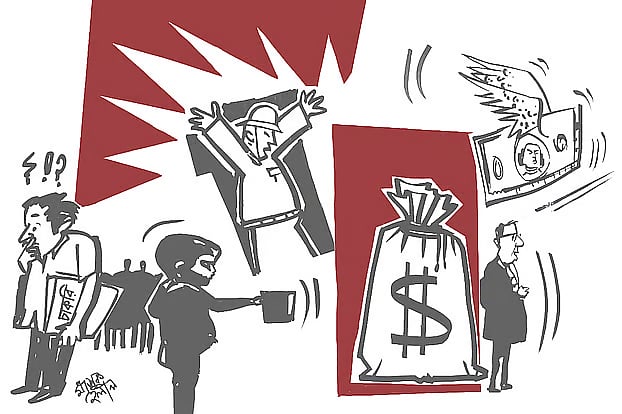
In less than two months, Bangladesh will be having a national election. Naturally, public conversation, discussion, and debate in the country are currently revolving around political issues. However, once the election is over and an elected government assumes office, a critical concern for the administration will be the state of the economy. This should be the new government’s highest priority.
Even setting aside all other matters, the economy is what weighs most heavily on the minds of ordinary people. This includes inflation, unemployment, inequality of opportunity, debt, the quality of basic social services, economic uncertainty, and mob violence, though the list is much longer. It is therefore only natural to expect that the new government will place the economy at the top of its agenda.
At the outset, attention needs to be drawn to three issues. First, alongside declaring a commitment to prioritising the economy, it is necessary to clearly identify which areas within the economy will receive priority.
Second, the commitments and identified priorities of the interim government should be incorporated into the new government’s policy framework.
Third, immediately after assuming power, the ruling party must formulate a medium-term economic roadmap for Bangladesh.
In view of the current realities of Bangladesh’s economy and its future prospects, this economic roadmap needs to give due importance to three types of challenges: ongoing challenges, accumulated challenges, and emerging challenges. At the top of the ongoing challenges are poverty and inequality. According to a World Bank report, much of Bangladesh’s recent progress in poverty reduction has been eroded in recent years.
Between 2010 and 2022, a span of twelve years, Bangladesh managed to lift around 34.9 million people above the poverty line. However, over the past three years, the poverty rate has risen again from 18 per cent to 21 per cent. Today, 36 million people in the country live below the poverty line.
One of the defining realities of our economy is inequality and disparity. According to the Bangladesh Demographic and Health Survey 2022, the average under-five mortality rate in the country stands at 31 per 1,000 live births. While there is a gap between wealthy and poor households, among the poorest 20 per cent of families this rate typically remains around 45 to 50 per 1,000.
The second ongoing challenge is the poor quality of basic social services such as health and education. There is no doubt that the education and health sectors have expanded in quantitative terms; however, this expansion has not been accompanied by corresponding improvements in quality. In education, the primary objective has become the acquisition of certificates rather than the attainment of knowledge or skills.
In the health sector, the main focus remains the construction of physical infrastructure, not the delivery of high-quality care. In both sectors, high-quality services are largely reserved for the affluent. This kind of disparity acts as a driving force behind the acceleration of inequality in Bangladeshi society.
The third challenge is stagnation in savings, investment, and resource mobilisation. Compared to neighboring countries, Bangladesh’s savings rate is extremely low. In the past, Bangladesh has failed to attract a substantial volume of foreign direct investment. A glance at Vietnam makes this shortfall evident. Bangladesh’s tax-to-GDP ratio stands at only 8 to 9 per cent, compared with 19 per cent in Nepal and 12 per cent in India. Historically, Bangladesh has relied heavily on indirect taxes such as import duties, and this reliance has yet to shift meaningfully toward direct taxation.
The list of Bangladesh’s accumulated challenges is a long one. Jobless growth, massive unemployment, non-performing loans, and significant human deprivation have taken root in the country’s economy. According to official figures, the number of unemployed people currently stands at 2.7 million. Among university graduates, the unemployment rate is 13 per cent. Youth unemployment is twice the national average. At present, jobless growth and unemployment have become concentrated problems in Bangladesh’s economy.
On the global front, Bangladesh’s graduation from the group of least developed countries, along with the imposition of countervailing import tariffs by the United States, may give rise to a range of economic challenges in the coming years.
The country’s financial sector is in deep crisis. The volume of non-performing loans has reached the highest level in Bangladesh’s history, currently amounting to Tk 659,000 crore. None of the vast sums of money illegally siphoned abroad has been recovered. Discipline has yet to be restored in the financial sector.
Non-income human deprivation is becoming even more acute. Nearly 110 million people lack access to safe drinking water. Among children under the age of five, only 41 per cent are registered at birth, meaning 59 per cent have no birth certificate. After completing primary education, 57 per cent of children fail to reach Grade 10. Child labour has increased over the past six years, and the rate of child marriage has risen. The crisis of climate change is also intensifying, with adverse effects on economic growth and human development. In Bangladesh, discrimination against women and violence toward them are not merely disturbing realities; they have emerged as deeply entrenched crises.
The emerging challenges facing Bangladesh’s economy will arise from both domestic and external sources. After many years of decline and stagnation, the fertility rate in Bangladesh has recently increased. This rise will affect population growth and urbanisation in the country.
This increase will generate adverse consequences for Bangladesh’s economy. Dhaka, with a population of 36.6 million, has already emerged as the world’s second-largest city by population. The city’s social infrastructure, such as air quality, sewage systems, and waste management, is steadily becoming fragile. Open spaces, ponds, and wetlands have disappeared, turning Dhaka into a city of brick and concrete. All of this is likely to create an impending crisis in everyday life.
On the global front, Bangladesh’s graduation from the group of least developed countries, along with the imposition of countervailing import tariffs by the United States, may give rise to a range of economic challenges in the coming years. The question is how prepared Bangladesh is for these crises, and whether, with thoughtful planning, it will be able to confront these dangers and move forward after overcoming them.
The next elected government of Bangladesh must keep these challenges in mind and incorporate them into its future economic roadmap. With objective and prudent policies backed by institutional strength, if the government proceeds along the right path, Bangladesh can chart an economic trajectory that ensures an equitable and non-discriminatory form of economic democracy and secures the well-being of its people. Failure to do so would represent a massive missed opportunity, one that has occurred many times in Bangladesh’s history.
* Dr Selim Jahan is the former Director of the Human Development Report Office and the Poverty Reduction Division at the United Nations Development Programme (UNDP).
* The views expressed here are the author’s own.