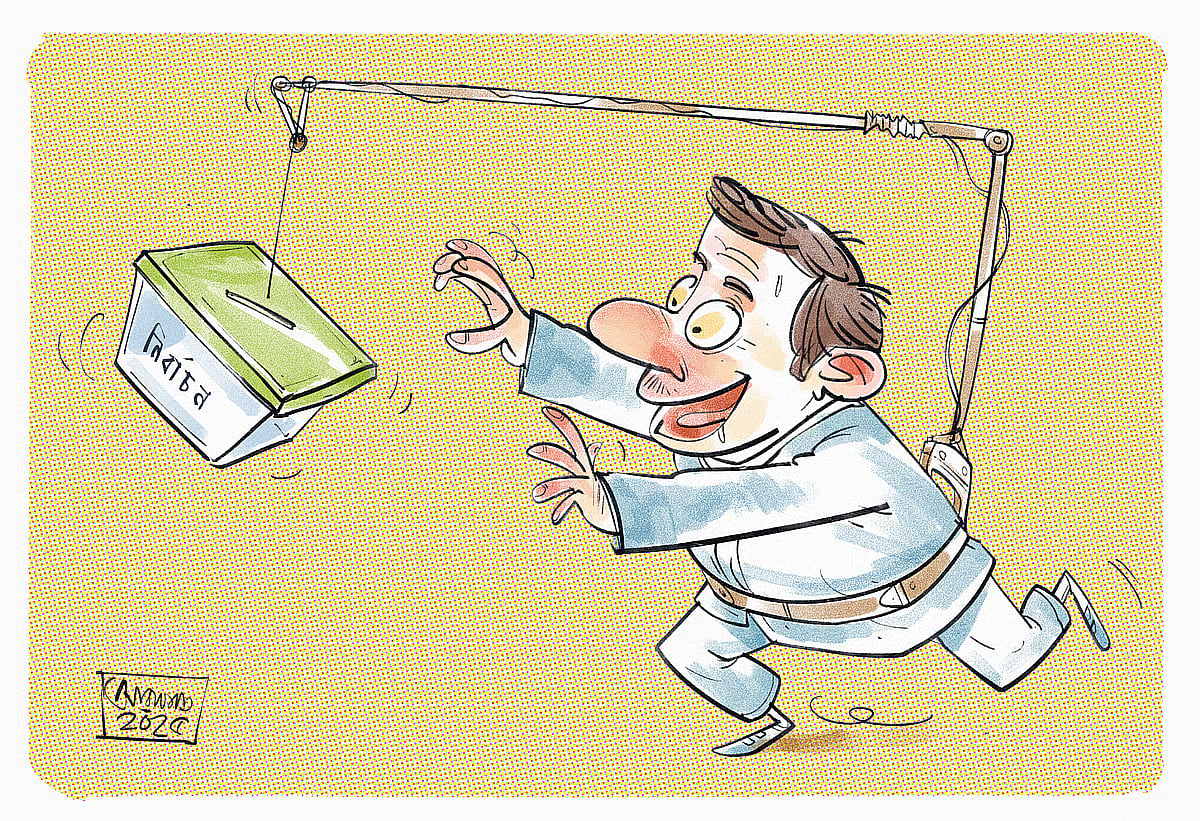
When a specific timeline for the election was announced, many people breathed a sigh of relief. I say ‘breathed’—in the past tense—because barely three weeks after the month of the election was declared, coinciding with the anniversary of the 5 August mass uprising, much of that relief has evaporated.
It is not that the government or the chief adviser has backtracked from the announced schedule. According to both the chief adviser and the chief election commissioner, the election will be held in early February 2026, with the schedule to be announced in December this year. The question is why then is there still so much doubt in people’s minds about the election? Why does everyone keep asking will the election really be held in February.
The reactions of political parties to the announcement of the election schedule varied significantly. BNP’s Secretary General Mirza Fakhrul reacted by saying, “This historic announcement will end Bangladesh’s political deadlock and smooth the path to democratic transition.”
But BNP’s enthusiasm was not shared by other parties. Jamaat-e-Islami welcomed the announcement with several “ifs” and “buts.” They emphasised holding elections based on the “July Charter,” ensuring its legal foundation, and incorporating it into the constitution.
Reaction of leaders of the National Citizen Party (NCP) was more lukewarm, saying the mass uprising was not just for the sake of an election. They demanded visible progress in ensuring neutrality of the administration, reforms, and justice before polls. They also called for the resignation of the current Election Commission.
Islami Andolan’s stance was even more negative. They said the environment for an election had not yet been created and that it would be difficult for them to participate. The party’s Ameer remarked at the time that elections should be held only under a proportional representation (PR) system, and they made it clear that they were not backing down from this demand.
These reactions made it evident that the parties were still holding back some cards. As the election date approaches, parties have started playing these cards based on their political calculations. The problem is that the way these cards are being played is fueling doubts and anxieties over whether the election will actually be held as scheduled.
BNP, meanwhile, had originally wanted elections by December this year. But they eventually welcomed the February 2026 schedule with satisfaction. Many observers believe this is because BNP sees its political interest in an early election. The prevailing belief is that the sooner the election, the better the outcome for BNP.
2.
There is now sufficient reason to believe that NCP leaders have adopted an anti-election stance regarding the announced timeline. One leader even bluntly said, “The election will not be held in February.” If this were not the official party line, some clarification should have been provided—but we did not get any.
Raising demands like “No election without reforms” or “Election only under a new constitution” essentially means rejecting the February 2026 election. NCP’s actual popular support has not yet been tested, but as a new party led by student leaders of the mass uprising, its political significance cannot be ignored.
Hence, NCP’s anti-election position is not being taken lightly. Of course, if their demands are merely tactics to secure legal recognition for the July Charter, put pressure on BNP, or bargain for more seats in an electoral alliance, that would be a different matter.
Jamaat-e-Islami, often considered a political ally of NCP, has not openly opposed the February election in the same way. But while a political consensus has formed around a bicameral parliament, Jamaat continues to insist on proportional representation in both houses.
Jamaat certainly knows that the February elections cannot be held under a PR system. Yet they have not formally tied this demand to the upcoming polls, suggesting it remains more of an ideological stance. Still, Jamaat harbors resentment that the interim government seems to prioritise BNP in issues like the London Declaration and the July Charter.
Islami Andolan, another potential NCP ally, is even more rigid on PR. Their Ameer reiterated just last Friday that no national election will be allowed without a PR system. Their position, like NCP’s, appears directly opposed to a February election.
All political parties that took part in the mass uprising should treat the February 2026 election as being above partisan interests. They should consider it a matter of national interest and work to eliminate uncertainty. To block reforms while seeing themselves as the future ruling party, or to sabotage the polls to prevent one party from coming to power—both paths are self-destructive.
In the current political polarisation, many see NCP, Jamaat, and Islami Andolan as belonging to the same bloc. Where this alignment ultimately leads is uncertain. What is clear is that NCP and Islami Andolan (whatever internal debates they may have) are openly and strongly taking an anti-election stance, while Jamaat sits somewhere in the middle. Collectively, the three parties’ various conditions are sowing uncertainty about the February 2026 election.
BNP, meanwhile, had originally wanted elections by December this year. But they eventually welcomed the February 2026 schedule with satisfaction. Many observers believe this is because BNP sees its political interest in an early election. The prevailing belief is that the sooner the election, the better the outcome for BNP.
The party itself expects victory in February. Their positions on the July Charter and reform initiatives reflect they believe themselves as the country’s next ruling party. This raises the question that is some force trying to derail the election precisely because they expect BNP to come to power in February?
Mass uprisings and major political shifts always create openings for different forces to become active. Anarchy and adventurism are part of politics. Since 5 August, such forces have been maneuvering in various ways. Small groups and individuals are trying to influence both political parties and the interim government.
Meanwhile, the ousted Awami League, according to reports, is strategising from exile in India. The murkier the political waters, the more opportunities these forces will have to fish.
3.
The interim government, led by Professor Yunus, has now completed its first year. Governing after 16 years of authoritarian rule and a bloody mass uprising was never going to be easy. Whatever the successes or failures of the interim administration, there is no doubt that power must soon be transferred to a democratically elected government. There appears to be no turning back from the announced timeline of early February.
All political parties that took part in the mass uprising should treat the February 2026 election as being above partisan interests. They should consider it a matter of national interest and work to eliminate uncertainty. To block reforms while seeing themselves as the future ruling party, or to sabotage the polls to prevent one party from coming to power—both paths are self-destructive.
Parties must carefully consider that who really benefits if the election becomes uncertain? Who would not want Bangladesh to embark on a democratic process through a free and fair election?
AKM Zakaria is Deputy Editor at Prothom Alo.
[akmzakaria@gmail.com]
*The opinions expressed are the author’s own.