David Bergman's column
The Wrong Man in the Dock? Examining the ICT’s year long detention of an Awami League MP
Everyone in Bangladesh is familiar with the shooting of Abu Sayed in Rangpur on 16 July 2024, the first of what would become hundreds of fatal casualties in the student protests. The incident was caught on camera, and the viral circulation of footage showing the police shooting at the young student, with his arms spread out, helped trigger the events which ultimately led, three weeks later, to the fall of the Sheikh Hasina government.
Abu Sayed was not the only protestor or bystander killed that day.
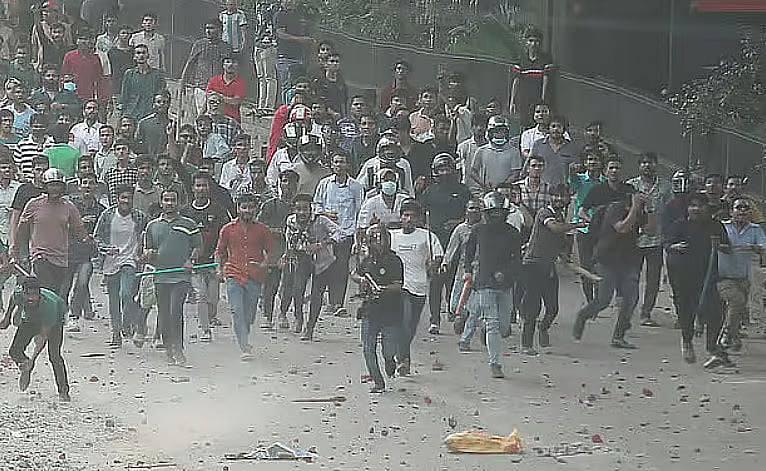
In Chattogram city, three men - Faisal Ahmed Shanto, Wasim Akram and Md Faruk were also killed on 16 July. Unlike in Rangpur, however, the police were not the primary actors implicated in these deaths. Instead, the shooting in Chattogram involved Awami League activists and their political leaders.
Six days later, the independent news outlet Netra News published a detailed investigation into the Chattogram killings, analysing available video footage alongside contemporaneous on-the-ground reporting. The investigation identified individuals who fired on protesters and concluded that they were activists affiliated with various wings of the Awami League. It further found that the shooters were known and documented followers of Helal Akbar Chowdhury Babar and Nurul Azim Rony.
The investigation also established that Babar himself was present at the scene, leading a procession of Awami League activists, and that video evidence suggested the firearms used in the shootings were supplied by one of Babar’s associates.
Crucially—and central to the concerns of this article—Netra News concluded that both Akbar Chowdhury Babar and Nurul Azim Rony were “two of the staunchest grassroots associates” of Mohibul Hasan Chowdhury Nowfel, who was at the time the country’s education minister and the Member of Parliament for the constituency in which the killings took place.
The news outlet said that it had “obtained around a hundred photographs of Nowfel and Babar attending political and social gatherings together, as well as dozens of photographs showing Nowfel visiting Babar’s home” and that “Rony is considered the de facto leader of the pro-Nowfel wing of the Chhatra League in the city and surrounding areas.”
While the Netra News investigation obviously does not constitute anything like conclusive proof of criminal responsibility for the events in Chattogram on 16 July, it nevertheless provided a clear and detailed roadmap for investigation. For the Bangladesh Police—and equally for investigators at the International Crimes Tribunal—the article identifies the alleged shooters, points to evidence concerning the source of the weapons, establishes Babar and Rony as the shooters’ political patrons, and documents their close and sustained links to the then education minister, Nowfel.
The arrest of Fazle Karim Chowdhury
Despite all this, it was not any of the individuals identified by Netra News whom prosecutors at the International Crimes Tribunal (ICT) initially targeted for the Chattogram killings. Instead, they pursued a completely different former Awami League Member of Parliament.
On 16 February 2025, Fazle Karim Chowdhury, the MP for the Chattogram constituency of Raozan, was produced before the ICT judges and, following a submission by the prosecutor Abdullah Noman, was arrested and detained on allegations of crimes against humanity.
At the time, it was unclear precisely what crime Karim was alleged to have committed. The Tribunal’s detention order provided no particulars, stating only—at the broadest level—that the prosecutor had alleged that the former MP had “committed the offences of killing, genocide, crime against humanity and so on in the recent movement taken place in July-August by his active participation, abetment, instigation and direction.”
Subsequently, ICT prosecutors provided Karim’s lawyers with a single-page note setting out the purported basis for his detention. This document linked him to the three killings that took place in Chattogram city on 16 July 2024. It claimed that Karim, together with other Awami League leaders, was involved in “planned attacks” to suppress the anti-discrimination movement, resulting in the deaths of the three men. The note, however, cited no evidence in support of this allegation.
At that point, Karim was the only person whom the ICT had detained—or even applied to arrest—in connection with those killings.
To many, his detention made little sense. Why was he being accused of involvement in the Chattogram killings when video footage and other available evidence—most notably that documented by Netra News—pointed instead to the responsibility of entirely different Awami League figures? Moreover, in Karim’s own constituency of Raozan, some 30 kilometres from Chattogram city, where he did exercise political authority, there had been no similar shootings, no serious injuries, and no deaths of protesters during the July unrest.
Settling scores?
Seeds of the likely answer to this question are likely to be found in the identities of two men who claimed at an impromptu press conference outside the International Crimes Tribunal, minutes after the detention order was given, that the decision to arrest Karim was based on their “complaint” to the ICT. In their account, Helal Akbar Chowdhury Babar and Nurul Azim Rony—identified by Netra News as central to the violence in Chattogram on 16 July—were not political enforcers linked to the then education minister. Instead, the two men asserted that Babar and Rony had operated “under the leadership of Fazle Karim.”
The two men who spoke at the press conference - Abdullah Al Mamoon and Jubayer Ahmed - are associated with a religious group called Muniria Jubo Tabligh which is centred around Karim’s former constituency. While some regard Muniria as a legitimate religious organisation, others view it as extreme and linked to criminal activities, including land-grabbing. Whatever may be the truth of the allegations against Munira, it is clear that during Karim’s tenure as MP for Raozan, he and Muniria Jubo Tabligh were frequently at odds, locking horns, with Karim attempting—by his account—to curb their criminal conduct.
Karim’s family maintain that it is this conflict that explains his continued detention: that pressure exerted by individuals associated with Muniria, now seeking to settle scores, has driven the prosecution against him.
It is certainly the case that figures linked to Muniria – who also are connected with other new student groups - have repeatedly sought, and gone to great lengths to ensure, Karim’s continued detention, prosecution, and even execution.
In October 2024, before the ICT arrested him, one Munira member, Samrat Robayat— who subsequently was involved in the original complaint to the ICT—led a rally outside a Chattogram court, displaying a banner depicting a noose around Karim’s neck, explicitly calling for his “hanging.”
In January 2025, a group of students, including at least one associated with Muniria Jubo Tabligh, met with the recently retired Chief Justice, Syed Refaat Ahmed. A Facebook post describing the meeting as a: “Courtesy meeting with Honourable Chief Justice on various issues including the … maximum punishment on top gangster of Raozan, Fazle Karim.” “Maximum punishment” is widely understood to mean the death penalty.
And on 12 January 2026 after the family had applied to the ICT Tribunal asking that Karim be transferred a hospital due to serious health concerns, activists staged a gherao directly outside the International Crimes Tribunal, aimed explicitly at preventing Karim from securing, what they referred to as “bail”. Speaking at the protest, Robayat declared: “A certain group is conspiring to grant bail to ABM Fazle Karim Chowdhury, another major perpetrator of massacres in Chattogram. …We do not want these killers to be granted bail under any circumstances.” Indeed, a few weeks earlier at a meeting in Karim’s Raozan constituency, another activist was recorded threatening that if the “schemes you are crafting to release him from the tribunal” proved true, local people “will demolish your tribunal”.
The ICT responds
The ICT Prosecutor Abdullah Noman responsible for this case acknowledged that external groups had exerted pressure on the ICT to charge Karim, while insisting that prosecutors were resisting such demands.
“It is correct that Muniria, is trying to somehow intervene in the proceedings, and trying to make some mob for ensuring the involvement and charge of Fazle Karim. But from our side, being a prosecutor of ICT, and concerned prosecutor in this case, we are not going for anyone until or unless we have got proper final prima face case and that is why this case is still under investigation.”
Noman also conceded that there were substantial factors militating against Karim’s prosecution. “No atrocities has happened or committed in [Karim’s own] constituency, from where he has been elected as member of parliament,” he said. Karim was “not holding any position in Awami League, or Jubo league or Chhatra league in Chittagong city,” where the relevant killings took place, the prosecutor said.
Noman, however, noted that the original complaint filed by Munira specifically alleged that Karim had supplied arms and ammunition during the July uprising to kill students. “We are still investigating that allegation.”
So, a year on from his detention, Karim and his family have to wait even longer to learn his fate - though now other men involved in Chattogram city Awami League, and associated groups, including the former education minister, Mohibul Hasan Chowdhury Nowfel, have been arrested or have warrants out for their arrest.
The mounting concern is that the continuing detention of Fazle Karim Chowdhury himself has nothing to do with evidence of a crime; that what this is really about are ICT prosecutors being effectively deterred from releasing a former Awami League MP by the prospect of organised backlash from Muniria Jubo Tabligh and affiliated student groups, notwithstanding the lack of evidence supporting the original allegations.
* David Bergman is a journalist. His Facebook ID is (david. bergman.77377)
* Views expressed are the author's own