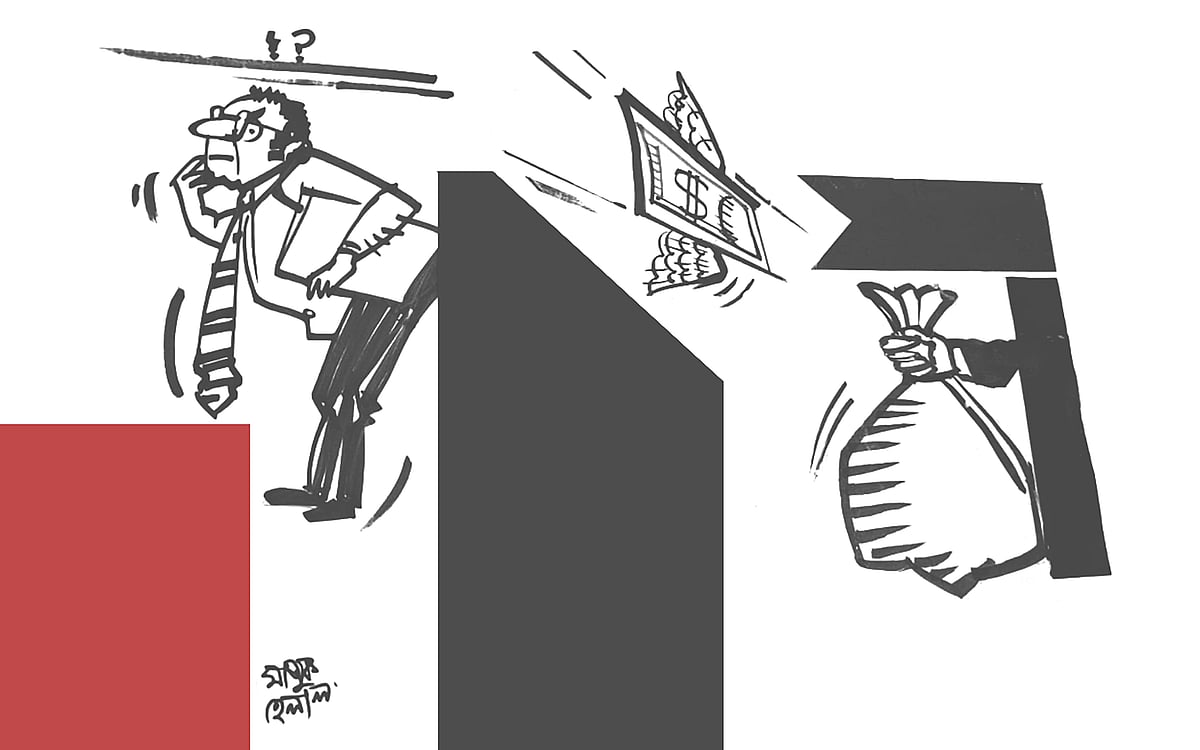
After the mass uprising, the interim government led by Professor Muhammad Yunus came to power with immense popularity. A wave of hope swept through the nation. There was widespread talk of reform, a new order, and a government driven by responsibility and empathy. However, within a year, much of that hope has seemingly turned to dust. Mob violence, deterioration of law and order, economic stagnation, a crisis in employment, inflation, corruption, extortion—all combined, have failed to bring any relief to public life.
New people may have entered the old system, but the system itself has seen little change. In fact, some of those who spoke of a new order are now facing allegations of irregularities and corruption.
The latest addition to this disillusionment is the accusation made by Nahid Islam, former advisor to the interim government and current convener of the National Citizen Party, regarding the current advisors. In a recent interview with Ekattor Television, Nahid Islam accused some of the advisors of betrayal. He claimed that many advisors have looked after their own interests or have betrayed the ideals of the mass uprising. He also mentioned that several advisors are now considering a 'safe exit'.
The latest addition to this disillusionment is the accusation made by Nahid Islam, former advisor to the interim government and current convener of the National Citizen Party, regarding the current advisors. In a recent interview with Ekattor Television, Nahid Islam accused some of the advisors of betrayal. He claimed that many advisors have looked after their own interests or have betrayed the ideals of the mass uprising. He also mentioned that several advisors are now considering a 'safe exit'.
This is a very serious allegation. If those whom the people trusted and placed in power with the hope of reform and a new system are instead working to secure their own interests, then it is indeed a betrayal of the aspirations of the mass uprising. Moreover, talk of a 'safe exit' often arises when one is involved in wrongdoing, corruption, or repression. However, Nahid Islam did not clarify exactly who among the advisors secured their own benefits or is now considering a safe exit. On such a serious matter, it is important that he speaks clearly and makes the issue transparent.
However, it’s not just the advisors of the interim government who are being accused of looking after their own interests. There are allegations that various influential and self-serving groups are also using the interim government for personal gain. Let’s look at a few examples.
Government bureaucrats have secured promotions without even holding new positions. Some officials who had already retired have also received promotions. Since the formation of the interim government, 764 retired officials have been promoted to positions including that of secretary. Additionally, between 8 August last year and 4 August this year, 785 officials received regular promotions. Most recently, on 28 August, 268 individuals were promoted to the rank of deputy secretary.
Furthermore, a pay commission has been formed to increase the salaries of government employees. This has raised the question: is introducing a new pay scale truly within the responsibilities of an interim government?
The interim government was supposed to implement key recommendations from the Public Administration Reform Commission to make the bureaucracy more citizen-friendly. While there’s been little significant progress in that area, the pay scale initiative is moving forward.
Decisions about increasing salaries for government employees should ideally be taken by an elected political government, taking into account the country’s economic capacity. Otherwise, if the interim government hastily implements a new pay scale under pressure from bureaucrats, the burden may become too much for the next elected government to handle. Given the current poor state of the economy and the massive revenue deficit, questions remain about how prudent this initiative truly is.
Transport businessmen are also extracting special benefits from the government. There was a promise that buses and trucks over 20 to 25 years old would be removed from the roads. That hasn’t happened. Instead, they are being granted even more privileges. According to a report published in Daily Samakal, steps are being taken to increase the maximum age limit for reconditioned buses and trucks from 5 years to 12 years. Preparations are underway to offer low-interest loans to owners for purchasing these vehicles. At the same time, measures are being taken to reduce their tax burden.
Decisions about increasing salaries for government employees should ideally be taken by an elected political government, taking into account the country’s economic capacity. Otherwise, if the interim government hastily implements a new pay scale under pressure from bureaucrats, the burden may become too much for the next elected government to handle. Given the current poor state of the economy and the massive revenue deficit, questions remain about how prudent this initiative truly is.
Meanwhile, loan defaulters have managed to reschedule their defaulted loans by making just a 2 per cent down payment. As a result, they will now receive a new 10-year repayment period, including a two-year grace period. Under the previous government, well-connected big business owners close to the ruling party received such special privileges. This time, the beneficiaries include business groups who were under pressure during the Awami League government and who are affiliated with the politics of the BNP and Jamaat-e-Islami.
Another example of using the interim government for personal gain is the acquisition of private TV channel licenses. According to a report published in Prothom Alo, in June and July of this year, two such licences were granted—one to Md Arifur Rahman Tuhin, Joint Chief Coordinator of the NCP (National Citizen Party), and the other to Arifur Rahman, a member of the National Citizens’ Committee. The names of their channels are Next TV and Live TV, respectively.
Next TV also includes AKM Golam Hasnain, the son of former BNP MP from Bogura, AKM Hafizur Rahman. Hasnain is also the president of the Saudi Arabia (Eastern Region) chapter of the BNP. Notably, these licences were issued by the Ministry of Information and Broadcasting without any clear policy or competitive process—similar to the way licences were handed out under the previous Awami League government, based on political and partisan considerations.
Yet, even the existing TV channels in the country are struggling to survive. Although 50 private channels have been approved, only 36 are currently operational. Most of them are in poor financial condition, and the advertising market is not large enough to support such a high number of channels.
In fact, the Media Reform Commission formed by the interim government has already pointed out in its report that a chaotic situation has arisen from issuing far more licences than the market can bear—driven by political loyalty, nepotism, and corruption. The interim government was expected to follow the commission's recommendations by establishing a media regulatory commission and reviewing the existing TV licences. Instead, two new licences have been granted based on political considerations.
Meanwhile, despite Chattogram Port being profitable, the government has increased port tariffs by 41 per cent to benefit foreign companies. This hike will raise the cost of imports and exports in Bangladesh, but it will profit foreign operators like DP World, APM Terminals, and PSA International. On the advice of the International Finance Corporation (IFC), a World Bank Group affiliate, this tariff hike will make Chattogram Port more expensive than 13 out of 14 ports in seven countries—Bangladesh, India, Sri Lanka, Malaysia, Myanmar, Vietnam, and Cambodia.
These are just a few examples—reported in the media—of how different domestic and foreign groups are securing their own interests. To these can be added many other activities, still unreported, through which both local and international vested interests are benefitting—many of which we may not even be aware of.
At one time, many people wished for the interim government to stay in power longer. They believed the longer it remained, the better it would be for the country, and the more reforms would be achieved. But perhaps they didn’t consider how any irregularities committed during this government’s tenure would be held accountable. Unlike an elected political government, there is no way to punish or vote out an unelected interim regime.
So, what has come of a government staying in power for over a year now? Serious allegations have surfaced against the advisors—claims of personal profiteering and planning 'safe exits'. At the same time, there are accusations that various domestic and foreign interest groups are exploiting the interim government to serve their own ends. It is truly tragic that such a situation has arisen after a mass uprising that claimed so many lives in the pursuit of change.
#Kallol Mustafa writes on power, energy, environment, and development economics
He can be reached at kallol_mustafa@yahoo.com
*The opinions expressed are the author's own.