Opinion
Qatar to take new Bangladeshi workers, what about the old ones?
Over the past two decades, Qatar has become one of the most important destinations for Bangladeshi workers among Middle Eastern countries. Hundreds of thousands of Bangladeshi workers are employed there in construction, infrastructure development, the service sector, and domestic work.
Recently, the visit to Dhaka by Qatar’s Labour Minister, Dr. Ali bin Samikh Al Marri, and Qatar’s interest in recruiting more skilled workers from Bangladesh are undoubtedly encouraging developments. The government has also presented this as a major diplomatic success.
During his two-day visit, which began on 17 May, he held meetings with top Bangladeshi officials. At the seventh Bangladesh-Qatar Joint Committee meeting held on 18 May, Qatar expressed interest in skilled workers from Bangladesh. In particular, the country showed interest in recruiting workers in technical fields such as electricians, plumbers, welders, and AC technicians.
Qatar’s labour minister said that around 473,000 Bangladeshis are currently working in Qatar, and nearly 30 per cent of them are employed in development projects. He also said that Qatar wants to recruit skilled workers directly from five specific Technical Training Centers (TTCs) in Bangladesh.
The Bangladesh government is also viewing the visit as the opening of new opportunities. According to the Ministry of Expatriates’ Welfare and Overseas Employment, 107,598 workers from Bangladesh went to Qatar in 2023. Relevant officials have expressed optimism that this number will increase further this year.
But the question is: how realistic and humane is the enthusiasm for sending new workers at this moment? Has the time really come to send more workers to Qatar?
The government should therefore seek answers to some fundamental questions: How many Bangladeshis in Qatar are currently unemployed? How many have been victims of fraud? How many are living in inhumane conditions without work?
The reality is that thousands of Bangladeshi workers in Qatar are currently jobless, unpaid, uncertain about their future, and living in inhumane conditions. A large number of them have fallen victim to visa trading and fraudulent middlemen, leaving them unemployed. Many have not received salaries for months, some have become undocumented, and others are suffering severely due to lack of food and medical care. Ignoring this, and rushing to send new workers, is not only shortsighted but also irresponsible. Ensuring protection and employment for existing workers must now be the priority before sending new ones.
An invisible crisis behind remittances
Remittances from expatriate workers are extremely important to Bangladesh’s economy. In the 2024–25 fiscal year, the country received approximately $30.33 billion in remittances overall — the highest amount in the nation’s history for any fiscal year. As a result, governments often portray sending workers abroad as an “economic success.” However, the humanitarian crisis hidden behind this success rarely receives much attention.
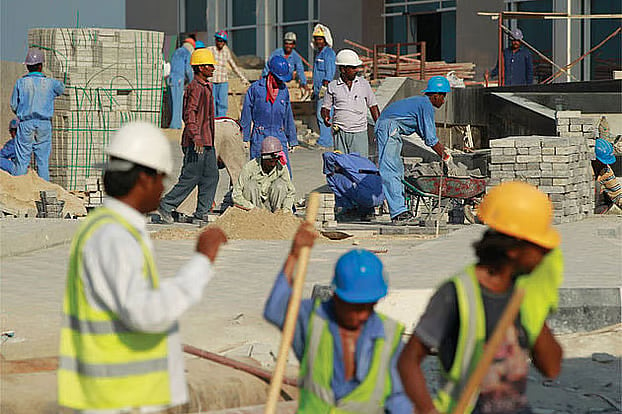
Among Middle Eastern countries, Qatar is one of the largest labour markets. Ahead of the 2022 FIFA World Cup, Qatar carried out massive infrastructure development projects over the course of a decade. Stadiums, metro rail systems, roads, hotels, and airports all employed huge numbers of foreign workers. Hundreds of thousands of workers from Bangladesh also went there.
But after the World Cup ended, employment in much of the construction sector declined sharply.
Many companies wrapped up their projects, while others laid off workers. As a result, many labourers are now spending their days in uncertainty after losing their jobs. New job opportunities have therefore become more limited than before. In this situation, sending large numbers of new workers would only make the existing crisis more complicated.
In various areas of Doha and its surrounding regions, countless Bangladeshi workers now wait for temporary work. Some go weeks without finding jobs. Others remain unpaid for months. A large portion of these workers had taken loans in order to go abroad. Without regular work, they are unable to send money home to their families and are themselves struggling just to survive.
‘Free visa’ is just legalized fraud
A major reason behind the suffering of Bangladeshi workers in Qatar is the “free visa” business. In reality, a free visa means sending workers abroad without any guaranteed job. In Bangladesh, brokers and some recruiting agencies tell workers, “Once you get to Qatar, you’ll easily find work and earn a lot of money.”
Believing these promises, workers spend between 400,000 and 700,000 taka. But after arriving in Qatar, they discover that there is no guaranteed job waiting for them. Although a company’s name may appear on paper, in reality there is no work. They then wander around looking for illegal day labour or temporary jobs. Many face police harassment, arrest, or the risk of deportation.
This system is essentially a form of visa trading. Brokers, recruiting agencies, and some dishonest businesspeople profit from it, while the workers become trapped in debt and an uncertain future.
After speaking with many Bangladeshi workers living in Qatar, I learned that some sold land to finance their migration, others borrowed money at high interest rates, and some pushed their families into debt. Unable to find work, their lives have effectively collapsed. Overall, unemployment has forced them into an inhumane existence.
This visa-trading system is not only impoverishing workers; it is also damaging Bangladesh’s international reputation. Gulf countries, including Qatar, are increasingly moving toward skilled and regulated labour markets. If Bangladesh continues sending workers through uncontrolled and fraudulent processes, the entire labour market could face long-term risks.
A strict stance must be taken against visa trading. It must be ensured that no worker can go abroad without a confirmed job contract. The biggest failure here is the lack of oversight. Bangladesh’s overseas employment sector has long been controlled by powerful broker syndicates. From village-level middlemen to licensed recruiting agencies, many are part of this network. Overcharging workers, making false promises, providing fake contracts, and supplying illegal visas have become almost a “normal” business practice.
It is important to remember that the Middle Eastern labour market is changing rapidly. Gulf countries are gradually shifting away from unskilled labor and demanding more skilled, technology-oriented workers. If Bangladesh continues to rely on unskilled workers and an uncontrolled visa system, it risks losing this market in the long run.
Improve skills, but no unplanned labour export
The current government says that international-standard training is being provided at Bangladesh’s 110 Technical Training Centers (TTCs). This is indeed a positive initiative. The fact that Qatar’s labor minister has expressed interest in recruiting skilled workers from five specific technical training centers in Bangladesh is also undoubtedly encouraging.
However, to make this opportunity meaningful, the first requirement is to create a real connection between skills development and employment. Skill development will only be meaningful if it is linked to guaranteed jobs. Training alone is not enough; there must also be assurance of employment, fair wages, and legal contracts after the training is completed.
Training should not be aimed merely at sending workers abroad. International-standard wages, safe working conditions, and workers’ rights must also be ensured. Otherwise, even skilled workers will fall victim to exploitation and fraud.
Bangladesh must now establish itself not as a “source of cheap labour,” but as a “country of skilled human resources.”
Competition in the global labour market is currently increasing. India, Nepal, the Philippines, and various African countries are strengthening their positions by sending skilled workers abroad. If Bangladesh continues to rely mainly on unskilled labor, it risks losing market share in the future. Therefore, technical education, language proficiency, internationally recognized certification, and training on workers’ rights are extremely important.
However, skill development does not mean sending as many people abroad as possible. Employment opportunities must also be created within the country. After all, dignified employment at home is far more sustainable than living an uncertain life abroad. In its development planning, the government should view migrant workers not merely as a source of remittances, but as valuable human resources.
Employment for existing workers must come first
The praise from Qatar’s labour minister for Bangladeshi skilled workers is certainly positive. But to make use of this interest, the existing problems must first be resolved. The Bangladesh government’s most urgent task should now be to assess the actual condition of workers currently living in Qatar.
A reliable survey is needed to determine exactly how many Bangladeshis there are unemployed, how many are in irregular status, how many are not receiving wages, and how many are facing legal complications. The embassy and labor wing must become more active in receiving workers’ complaints and providing legal assistance and rehabilitation support.
Most importantly, the government must stop sending new workers abroad without guaranteed jobs. Unless the culture of sending workers under so-called “free visas” or uncertain employment arrangements is ended, the crisis will only worsen. Ensuring employment for existing workers before sending new ones is necessary both morally and diplomatically.
People first, remittances second
Bangladesh’s relationship with Qatar is certainly important. But that relationship should be based on mutual interests, fair labor policies, and human dignity. Sending new workers merely in hopes of remittances while ignoring the suffering of existing workers cannot be the behaviour of a responsible state.
The expatriate workers who have kept Bangladesh’s economy running through years of hard labor deserve security and rights. Competing to send more workers abroad without ensuring those protections is not humane.
Bangladesh should now pause and reflect. Before sending new workers to Qatar, the government must first ensure full employment for existing workers, payment of overdue wages, legalisation of undocumented workers, and effective measures against visa trading.
Otherwise, the country will simply repeat the same mistakes, where a handful of brokers and agencies profit while thousands of workers are left burdened with debt, uncertainty, and humiliation, forced to endure inhumane lives on foreign soil.
The government should therefore seek answers to some fundamental questions: How many Bangladeshis in Qatar are currently unemployed? How many have been victims of fraud? How many are living in inhumane conditions without work?
Without answering these questions, excitement over expanding labor markets amounts to dangerous self-satisfaction. In the case of Qatar, Bangladesh’s greatest responsibility right now is to save the existing workers before sending new ones.
* Dr. Selim Reza is Associate Professor and Coordinator, Center for Migration Studies, North South University
* The opinions expressed are solely those of the author.
* This article appeared in Bangla Prothom Alo online and has been rewritten in English by Ayesha Kabir